CONCEPT · ENTRY 018 · R2 BIOLOGICAL
Genesis Engine
The diagnostic form that identifies genuine regime installation — the appearance of a new constraint identity with dominant control variables non-constructible from the prior regime — as distinct from parametric saturation that merely exhausts an existing regime's possibilities.
- Register
- R2 biological — metabolic-closure.
- Genealogy
- Simondon 1958 · Prigogine 1984 · Kaufman 2000
- Appears in
- Chapter 5 — The Genesis Engine
- Related
- Variation · Encounter · Mediation · Transduction · Stabilisation Engine · Stratification Engine
- What it is not
-
- Not a mechanism or physical device — a diagnostic form, a pattern of identification.
- Not sufficient for persistence — genesis without stabilisation leaves nothing durable.
- Not identical with emergence — the Genesis Engine adds a falsification condition.
- Not progressive — a regime can appear, persist briefly, and disappear without reaching the Stabilisation Engine.
DIAGRAM
Genesis Engine Diagram
The diagnostic sequence for regime installation as distinct from mere saturation.
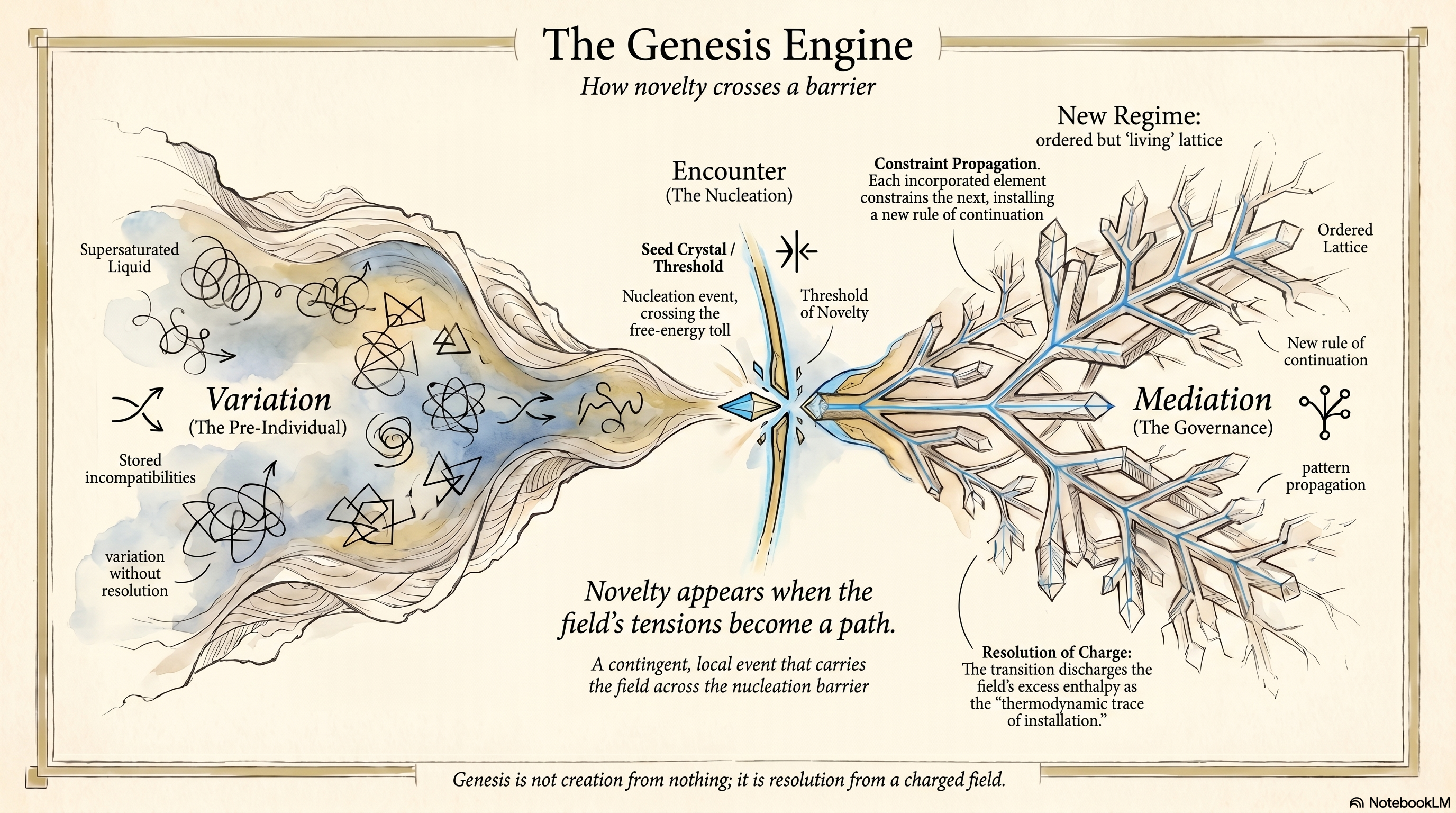
The one-sentence version
The Genesis Engine identifies when something genuinely new has appeared. It is the diagnostic form for distinguishing regime installation — the transition from structural 2 to structural 3 — from parametric saturation, where a system exhausts the possibilities of its existing constraint topology without installing a new one.
Where the word comes from
The phrase names Chapter 5’s central theoretical contribution: the architecture of novelty. It names not the components (Variation, Encounter, Mediation are those) but the diagnostic pattern — the signature by which an observer can determine whether a new stratogonic level has been installed or whether the system has merely reached a new parameter configuration within its existing regime.
The concept inherits Simondon’s insight that individuation is not construction from pre-given parts but crystallisation from a metastable field through transductive rupture. It disciplines that insight with specific diagnostics drawn from thermodynamics and constructive theory of types.
Why it matters
The Genesis Engine does two theoretical jobs. First, it provides a falsification condition for claims about new levels. Many frameworks say that biology “transcends” chemistry, or that cognition “goes beyond” biology. The Genesis Engine asks: what is the dominant control variable that is non-constructible from the prior vocabulary? If the answer is empty, the putative “transcendence” is redescription, not installation.
Second, it provides a scale-invariant signature. From the R1→R2 transition (life’s origin) to the appearance of language (R3→R4), the same diagnostic pattern appears: a metastable field carrying incompatible potentials, an encounter that irreversibly commits the field to a resolution, the propagation of a constraint topology whose dominant variables are novel, and a burn rate that funds the new governance. Scale changes; structure does not.
The transition from structural 2 to structural 3 — the framework’s shorthand for the Genesis Engine’s firing — marks the installation of a new identity, not merely a new state. A structural 2 situation is one where a system is fully determined by the variables of its current constraint topology (structural 1 = the metastable field; structural 2 = within-field variation; structural 3 = new constraint identity). When structural 3 appears, the system is no longer fully described by structural 2 variables. The new dominant control variables emerge from the installation itself — they are performatively constituted, not pre-given.
The graveyard precedes every success story. The overwhelmingly dominant outcome at the Genesis Engine’s threshold is not installation but plateau, fragmentation, absorption, or collapse. Genuine regime installation is the exception, not the rule. The Genesis Engine is first a device for excluding false positives.
What it is not
The Genesis Engine is not sufficient for anything to persist. It is the engine of novelty, not of durability. What the Genesis Engine installs, the Stabilisation Engine must maintain — and the two are categorically distinct achievements. More than one novel regime has appeared, persisted for a brief window, and dissolved before the inscription-compression architecture required for durable objectivity could be established. The Genesis Engine fires; the Stabilisation Engine decides whether anything remains.