CONCEPT · ENTRY 001 · R1 FIELD
Transduction
The irreversible resolution of a metastable field through which a new regime — with its own vocabulary, norms, and conditions of failure — precipitates.
- Register
- R1 field — pre-individual.
- Genealogy
- Simondon 1958
- Appears in
- Chapter 1 — The Hard Problem of Grounding
- Related
- Individuation · Metastability · Ontogony
- What it is not
-
- Not a phase transition that merely rearranges existing parts.
- Not emergence in the loose, observer-relative sense.
- Not a metaphor for "transformation in general."
DIAGRAM
Transduction
The irreversible resolution of a metastable field through which a new regime — with its own vocabulary, norms, and conditions of failure — precipitates.
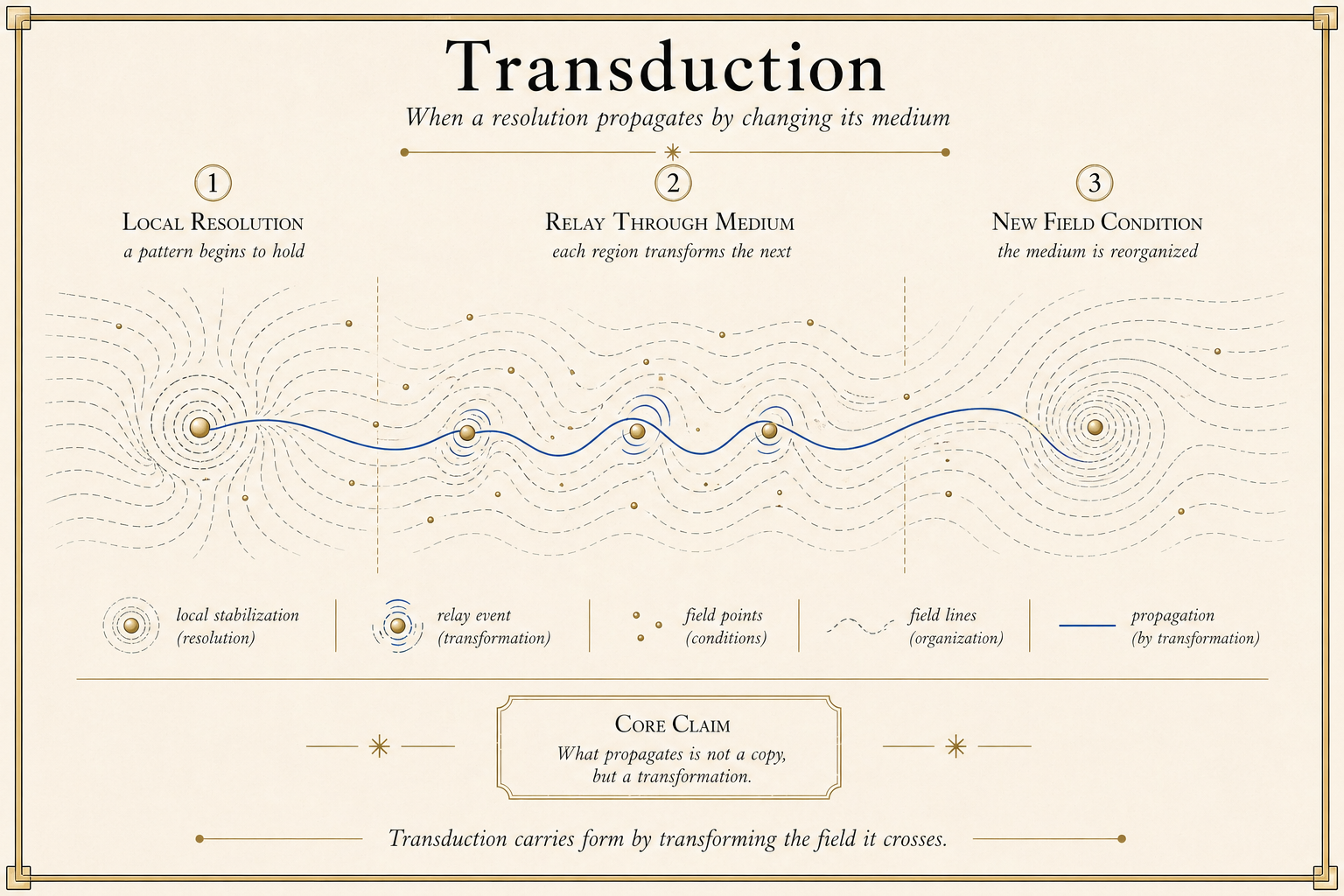
The one-sentence version
Transduction is what happens when a field of incompatible potentials resolves itself by installing a new regime that the prior regime could not have described.
It is not a transformation between two pre-given things. It is the moment a something becomes available to be described at all.
Where the word comes from
Gilbert Simondon used transduction for the operation by which an individual precipitates out of a préindividuel — a metastable field of unresolved potentials. The point was not that something “emerges” from something simpler. The point was that the field’s own vocabulary cannot name what comes next. The new individual is not a recombination of prior parts; it is the installation of a new set of dynamically autonomous variables.
Ontogony retains Simondon’s commitment and adds a thermodynamic spine: every transduction is a priced operation. There is no free precipitation.
The triad
A transduction always composes three functions, and all three are necessary:
- Variation. A field tense with incompatible potentials, none yet selected. The supersaturated solution. The ion gradient. The unresolved difference.
- Encounter. The dyadic event that carries the field across its threshold — the seed crystal touching the surface, the first binding event, the contingent local trigger. Brute and specific: this surface, this instant.
- Mediation. The governance the encounter installs. Constraint propagating through the new domain — each newly incorporated element shaping the conditions for the next. Mediation is what turns an encounter into a regime.
Strip any one of these and the configuration either equilibrates back into noise or fails to close. The triad is irreducible.
Why it matters
Transduction is the general operator the rest of Ontogony is built on. The same structural shape recurs at every register where something genuinely new comes into being:
- A crystal precipitating from a supersaturated solution.
- A cell installing a self-regenerating metabolic closure.
- A nervous system bootstrapping a sensory-motor coupling.
- A symbolic system installing a vocabulary its predecessors could not formulate.
These are not metaphorically related. They share a structure: a metastable field, a contingent encounter, and a mediation that installs a regime whose dominant variables were not constructible from the prior register. The cost of installation, and the cost of continued maintenance, are both measurable in joules.
What transduction is not
- Not a phase transition that merely rearranges existing parts.
- Not emergence in the loose, observer-relative sense.
- Not a metaphor for “transformation in general.”
A phase transition can be a transduction (the crystal); it is one only when the post-transition regime is dynamically autonomous from the prior one. The distinction is operational, not stylistic.