CONCEPT · ENTRY 013 · R2 BIOLOGICAL
Stratogonic Principle
A stratogonic level exists when and only when three conditions hold jointly — stabilised aspect-selection, a non-zero burn rate that regenerates the regime's own constraint-architecture, and a cessation signature whose order of collapse is regime-specific rather than merely thermodynamic.
- Register
- R2 biological — metabolic-closure.
- Genealogy
- Prigogine 1984 · Montévil & Mossio 2015 · Kauffman 2000
- Appears in
- Chapter 3 — The Price of Being
- Related
- Constitutive Dissipation · Burn Rate · Cessation Signature · Ontogony · Normogenesis
- What it is not
-
- Not a criterion for life or consciousness specifically.
- Not a claim that higher levels are metaphysically autonomous from lower ones.
- Not identical with emergence — the principle is thermodynamically auditable, emergence often is not.
- Not satisfied by complexity, dissipation, or self-organisation alone.
DIAGRAM
Stratogonic Principle
A stratogonic level exists when and only when stabilised aspect-selection, a non-zero burn rate, and a regime-specific cessation signature hold jointly.
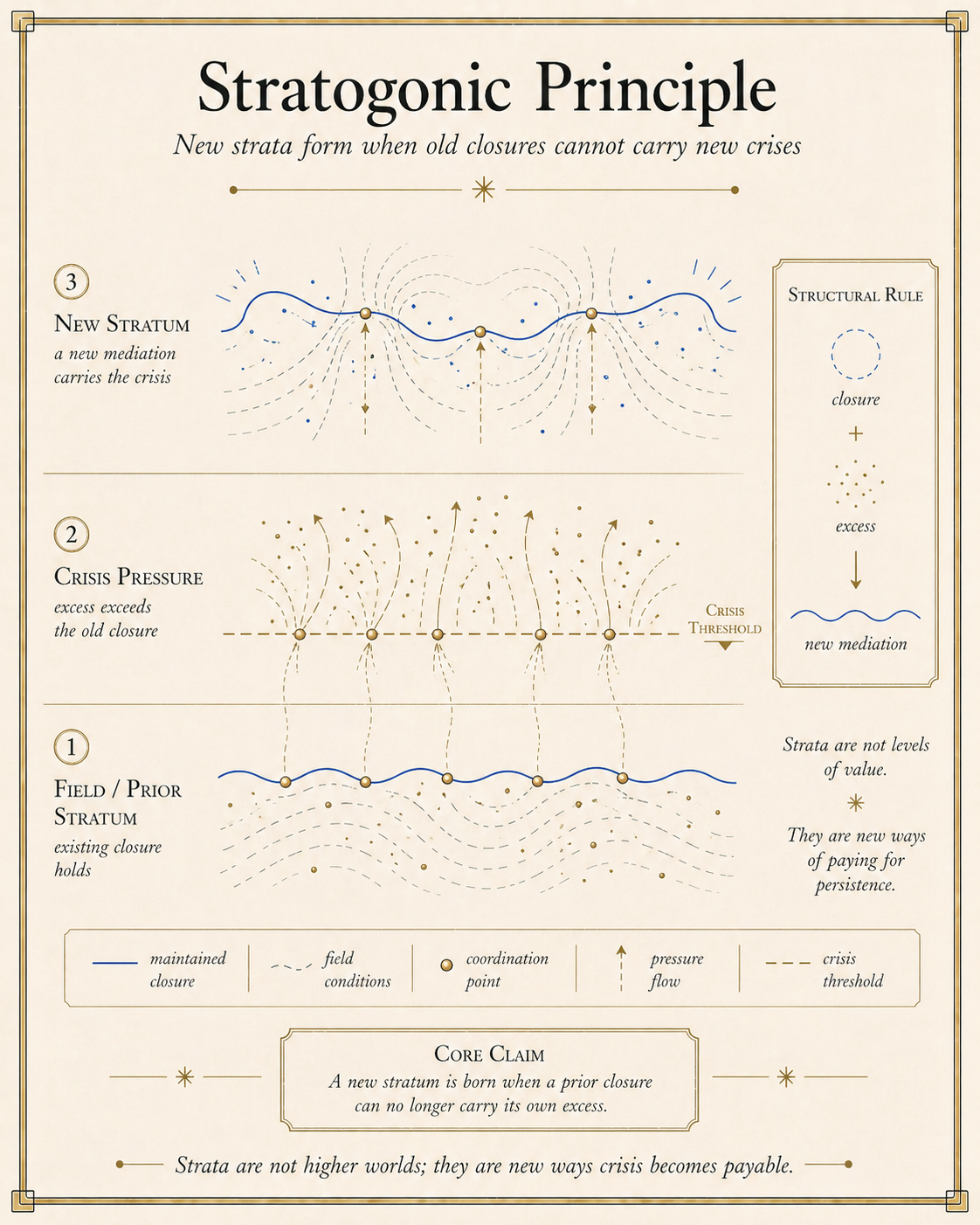
The one-sentence version
A level is real if and only if you can price it. The Stratogonic Principle is the framework’s core ontological criterion: a stratogonic level exists wherever a regime maintains itself by regenerating its own constraint-architecture at a measurable, continuous thermodynamic cost, and its breakdown is a regime-specific cessation sequence rather than undifferentiated relaxation.
Where the word comes from
Stratogonic is constructed from the Greek for “stratum” and “generation.” The principle is the formal statement of what it takes for a level to be real — not merely described, not merely emergent, but priced and diagnosable.
It draws on three converging traditions. Prigogine’s dissipative structures established that certain regimes far from equilibrium maintain their organisation through continuous free-energy expenditure. Montévil and Mossio’s closure-of-constraints framework identified the self-referential loop by which biological systems maintain the conditions of their own maintenance. Kauffman’s work-constraint skeleton identified the abstract architecture of how constraints channel work that regenerates constraints. The Stratogonic Principle integrates all three and adds a diagnostic apparatus neither supplies: the cessation test.
Why it matters
The Principle does three things simultaneously.
It distinguishes levels from descriptions. Many frameworks identify levels through the predicates we use — physical, chemical, biological, cognitive. The Stratogonic Principle grounds the distinction in the regime’s own thermodynamic operations: a level is not a vocabulary but a cost-structure. If there is no burn rate, there is no level — just a convenient redescription of what the level below is doing.
It supplies a falsification condition. The cessation test operationalises the criterion. Interrupt the regime’s funding and watch what dissolves in what order. If the order is regime-specific — if it inverts the hierarchy of energetic commitments rather than following simple thermodynamic relaxation — then a stratogonic level was there. If the system simply reverts to its substrate, it was throughput-dependent but not closure-forming.
It grades levels. The Principle generates a spectrum rather than a binary: constitutive stability at the Hamiltonian floor (molecular bonding geometry, zero burn rate, no closure), genesis-transitive closure (the crystal: pays once to install, then thermodynamically maintained without continuous regeneration), and full closure (the cell: pays continuously, regenerates its own maintenance conditions, has a cessation signature that maps its entire organisational hierarchy). Each grade is a different relationship between cost and closure.
The word stratogonic was coined to escape the ambiguity of “emergent,” which can mean anything from “surprising” to “irreducible.” A stratogonic level has a receipt.
What it is not
The Stratogonic Principle is not a theory of everything that is complex or organised. Hurricanes dissipate energy and exhibit self-organising form; they do not regenerate their own constraint-architecture. Crystals cross a thermodynamic threshold to form; they do not continuously purchase their persistence. The Principle is specifically about the subset of regimes that maintain themselves by looping their own dissipation back into the boundary conditions that channel further dissipation — and it is indifferent to whether those regimes are biological, cognitive, or institutional.