CONCEPT · ENTRY 024 · R3 COGNITIVE
Stratification Engine
The diagnostic form for genuine stratum installation — the appearance of an enveloping closure that takes a prior closure's constraints as its material, governed by the four diagnostic tests (breakdown signature, intervention, dependency, and revisability) and the revisability gradient.
- Register
- R3 cognitive — neural-integrative.
- Genealogy
- Maturana & Varela 1980 · Pattee 1972 · Deacon 2011 · Ladyman & Lorenzetti 2024
- Appears in
- Chapter 7 — The Stratification Engine
- Related
- Normogenesis · Closure-Crisis Lemma · Witness–Canon Architecture · Genesis Engine · Recursive Stack
- What it is not
-
- Not a claim that strata are ascending or progressive.
- Not a description of any single biological or social system — a diagnostic form applicable across scales.
- Not a theory of complexity or self-organisation in general.
- Not a hierarchy — strata fold around each other, they do not sit above each other.
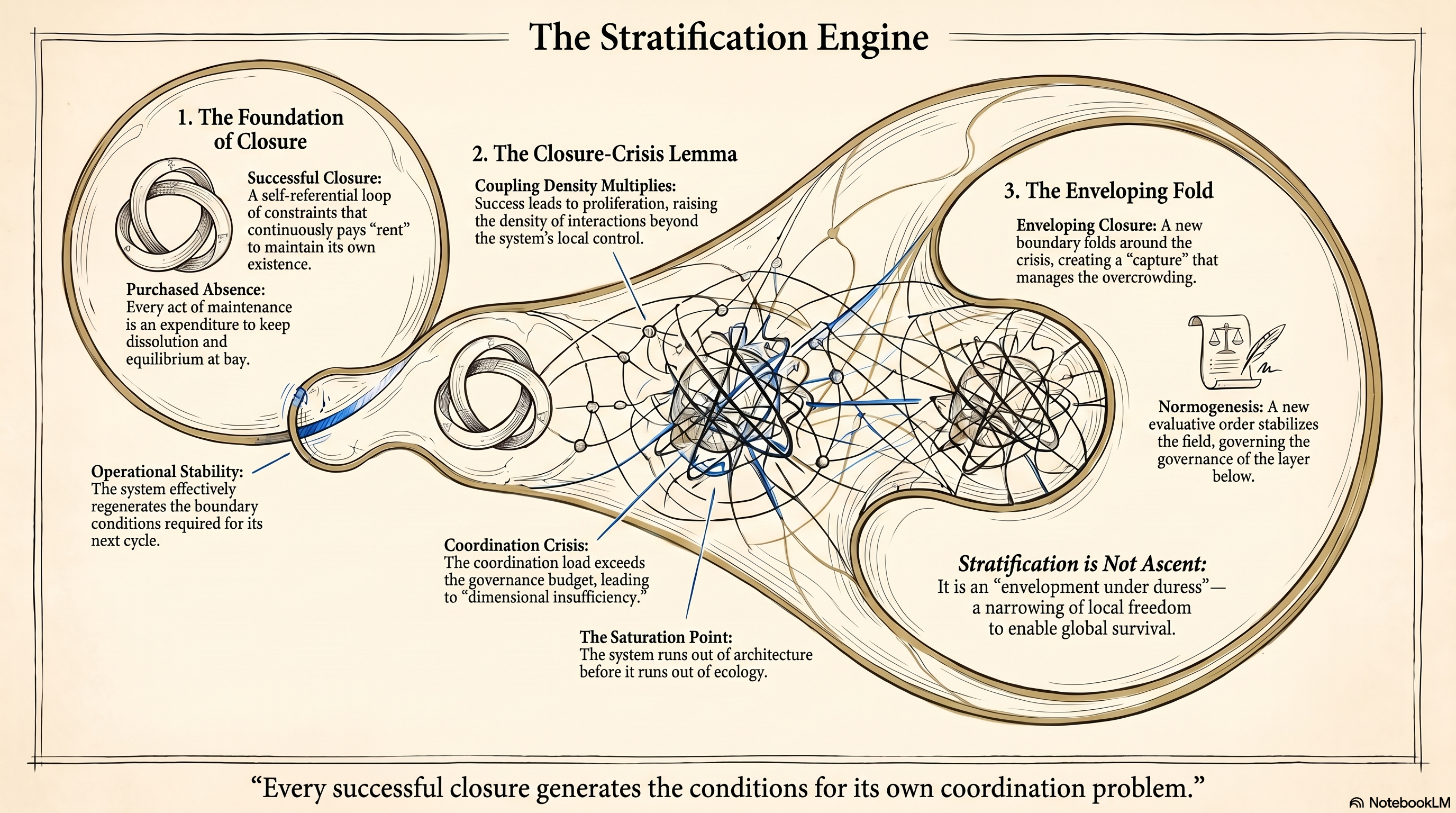
DIAGRAM
Stratification Engine Diagram
The transition from successful persistence to crisis and rare envelopment.
The one-sentence version
Stratification is envelopment under duress, not ascent. The Stratification Engine names the diagnostic form for genuine stratum installation — the appearance of a new enveloping closure that takes a prior closure’s constraints as its material and is tested by four operational criteria that distinguish genuine stratification from mere complication.
Where the word comes from
Chapter 7 introduces the Stratification Engine as the third of the three engines, inheriting both the Witness–Canon architecture and the Closure-Crisis Lemma as preconditions. The governing image is not the penthouse above an apartment building but the bunk beds built inside it: stratification is a cramped solution to a crowding crisis, not a monument to organisational genius.
The concept inherits from Maturana and Varela’s autopoiesis (second-order closure that maintains itself through self-production), Pattee’s epistemic cut (the irreducible distinction between rate-independent symbolic description and the rate-dependent dynamics it constrains), and Deacon’s autogenesis (constraints that become self-maintaining through reciprocal catalytic and containment cycles). The Stratification Engine synthesises these lineages and adds what none supplies independently: the four diagnostic tests that operationalise the distinction between genuine stratification and nested complication.
Why it matters
The Stratification Engine resolves the central explanatory gap left by the two prior engines. The Genesis Engine explains the appearance of new constraint identities; the Stabilisation Engine explains why some of them persist; the Closure-Crisis Lemma explains why persistence generates coordination pressures. None of these explains the transition from accumulated pressure to new governance architecture. The Stratification Engine fills that gap.
The four diagnostic tests operationalise the criterion:
Breakdown signature: When the system fails, does the failure require governance-level vocabulary for its characterisation? A eukaryotic cell that dies exhibits apoptotic cascades and organelle-specific stress responses — not simple thermodynamic relaxation. The failure signature names the stratum.
Intervention test: Do interventions at the governance level reliably reorganise substrate-level trajectories? This is Craver’s constitutive relevance criterion deployed as a probe: constitutive coupling is confirmed when bidirectional intervention propagates reliably between levels.
Dependency test: Has the substrate been reorganised to the point where its own persistence conditions include the governance architecture that constrains it? The endosymbiont’s genome has shed the genes it would need for independent survival. The tenants cannot leave the building because the building has become their biology.
Revisability test: What kind of revision is admissible without collapse? At R2, non-revisable (thermodynamics cannot be negotiated). At R3, partially revisable within architectural constraints (policies can be updated; integration requirements cannot be abolished without loss of competence). At R4, collectively revisable via procedure and sanction — but the question of who revises is the political content of the stratum.
What it is not
The Stratification Engine does not predict stratification. The overwhelmingly dominant outcome at every scale is not stratification but plateau, absorption, fragmentation, collapse, or parasitic exploitation. The graveyard precedes every success story. The Engine identifies the structural form of successful stratification; it does not claim that stratification is the typical or inevitable resolution of coordination crises. It is the exception, and what it achieves when it fires is a desperate installation, not an optional upgrade.