CONCEPT · ENTRY 023 · R2 BIOLOGICAL
Closure-Crisis Lemma
Every successful stabilisation, by exhausting the coordination space that permitted it, generates the metastable conditions for the next crisis — the Genesis Engine's exhaust is the Stabilisation Engine's fuel, and successful stabilisation accumulates coupling density faster than within-regime governance can absorb.
- Register
- R2 biological — metabolic-closure.
- Genealogy
- Prigogine 1984 · Kauffman 2000
- Appears in
- Chapter 5 — The Genesis Engine
- Related
- Genesis Engine · Stabilisation Engine · Stratification Engine · Metastable Field · Normogenesis
- What it is not
-
- Not a claim that crises are inevitable — the Lemma identifies the structural conditions for crisis, not a universal trajectory.
- Not a cycle — the Closure-Crisis Lemma describes the structural generation of new conditions, not a recurring pattern of the same events.
- Not pessimistic — the fact that stability generates instability is neither good nor bad; it is a structural consequence of effective closure.
- Not identical with "every solution creates new problems" — the Lemma is a precise structural claim about coordination load, coupling density, and governance budget.
DIAGRAM
Closure-Crisis Lemma
Every successful stabilisation exhausts the coordination space that permitted it and thereby accumulates the metastable conditions for the next crisis.
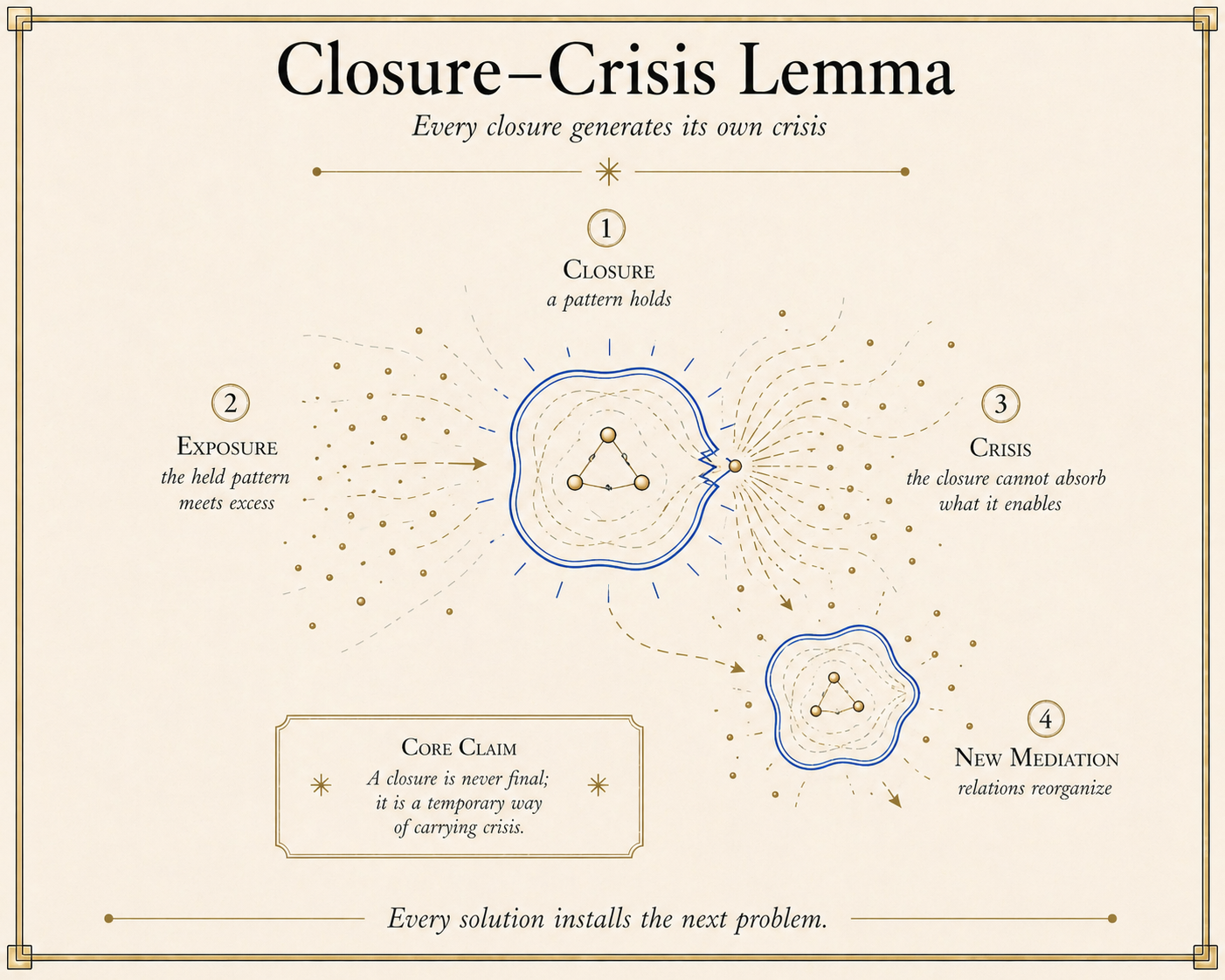
The one-sentence version
Stability is the engine of instability. The Closure-Crisis Lemma states that every successful regime closure — every stable individual that achieves durable objectivity through the Witness–Canon architecture — generates, as a structural consequence of its success, the coordination pressures that will eventually exceed the governance budget of the regime that produced it.
Where the word comes from
The term names the accounting identity at the heart of the three-engine sequence. A lemma in its logical sense is a subsidiary result that enables a larger proof. The Closure-Crisis Lemma is the structural bridge between the Stabilisation Engine (explaining persistence) and the Stratification Engine (explaining stacking): it identifies the mechanism by which persistence generates the conditions for stratification.
The argument has two steps. First, successful stabilisation increases coupling density: a stable individual is a node that other systems can interact with reproducibly, and as the density of stable individuals increases, the interaction density among them increases faster (quadratically, as a network effect). Second, the governance capacity of the incumbent regime — the within-regime resources for coordinating interactions — scales more slowly than interaction density. At some threshold, the governance deficit exceeds the regime’s coordination budget, and the surplus manifests as crises that require new vocabulary for characterisation.
Why it matters
The Closure-Crisis Lemma closes the argument that neither the Genesis Engine nor the Stabilisation Engine could complete. Without the Lemma, the sequence stops at stabilisation: individuals appear, persist, and accumulate indefinitely without any structural pressure toward new strata. The Lemma adds the coupling density accounting that makes stratification structurally expectable — not inevitable, but structurally generated as a pressure the incumbent regime cannot absorb.
The Lemma also explains the asymmetry between the three failure modes of crisis (plateau, fragmentation, collapse) and the one success mode (stratification). The crisis is a necessary consequence of successful stabilisation; stratification is one resolution mode among several, and the least likely. The Lemma does not predict stratification — it explains why the conditions for it arise.
The Lemma is recursive: once a new stratum is installed, its stabilised individuals generate their own coupling density, and the Lemma fires again at a new threshold. Each stratum inherits the exhaust of the one below. The exhaustive derivation of the four-stratum architecture follows from applying the Lemma to the outputs of each engine in sequence: R1 field → R2 crisis → R3 installation → R4 crisis → current institutional/symbolic stratum.
What it is not
The Closure-Crisis Lemma is not a theory of historical change or social conflict. At R4, the institutional stratum, the Lemma’s structural analysis identifies the architectural conditions for governance crises; it does not predict which crises will occur or which resolutions will prevail. The Lemma’s political economy is explicitly bounded: it identifies the structural form of crisis, not its content or outcome. This is the analytic consequence of the revisability gradient — R4 norms are collectively revisable, which means the political content of their revision is not deducible from the structural form of the crisis.