CONCEPT · ENTRY 017 · R1 FIELD
Mediation
The third function in the genesis triad — the ongoing governance that propagates constraint across the domain opened by Encounter, paid for continuously by the new regime's burn rate, transforming a transient event into a durable individual.
- Register
- R1 field — pre-individual.
- Genealogy
- Simondon 1958 · Peirce 1867
- Appears in
- Chapter 3 — The Price of Being
- Related
- Variation · Encounter · Transduction · Constitutive Dissipation · Burn Rate
- What it is not
-
- Not mediation in a social or communicative sense.
- Not a third party negotiating between two others.
- Not the outcome or product — Mediation is the ongoing operation, not the regime it maintains.
- Not free — Mediation has a burn rate, and when funding stops, the regime dissolves.
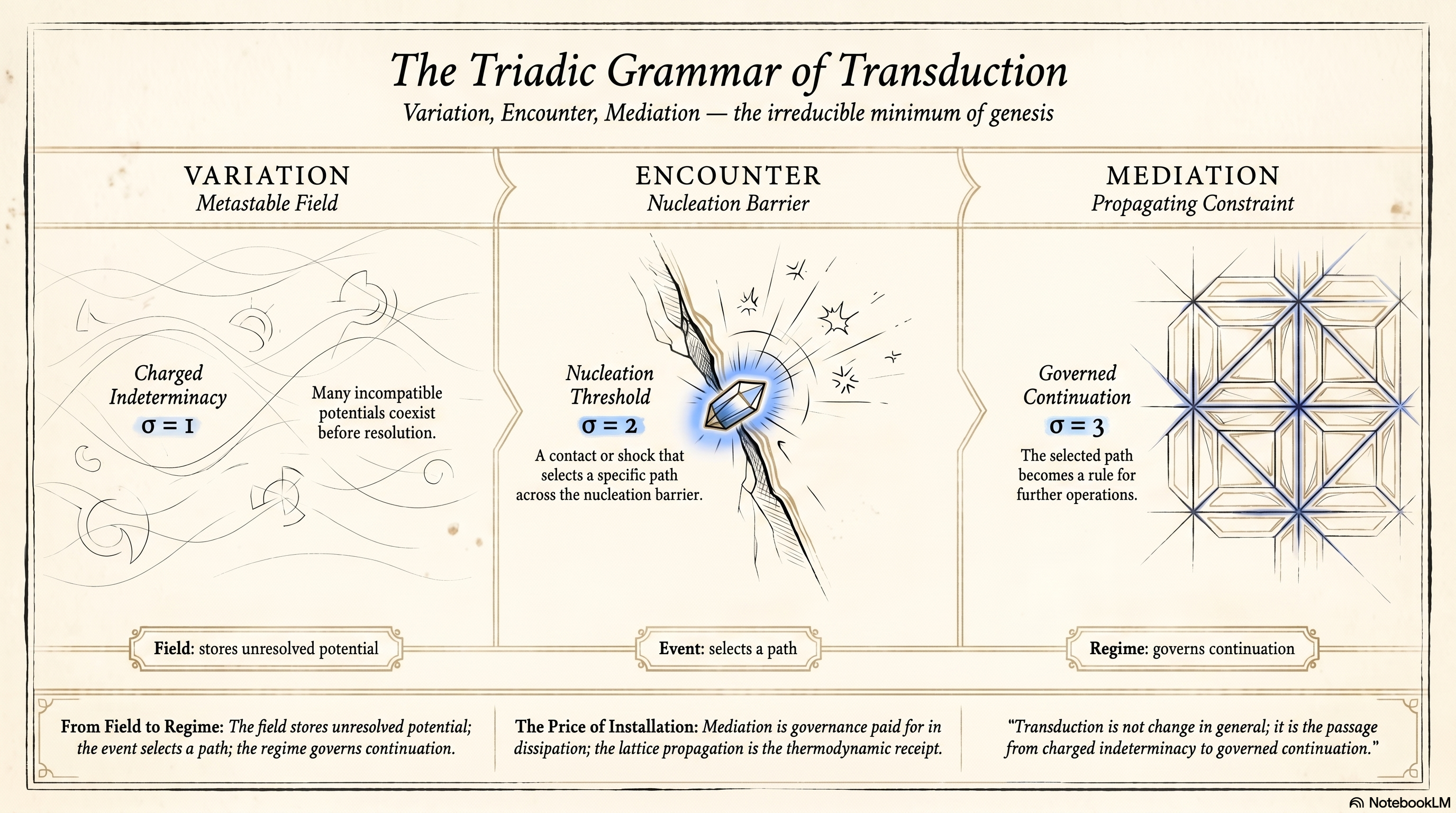
DIAGRAM
Variation-Encounter-Mediation
The triadic minimum of genesis and the grammar of novelty.
The one-sentence version
Mediation is governance constituted by dissipation. The third function in the genesis triad names the propagation of the constraint topology that an Encounter installed — not a single event but an ongoing operation that routes, gates, and selectively restricts the operations of the domain it governs, paid for at every moment by the regime’s burn rate.
Where the word comes from
In the supersaturated solution, Mediation is the lattice propagation: once the seed crystal forms, each newly locked ion provides a template for the next. The crystallographic constraint propagates through the domain, converting the metastable field into a regime that actively recruits its own extension. Mediation is what turns the Encounter from a local event into a global reorganisation.
Peirce’s Thirdness provides the philosophical index: Mediation is the category of relation, habit, sign, and law — the triadic that cannot be reduced to two dyadic encounters. No amount of Encounters adds up to Mediation; Mediation names the regime of governance that makes future encounters of the same type expectable. In this framework, however, Mediation is not merely semiotic — it is thermodynamically real. The propagation of lattice constraint costs energy at every step.
Why it matters
Mediation is what makes the genesis triad sufficient for a new level. Variation without Encounter gives a charged field that never discharges. Encounter without Mediation gives a brute event that dissipates before installing anything durable — the nucleation fires but the lattice does not propagate. Mediation converts the event into governance: it recruits its own extension, installs selective constraint across the domain, and thereby constitutes the new regime as something more than a transient fluctuation.
Three features of Mediation are essential. First, it is propagating — the constraint topology spreads from the Encounter site across the domain the Encounter opened. Second, it is selective — Mediation channels and restricts the domain’s operations; it does not merely label or describe them. Third, it is funded — Mediation has a burn rate, and the regime it maintains exists only as long as that rate is paid. When the funding stops, the governance dissolves.
The distinction between Mediation and simple persistence matters for the Stratogonic Principle. A crystal, once formed, is thermodynamically maintained without active governance — it sits in a deep energy minimum and stays there without doing anything. A cell, by contrast, actively mediates the interactions of its components: it routes metabolites, gates ion channels, and selectively degrades misfolded proteins. This is Mediation in the full sense: ongoing governance that regenerates its own constraint-architecture at the cost of continuous free-energy expenditure.
What it is not
Mediation is not the outcome of the genesis triad — it is the ongoing operation. The regime that Mediation installs is the product; Mediation is what keeps the product coherent. This is why cessation is diagnostic: when funding stops and Mediation ceases, the regime does not vanish at once but dissolves in an order that maps the architecture of the governance it depended on.