CONCEPT · ENTRY 019 · R2 BIOLOGICAL
Stabilisation Engine
The architecture by which the fragile singularities produced by transduction are lifted into durable objectivity through the coupling of redundant inscription (Witness) with selective compression (Canon), making the newly installed individual available as substrate for the next stratum.
- Register
- R2 biological — metabolic-closure.
- Genealogy
- Zurek 2003 · Joos et al. 2003 · Mossio & Moreno 2010
- Appears in
- Chapter 6 — The Stabilisation Engine
- Related
- Genesis Engine · Witness · Canon · Witness–Canon Architecture · Stratification Engine · Closure-Crisis Lemma
- What it is not
-
- Not a mechanism for preventing change — stabilisation maintains the constraint architecture that allows change at higher levels.
- Not the same as equilibrium — stabilised individuals are far from equilibrium, maintained by continuous free-energy expenditure.
- Not sufficient for stratification — the Stabilisation Engine explains persistence, not stacking.
- Not a repair mechanism — stabilisation is continuous maintenance of boundary conditions, not restoration after damage.
DIAGRAM
Stabilisation Engine Diagram
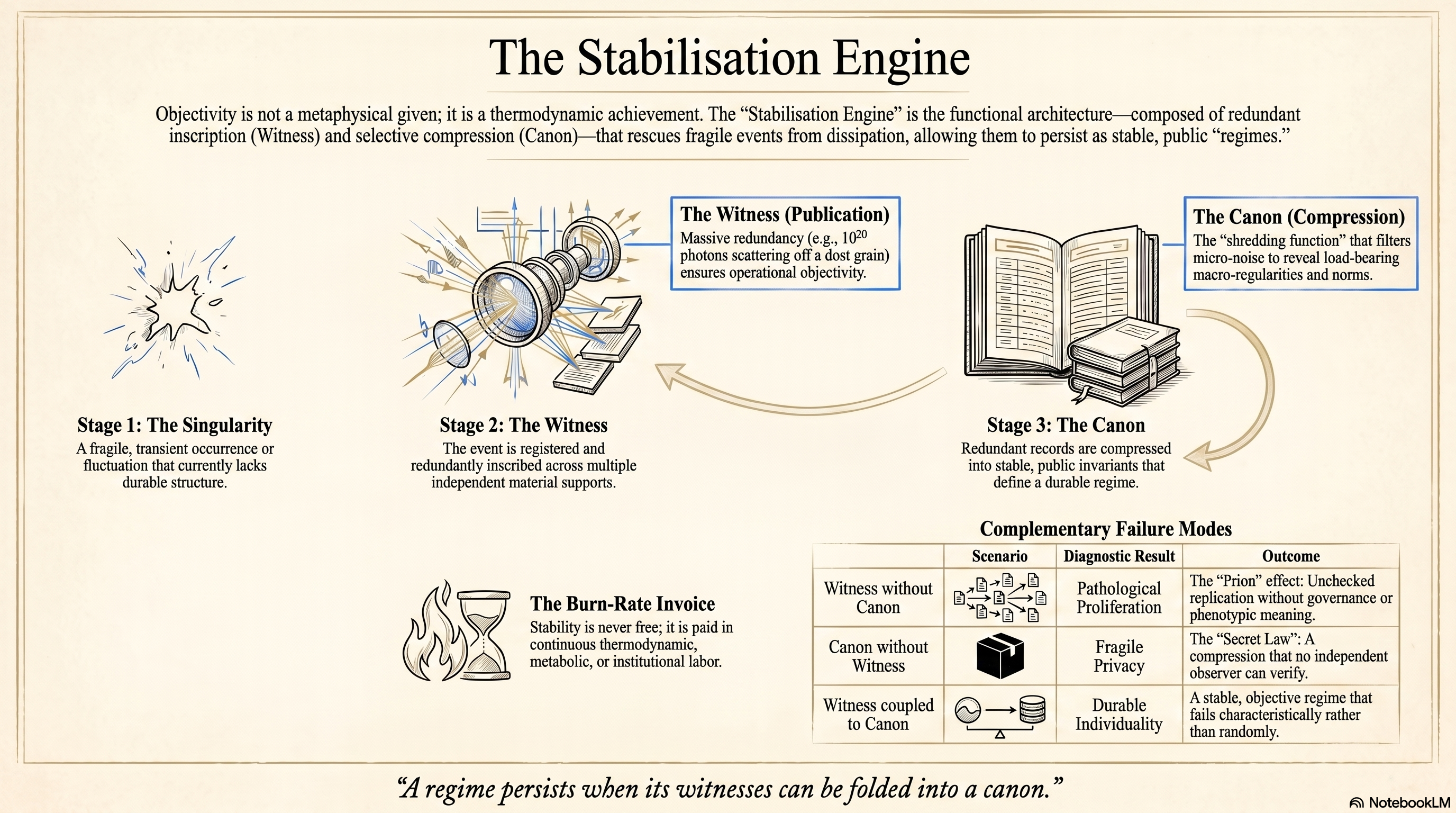
How newly installed regimes achieve durable objectivity through publication and compression.
The one-sentence version
The Stabilisation Engine is what keeps things real. Where the Genesis Engine identifies the installation of a new regime, the Stabilisation Engine identifies the architecture by which that regime persists: redundant inscription into the environment (Witness) coupled with selective compression of that inscription into governance-functional variables (Canon), creating the durable objectivity required for anything to serve as substrate for the next transductive event.
Where the word comes from
Chapter 6 names this the Stabilisation Engine to mark it as categorically distinct from the Genesis Engine. Genesis is the architecture of novelty; Stabilisation is the architecture of durability. The two are not sequential phases of a single process but separate engineering achievements, and the gap between them is where most genesis events fail.
The paradigmatic realisation is the eukaryotic chloroplast: not merely a photosynthetic organelle, but a system that inscribes its metabolic state into the cell’s environment through redundant molecular signals, while the cell’s regulatory architecture compresses that inscription into a small set of load-bearing parameters (ATP/ADP ratio, chlorophyll fluorescence yield, thylakoid membrane potential) that govern the cell’s downstream responses. The chloroplast is publicly accessible to the cell’s governance apparatus in a way that a simple chemical reaction is not — its state is inscribed in environmental copies that remain stable under the perturbations the cell must weather.
Why it matters
The Stabilisation Engine addresses a structural gap that the Genesis Engine leaves open. Transduction installs a new constraint identity — but the newly installed individual is initially fragile. Its constraint topology is enforced by the dissipative gradient that produced it, and any perturbation that interrupts that gradient will dissolve it before it can serve as substrate for further interaction. The Stabilisation Engine is what converts transient installation into durable presence.
This requires two coupled operations. The Witness function inscribes the individual’s dominant control variables into redundant environmental copies, achieving robustness through redundancy rather than intrinsic stability. The Canon function selects which of those inscriptions are load-bearing — which pointer states, metabolic signatures, or institutional categories will govern how other systems interact with the individual. Together, they implement a specific architectural achievement: the individual becomes publicly available as a stable constraint-coordinate in the environment of other systems.
The Stabilisation Engine is also the point where the three-stratum architecture of burn rates becomes visible. Physical stabilisation costs W/K. Biological stabilisation costs kcal/day. Institutional stabilisation costs person-hours/year. The costs are incommensurable across strata — you cannot trade organism-hours for watts — and this incommensurability is a structural feature, not a historical contingency.
What it is not
The Stabilisation Engine is not sufficient for stratification. A regime that persists indefinitely through Witness–Canon coupling has not thereby generated the conditions under which a new governance architecture will fold around it. Stabilisation explains why individuals endure; the Stratification Engine explains why durable individuals sometimes generate coordination crises that require new closure. The two engines explain different achievements, and neither explains the other.