CONCEPT · ENTRY 015 · R1 FIELD
Variation
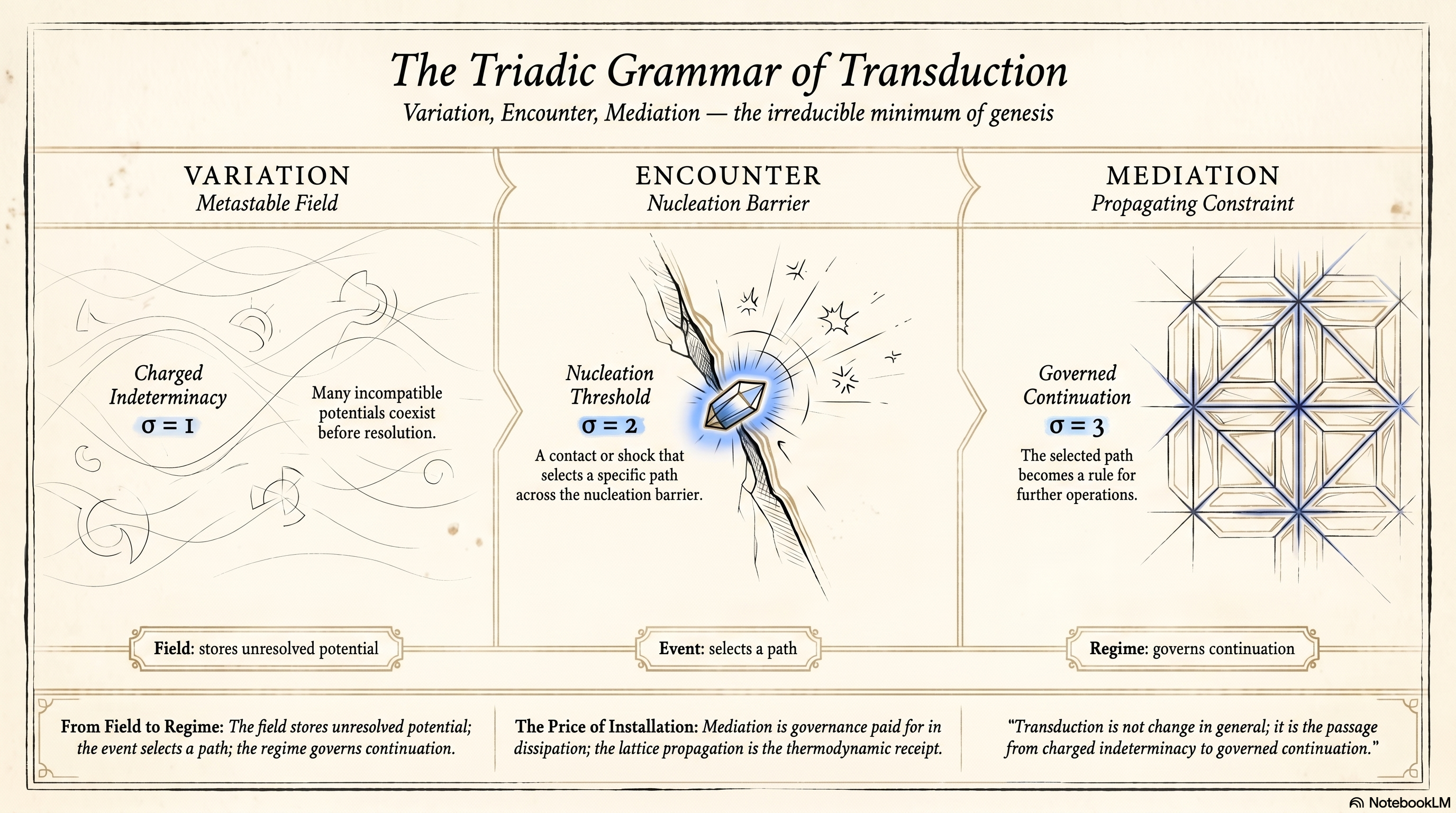
The first function in the genesis triad — a field of incompatible potentials held in thermodynamic deferral, superabundant with futures that exclude each other, providing the structured tension that transduction will irreversibly resolve.
- Register
- R1 field — pre-individual.
- Genealogy
- Simondon 1958 · Peirce 1867
- Appears in
- Chapter 3 — The Price of Being
- Related
- Encounter · Mediation · Metastable Field · Transduction
- What it is not
-
- Not variation in the biological sense of genetic mutation or phenotypic diversity.
- Not mere multiplicity or randomness.
- Not a synonym for possibility — Variation is thermodynamically real, not logically possible.
- Not the first step in a temporal sequence — the three functions of the genesis triad are co-constitutive, not sequential.
DIAGRAM
Variation-Encounter-Mediation
The triadic minimum of genesis and the grammar of novelty.
The one-sentence version
Variation is not randomness; it is charged tension. The first function in the genesis triad names the structured superabundance of a metastable field — incompatible futures held in thermodynamic deferral, the field’s internal differentiation exceeding what any single resolution can exhaust.
Where the word comes from
In the genesis triad, Variation names what Simondon called the préindividuel — the metastable field of incompatible potentials ontologically prior to any individual. The term is borrowed from Peirce’s phenomenological category of Firstness: pure qualitative possibility, prior to any relational determination. But in this framework, Variation is not logical or phenomenological — it is thermodynamic.
In the supersaturated solution, Variation is the excess free energy above saturation that funds two incompatible crystallographic futures at once. In the pre-electroweak vacuum, it is the symmetry whose breaking cannot be anticipated from within the symmetric regime. In the anoxygenic biosphere, it is the redox potential that no single metabolic pathway can exhaust. In each case, the field holds more futures than it can realise — and the excess is the source of every genesis event.
Why it matters
Variation is the reason genesis is irreversible and not merely rearrangement. Without Variation — without a field that holds incompatible potentials in genuine tension — every apparent change is parametric saturation: the system explores a possibility-space whose constraint topology remains invariant. Nothing new is installed. The ledger stays balanced.
The key structural feature of Variation is superabundance in a precise sense: the field is over-determined in that its internal differentiation exceeds what any single resolution can exhaust. This means that every Encounter is simultaneously an installation and a foreclosure. What the field becomes, the field can no longer be. The graveyard of unrealised futures is constitutive of genesis, not incidental to it.
Variation also explains why genesis cannot be predicted from within the metastable regime. The dominant control variables of the new constraint identity are non-constructible from the field’s current vocabulary: they become available only when the transductive event installs the regime they describe. This is why the Demon standpoint is not merely difficult to occupy — it is structurally excluded. No complete survey of Variation could issue in a prediction of what the Encounter will install, because the installation generates the predicates by which it would be described.
What it is not
Variation is not the first step in a temporal process. The three functions of the genesis triad — Variation, Encounter, Mediation — are analytically distinct but co-constitutive. The field does not first exist in pure Variation, then generate an Encounter, then achieve Mediation. What separates them is diagnostic structure, not temporal sequence. Variation names what the field is; Encounter names the event of resolution; Mediation names the governance the resolution installs.