DIAGRAM · CHAPTER 03
Stratogonic Principle.
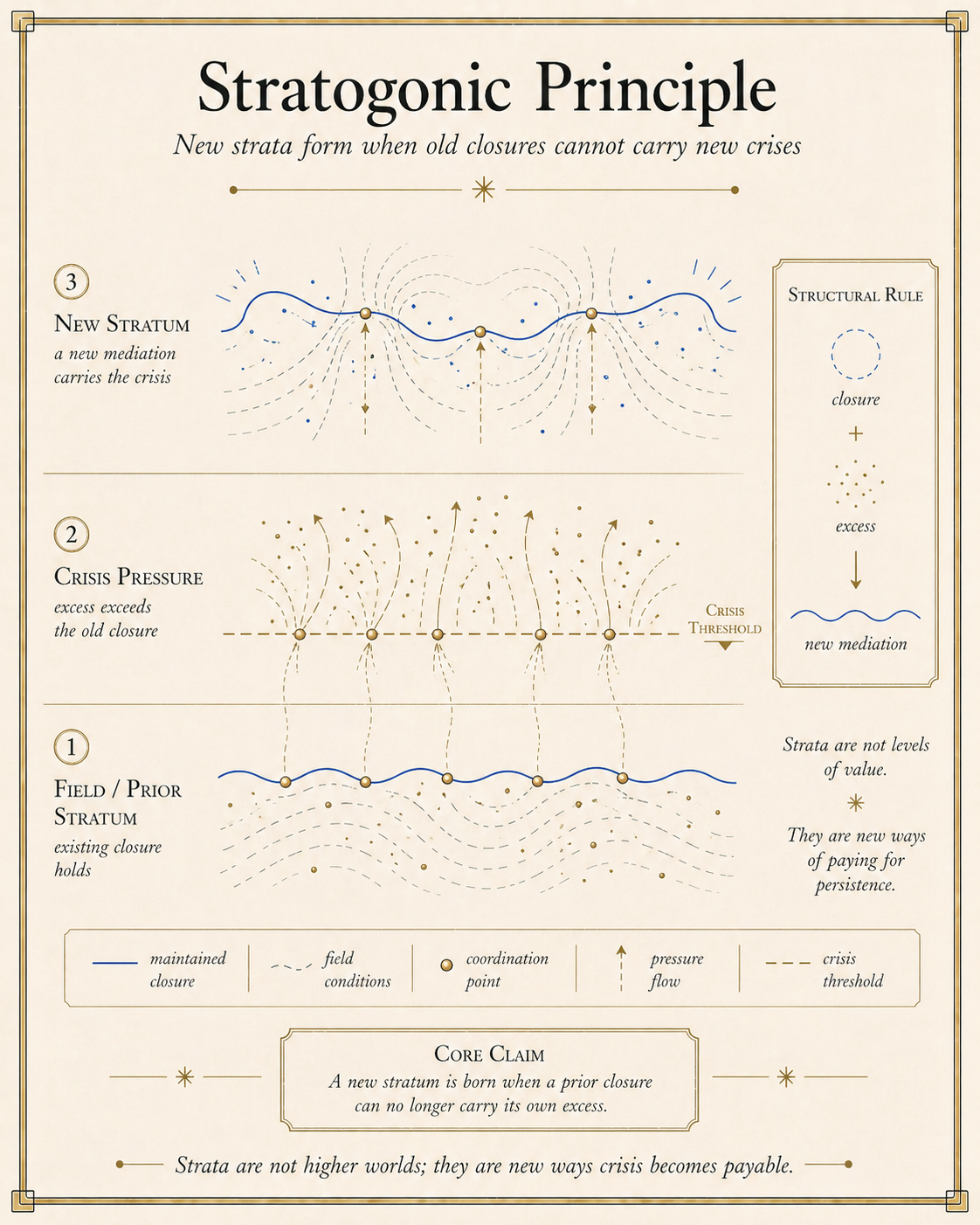
A stratogonic level exists when and only when stabilised aspect-selection, a non-zero burn rate, and a regime-specific cessation signature hold jointly.
ATLAS PLATE
Stratogonic Principle
A stratogonic level exists when and only when stabilised aspect-selection, a non-zero burn rate, and a regime-specific cessation signature hold jointly.
The one-sentence version
The Stratogonic Principle states the necessary and sufficient conditions for a level of reality: stabilised aspect-selection, a non-zero burn rate that regenerates the regime’s own constraint-architecture, and a cessation signature whose order of collapse is regime-specific rather than merely thermodynamic. All three conditions must hold jointly.
Where the term comes from
The principle synthesises Prigogine’s dissipative-structure conditions, Kauffman’s autocatalytic closure, and Montévil and Mossio’s constraint-closure thesis into a single auditable criterion. The term “stratogonic” — level-generating — is introduced in ontogony to mark that the principle describes not just how regimes persist but how they generate the conditions for further levels above them.
Why it matters
The Stratogonic Principle provides ontogony’s answer to the question of when a higher level is genuinely real rather than merely a useful description. Without all three conditions, what appears to be a new level is either a transient fluctuation, a borrowed constraint, or a purely epistemic partition. When all three hold, a new player enters the universe — one with its own burn rate, its own norm-set, and its own mode of death.
- Chapter
- 3
- Book title
- The Price of Being
- Collection
- Diagram