CONCEPT · ENTRY 007 · R2 BIOLOGICAL
Constitutive Dissipation
The thesis that a regime's identity is not defined by what it is made of but by the continuous price — in joules of free energy per second — that it pays to keep itself from dissolving.
- Register
- R2 biological — metabolic-closure.
- Burn rate
- The continuous rate of free-energy dissipation, denominated in the regime's native register — joules per second at the cellular scale; metabolic proxies higher up.
- Cessation signature
- The trajectory of collapse when funding is severed; reverses the order of energetic commitment, dismantling the most expensive achievements first.
- Genealogy
- Schrödinger 1944 · Prigogine 1984 · Montévil & Mossio 2015
- Appears in
- Chapter 3 — The Price of Being
- Related
- Ontogony · Transduction · Recursive Stack
- What it is not
-
- Not energy throughput in general.
- Not entropy production in general.
- Not a metaphor — burn rates are SI-measurable.
- Not restricted to biology.
DIAGRAM
Constitutive Dissipation
A regime's identity is not what it is made of but the continuous burn rate it pays to keep itself from dissolving — being is a sustained thermodynamic achievement.
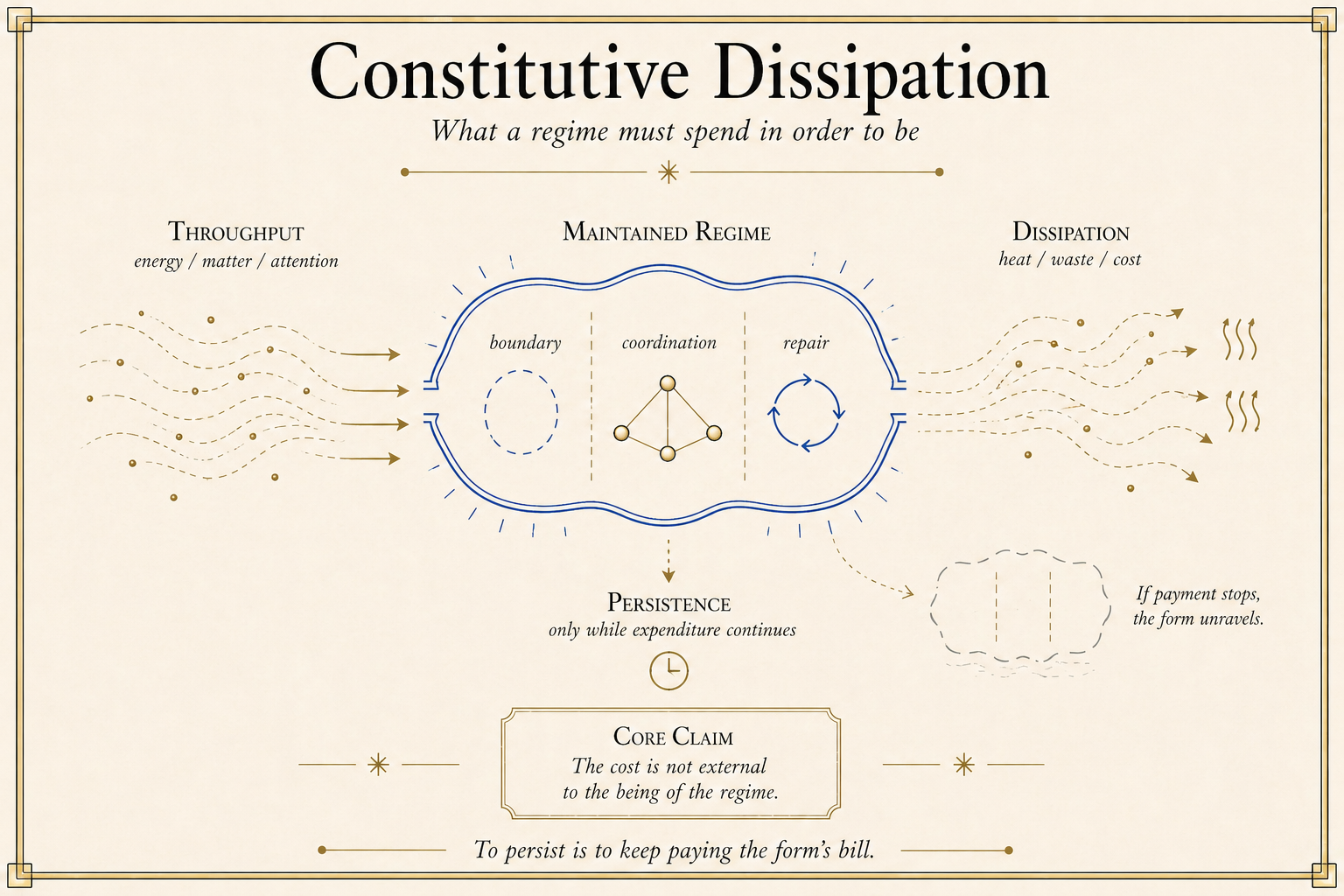
The one-sentence version
Persistence is priced, and the price is the regime. A self-regenerating closure is not a substance that happens to dissipate energy; it is a pattern of dissipation that, by occurring, keeps regenerating its own conditions. Stop the dissipation and the regime is not just damaged. It is gone.
Where the word comes from
The seed is in Schrödinger’s What Is Life? (1944), where organisms are described as feeding on negative entropy — sustaining an unlikely order by exporting disorder. Prigogine’s dissipative structures (Brussels school, 1960s onwards) generalised the idea: certain systems far from equilibrium organise themselves precisely because energy is flowing through them. The closure-of-constraints framework of Montévil and Mossio (2015) tightens it further: organisms are networks of constraints whose maintenance and the processes they constrain mutually depend on one another.
Ontogony takes the next step. The dissipation is not merely enabling of identity; it is constitutive of it. There is no underlying thing that has the dissipation as one of its properties. The dissipation is the thing.
Why it matters
The thesis turns identity into something measurable.
It distinguishes closure from mere flow. A waterfall dissipates energy. A candle flame dissipates energy. Neither regenerates the conditions of its own dissipation. A cell does. Constitutive dissipation is the criterion that lets you tell those cases apart without resorting to vocabulary about “life” or “purpose”: is the dissipation regenerating the boundary conditions of its own continuation, or not? If yes, the dissipation is constitutive; if no, it is just throughput.
It makes the cessation signature legible. When a regime’s dissipation stops, what dissolves first reveals what was being maintained at the highest cost. The order of collapse is not arbitrary; it inverts the order of energetic commitment. This is empirical, repeatable, and indexed to the regime’s own conditions of viability rather than to an outside observer’s taxonomy.
It compounds up the recursive stack. Higher layers in the stack are paid for partly out of the constitutive dissipations of the layers beneath them. Cognitive maintenance rents from biological maintenance, which rents from physical-chemical gradients. The framework is therefore not just about cells; it is about any layer at which a closure regenerates itself, and about how those layers compose.
The point can be put as a slogan: a regime is not what it is; it is what it costs.
What it is not
- Not energy throughput in general. Anything dissipates energy. Constitutive dissipation names the specific case in which the dissipation is the regeneration of the conditions for its own continuation.
- Not entropy production in general. The second law guarantees entropy production for any irreversible process; constitutive dissipation requires, additionally, that the process closes back on itself in a way that produces a regime with its own conditions of failure.
- Not a metaphor. Burn rates are SI-measurable. Cessation signatures are observable. The framework’s central claim is that identity has a unit, and the unit is the watt.
- Not restricted to biology. Any regime that regenerates its own boundary conditions through dissipation qualifies — chemical, biological, cognitive, or institutional. The bill takes different forms at different layers; the structure is the same.