CONCEPT · ENTRY 002 · R4 INSTITUTIONAL
Ontogony
The systematic study of how new regimes — with their own vocabularies, norms, and conditions of failure — come into being and pay the cost of staying.
- Register
- R4 institutional — symbolic-political.
- Genealogy
- Whitehead 1929 · Bergson 1907 · Simondon 1958 · Schrödinger 1944
- Appears in
- Chapter 1 — The Hard Problem of Grounding
- Related
- Transduction · Individuation · Constitutive Dissipation
- What it is not
-
- Not ontology in the classical sense.
- Not cosmogony.
- Not emergence theory in its loose form.
- Not process philosophy as a slogan.
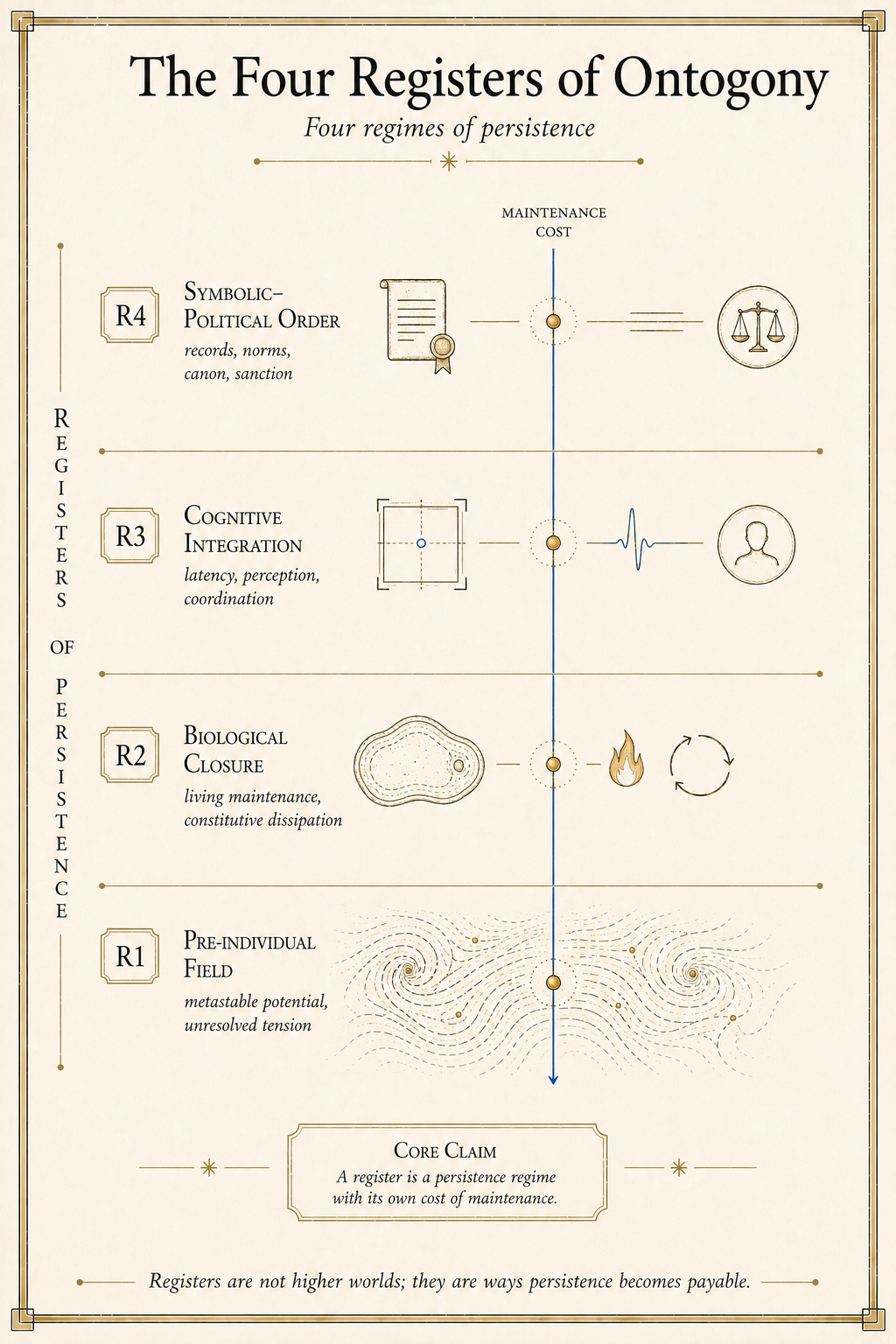
DIAGRAM
R1-R4 Strata
The four-register stack from field conditions to institutional closure.
The one-sentence version
Ontogony is the study of becoming, not of being. It asks how new kinds of things come into existence, what it costs them to keep existing, and what the precise signature of their dissolution reveals about what was being maintained.
Where the word comes from
The name is built from two Greek roots: ontos (being) and gonos (generation, birth). The contrast it draws is with ontology, which inventories what exists. Ontology asks what is there? Ontogony asks how did it come to be there, and what does it cost to keep it there?
The framework owes obvious debts. From Simondon: the priority of operations of individuation over a static catalogue of individuals. From Whitehead and Bergson: the seriousness of becoming as a primary subject of philosophy. From non-equilibrium thermodynamics: the recognition that persistence is a continuous achievement, not a default state. Ontogony does not repeat any of these. It binds them by a single thesis: every regime is identifiable by what it costs to maintain and by the order in which it falls apart.
Why it matters
Two consequences follow from taking becoming seriously.
First, identity becomes operational. A regime is not what it is made of; it is what it does to keep being the kind of regime it is. A cell is not its molecules — replace them all and the cell continues. A cell is the closure that regenerates the conditions for its own continuation, and the joules per second that closure burns are not incidental to its being a cell. They are constitutive of it. (See Constitutive dissipation.)
Second, novelty becomes auditable. Standard frameworks struggle with the question of how something genuinely new comes into being without smuggling in either top-down design or bottom-up reduction. Ontogony’s answer is structural: novelty arrives through transduction, the resolution of a metastable field into a regime whose dominant variables were not constructible from the prior register. The cost of installing the new regime, and the cost of maintaining it, are both measurable.
The framework is therefore not speculative. It commits to specific predictions about what should be observable: cessation signatures, burn rates, the recursive layering of regimes (Recursive stack), and the irreducibility of certain operations to their parts.
What it is not
- Not ontology in the classical sense. Ontology asks what is; Ontogony asks how something becomes the kind of thing it is.
- Not cosmogony, which is concerned with the origin of the cosmos. Ontogony is indifferent to ultimate origins and concerned with the operation of becoming wherever and whenever it occurs.
- Not emergence theory in its loose form. The framework rejects observer-relative or purely descriptive emergence and demands a thermodynamic and operational warrant for any claim of new structure.
- Not process philosophy as a slogan. Ontogony names processes by what they cost and how they end, not by metaphor.
The whole project is built so that any claim it makes can in principle be paid in joules.