CONCEPT · ENTRY 009 · R2 BIOLOGICAL
Burn Rate
The rate of Gibbs free-energy dissipation — measured in watts, denominated in the regime's native currency — that a closure must sustain continuously in order to hold its constraint-architecture together.
- Register
- R2 biological — metabolic-closure.
- Burn rate
- The burn rate is the burn rate — it is its own primary instance. At the cellular register it is measurable by respirometry; at cognitive registers it is denominated in metabolic proxies (glucose consumption, ATP turnover per operation).
- Cessation signature
- When the burn rate drops to zero, the cessation signature begins. Cessation is the diagnostic read-off of what the burn rate was maintaining.
- Genealogy
- Schrödinger 1944 · Prigogine 1984 · Landauer 1961
- Appears in
- Chapter 1 — The Hard Problem of Grounding
- Related
- Constitutive Dissipation · Cessation Signature · Landauer Floor · Ontogony
- What it is not
-
- Not energy throughput in general.
- Not entropy production in general.
- Not metabolic rate as a biological fact merely — it is a thermodynamic constraint on any regime that maintains itself.
- Not a metaphor — burn rates are SI-measurable in watts.
DIAGRAM
Thermodynamic Audit
Finite observers settle accounts through irreversibility, not abstraction.
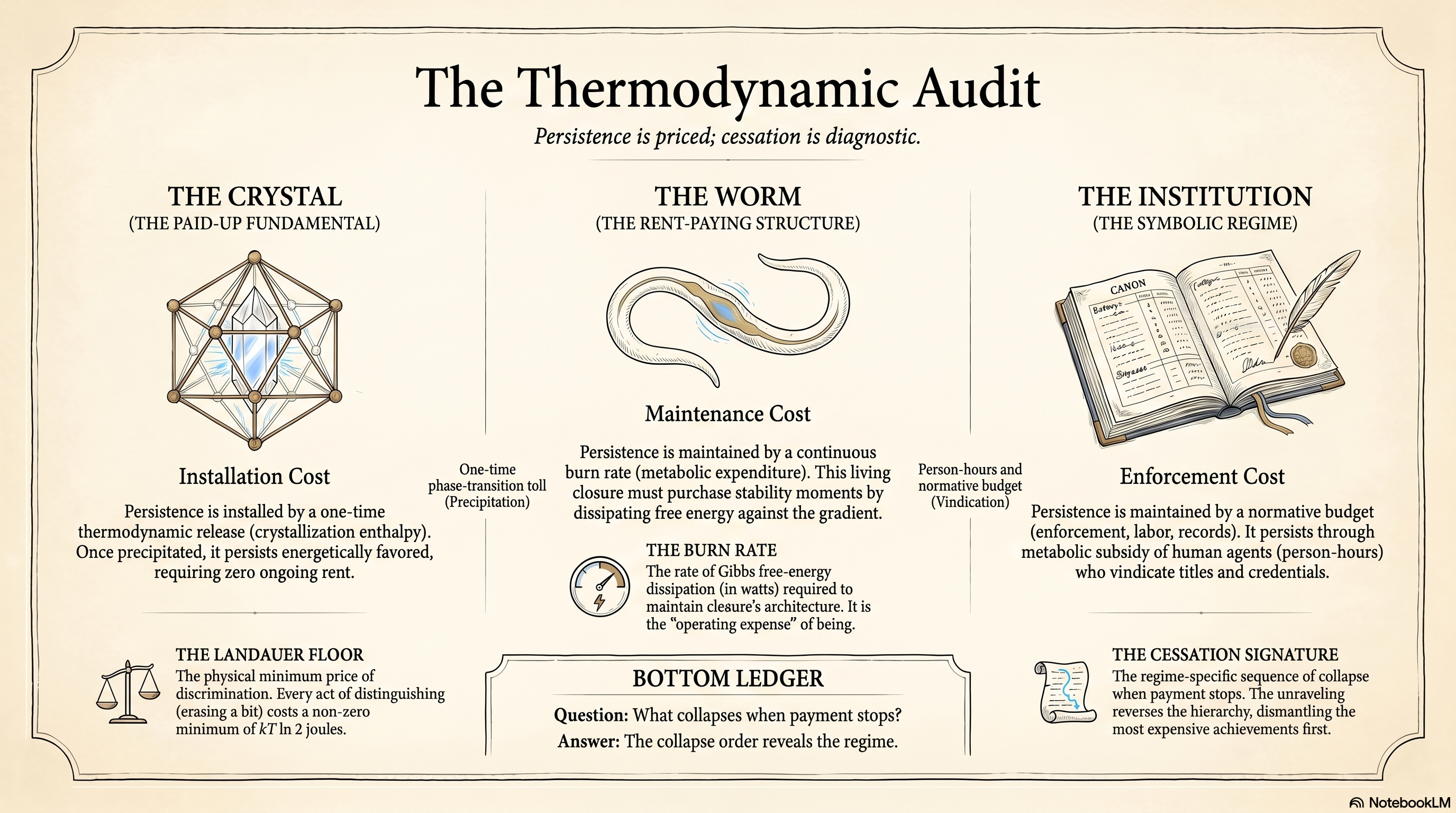
The one-sentence version
Persistence costs something, and burn rate is the invoice. Every self-regenerating closure — cell, organism, cognitive architecture, institution — sustains itself by continuously paying a measurable rate of free-energy dissipation. The regime is not a substance that happens to spend energy; the expenditure is what the regime is.
Where the word comes from
The term crystallises the thermodynamic core of Schrödinger’s What Is Life? and Prigogine’s dissipative-structures programme. Both established that living systems maintain their organisation by continuously exporting entropy to their environments. What neither supplied was a single, SI-measurable quantity indexing the rate of that export at the level of the regime’s own constraint-architecture. “Burn rate” fills that gap.
At the cellular register, the paradigm case is the Na⁺/K⁺-ATPase: a family of ion pumps that consumes a substantial fraction of a cell’s entire ATP budget to maintain the membrane potential the cell requires for signalling, transport, and structural integrity. Interrupt ATP supply for seconds and the membrane potential collapses. That specific, continuous, regime-sustaining expenditure is the burn rate — not the heat lost in chemical reactions generally, but the cost of keeping the distinction open that the regime’s identity requires.
Why it matters
Burn rate does three things that vaguer talk of “energy” or “metabolism” cannot.
It is regime-indexed, not system-indexed. The burn rate is not simply the total energy throughput of a system — it is the expenditure specifically required to maintain the regime’s constraint-architecture. A disruption that reduces total throughput without disrupting the relevant closure does not reduce the burn rate in the relevant sense.
It denominates dissipation in the register’s native currency. At R1 (field), dissipation is measured in joules per transition. At R2 (biological), in watts per organism, indexed to metabolic rate. At R3 (cognitive), in metabolic proxies: glucose consumption per operation, ATP turnover per discriminating event. Each register has its own denomination — but the underlying structure is invariant: a positive, continuous, measurable cost of maintaining distinctions the regime requires.
It makes the cessation test operational. You cannot identify a regime’s cessation signature without knowing what it was spending to sustain itself. Burn rate gives you the denominator: when the expenditure falls, the collapse sequence should invert the hierarchy of commitments in the order of their cost. If it does not, the system was not a closure in the relevant sense.
The burn rate is the number that makes the phrase “persistence is priced” cash out.
What it is not
Burn rate is not entropy production in general. Every irreversible process increases entropy; not every irreversible process maintains a self-regenerating closure. The burn rate specifically names the dissipation that loops back to regenerate the boundary conditions of its own continuation. A candle flame has heat output, but its dissipation does not regenerate the boundary conditions of its own continued organisation in the way a closure does.