CONCEPT · ENTRY 025 · R3 COGNITIVE
Normogenesis
The emergence of enveloping closures whose function is to manage the instability of prior closures — mechanisms of synchronisation, selection, and exclusion that are always also mechanisms of capture, distinguished across strata by the revisability gradient.
- Register
- R3 cognitive — neural-integrative.
- Genealogy
- Maturana & Varela 1980 · Pattee 1972 · Foucault 1975 · Agamben 1998
- Appears in
- Chapter 7 — The Stratification Engine
- Related
- Stratification Engine · Recursive Stack · Closure-Crisis Lemma · The Virtual
- What it is not
-
- Not the emergence of norms in a sociological sense specifically.
- Not progress or improvement — normogenesis is a structural consequence of coordination pressure, not an achievement.
- Not identical with rule-following or normativity as a philosophical problem.
- Not a single event — normogenesis is the recurring structural form of enveloping closure installation across all three strata.
DIAGRAM
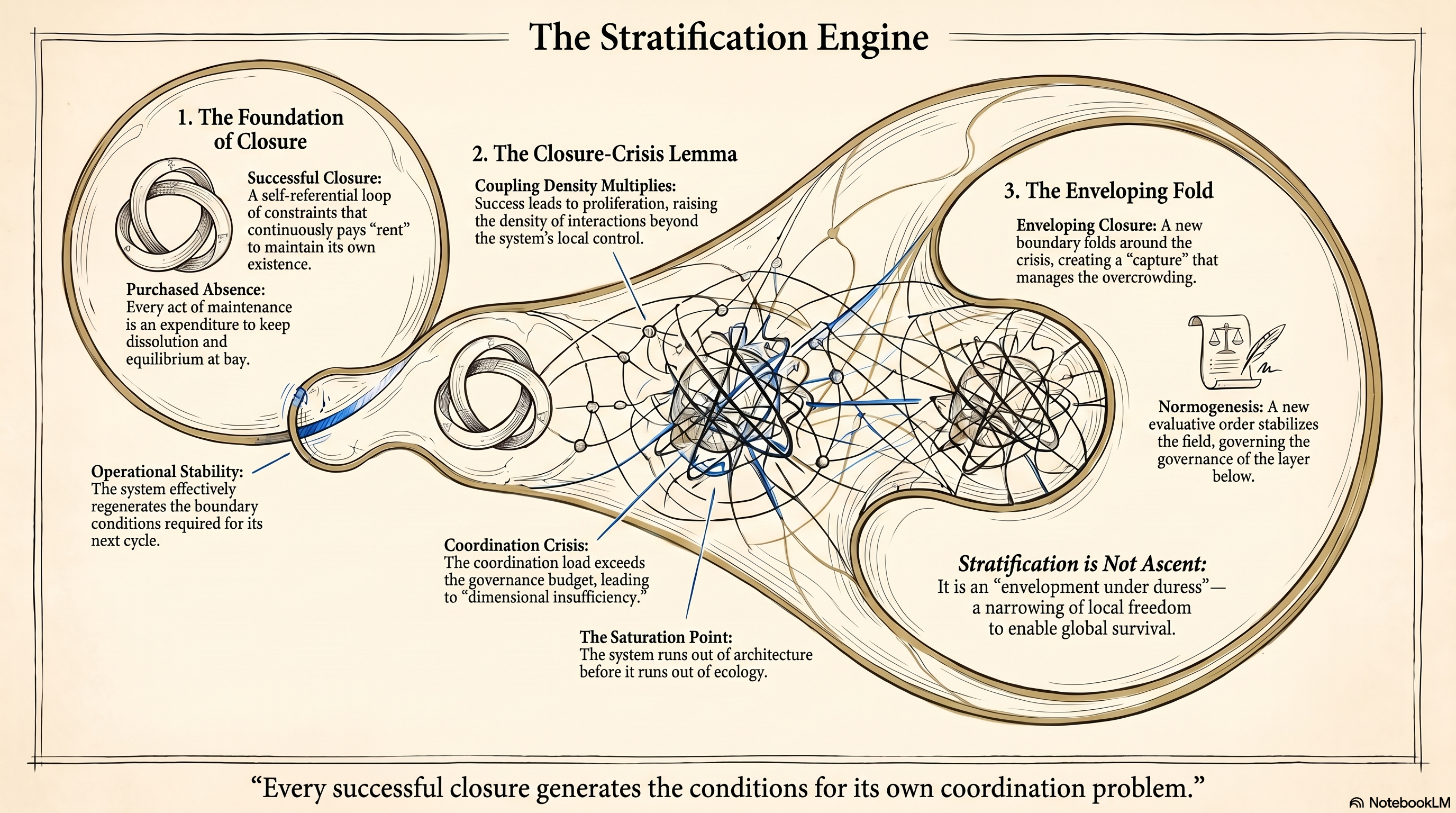
Stratification Engine Diagram
The transition from successful persistence to crisis and rare envelopment.
The one-sentence version
Normogenesis is not the discovery of norms but their installation. It names the appearance of enveloping closures whose function is to manage the instability of prior closures — and the structural fact that every such installation is simultaneously a mechanism of governance and a mechanism of capture.
Where the word comes from
Norms are the binding constraints a stratum imposes on its substrate — not merely rules that can be followed or violated, but constraints whose violation produces characteristic failure modes. Genesis signals that normogenesis is a creative event, not a description of pre-existing order. Normogenesis names the appearance of the binding architecture itself.
Chapter 7 introduces normogenesis to name what strata do when they appear: they install mechanisms of synchronisation (coordinating the operations of the substrate), selection (excluding substrate configurations incompatible with governance coherence), and exclusion (marking what the governance architecture cannot absorb and placing it outside the stratum’s jurisdiction). These three operations are inseparable: a governance architecture that synchronises without selecting cannot maintain coherence; one that selects without excluding generates indefinitely expanding obligation.
Why it matters
Normogenesis names the political structure latent in the framework’s thermodynamic analysis. The thesis that strata are installed as cramped solutions to coordination crises — bunk beds built because the room is too small — is a structural claim that carries political consequences. Every stratum is an installation, and every installation is a capture: the substrate regime that required governance is now reorganised around the governance architecture that constrained it.
The revisability gradient provides the analytic safeguard against normative flattening. Normogenesis at R2 installs biological viability constraints: non-revisable, binding force is metabolic necessity, violation is death. Normogenesis at R3 installs cognitive integration requirements: partially revisable through learning, binding force is effective agency, violation is loss of competence. Normogenesis at R4 installs institutional-symbolic architectures: collectively revisable via procedure and sanction, binding force is legal and social recognition, violation is exclusion from the institutional order.
The three modes are distinguished not by degree but by mechanism. The shared formal architecture — enveloping closure, Witness–Canon coupling, four diagnostic tests — must not be mistaken for shared mechanism. Metabolic necessity is not convention. Institutional sanction is not thermodynamics. The framework’s point is the opposite: precisely because all three strata share the same formal architecture, it becomes possible to see how radically different their enforcement mechanisms are.
Normogenesis is also the concept that links the book’s thermodynamic core to the biopower analysis developed in later chapters. Because R4 folds around R3, which folds around R2, the institution’s ultimate sanctions are always biological: starvation, confinement, the management of mortality risk. Not as exceptions to institutional normativity but as its ground-floor enforcement. The porosity of the firewall between strata is not a concession to political sociology — it is the structural consequence of what envelopment means.
What it is not
Normogenesis is not progress. The appearance of new enveloping closures does not represent an advance in organisation, consciousness, or freedom. It represents the structural consequence of having solved an earlier problem well enough to generate the conditions for the next one. The bunk beds are not a step toward the penthouse; they are the crowded solution to the room’s inability to house the number of bodies it must house. Every stratum is the next bunk bed.