CONCEPT · ENTRY 008 · R2 BIOLOGICAL
Cessation Signature
The regime-specific sequence in which a closure's achievements unravel when its funding is severed — dismantling the most energetically expensive commitments first, mapping by their order of collapse exactly what was being maintained.
- Register
- R2 biological — metabolic-closure.
- Genealogy
- Schrödinger 1944 · Prigogine 1984
- Appears in
- Chapter 1 — The Hard Problem of Grounding
- Related
- Constitutive Dissipation · Burn Rate · Transduction · Ontogony
- What it is not
-
- Not a description of how any physical system stops.
- Not observer-relative — the sequence is indexed to the regime's own conditions of viability.
- Not equivalent to entropy increase in general.
- Not limited to biology, though the biological register provides the clearest examples.
DIAGRAM
Burn Rate and Cessation Signature
Cessation is diagnostic: the order of collapse reveals what a regime was paying to maintain.
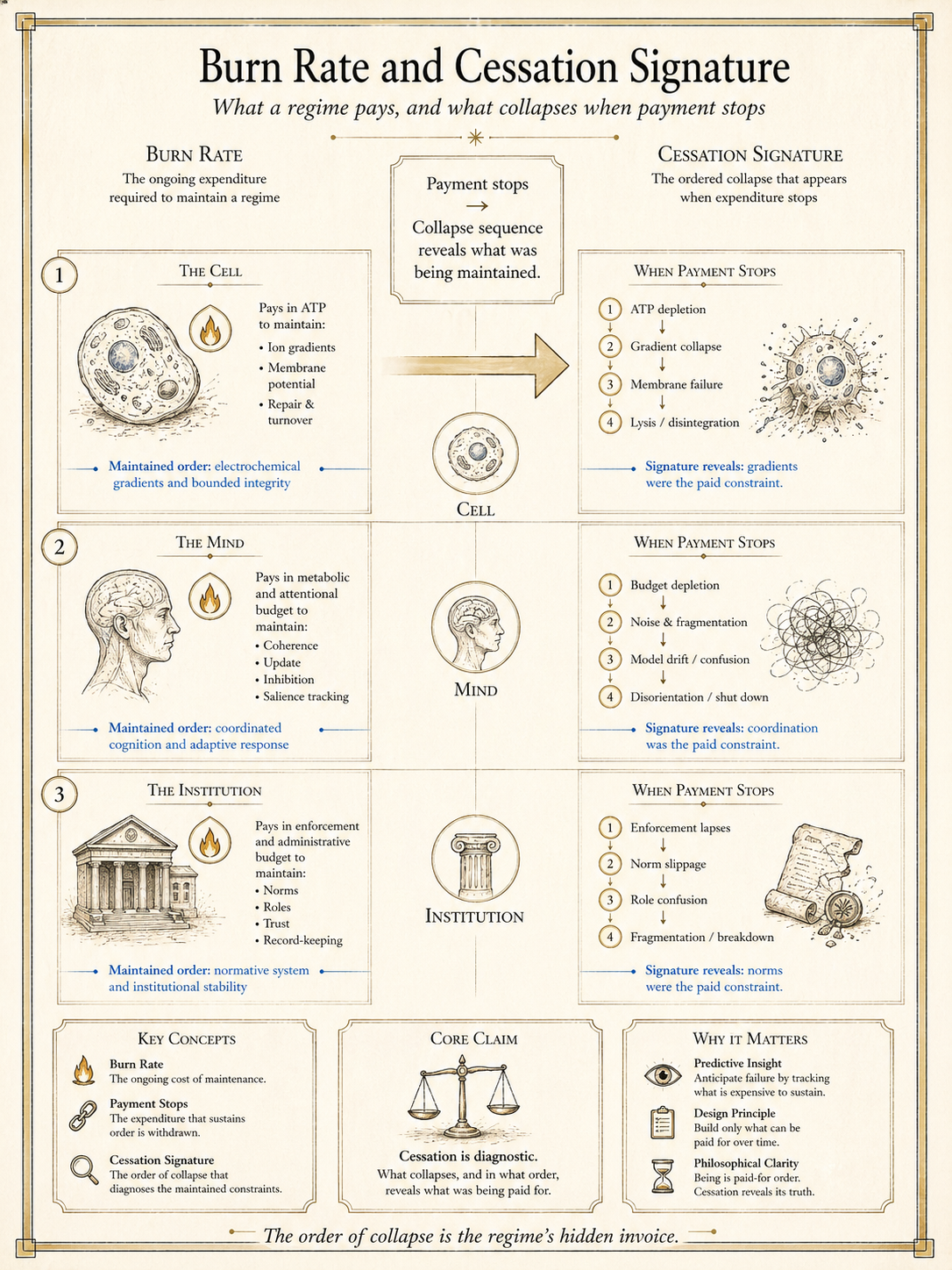
The one-sentence version
The order in which a regime collapses is the proof that it was a regime. When the expenditure that held a closure together is severed, what dissolves is not random. The most expensive achievements fail first — and the sequence maps, without any external observer imposing a taxonomy, what was actually being maintained at continuous cost.
Where the word comes from
The cessation signature is drawn from the opening ordeal of Chapter 1: a planarian flatworm in a depleted nutrient gradient. When the metabolic throughput that maintains the worm’s chemotactic coupling is cut off, cell membranes lose selective permeability first, then ion gradients dissipate, then enzymatic cascades halt. The unravelling has a specific order because the original architecture had a specific hierarchy of energetic commitments. The cessation signature discovers that hierarchy without presupposing it.
The concept is not named in prior literature under this term. It condenses insights scattered across Schrödinger’s What Is Life?, Prigogine’s dissipative-structures programme, and the closure-of-constraints framework — and makes their empirical content precise: not “what is alive?” but “what collapses in what order when funding stops?”
Why it matters
The cessation signature solves a diagnostics problem that definitions of life or organisation cannot.
It is discovered, not stipulated. You do not need to specify in advance what a regime is maintaining. You interrupt its funding and read the collapse sequence. The sequence tells you the regime’s internal hierarchy. This makes the cessation signature an empirical criterion, not a philosophical one.
It distinguishes closures from mere flows. A candle flame stops when it runs out of wax — but it does not exhibit a cessation signature because there is no self-regenerating constraint-architecture to unravel. The dissolution of a vortex leaves no residue of reversed commitments. The cessation signature is what separates a closure (which has one) from a dissipative pattern that is merely throughput-dependent (which does not).
It grounds normativity without importing it. What counts as the regime’s failure is determined by what the regime itself was doing — not by an observer’s functional description. The cessation signature is the regime’s own breakdown map, available from the outside through empirical intervention.
At higher registers, cessation signatures become more complex — cognitive architectures dissolve in characteristic sequences under anaesthesia or trauma, institutions fail in patterns that index their constitutive dependencies — but the logical form is the same: the order of collapse inverts the order of energetic commitment.
What it is not
The cessation signature is not a description of how any physical system reaches equilibrium. Entropy always increases; the cessation signature is not simply the arrow of time. It is specifically the structured reversal of a regime’s own hierarchy of achievements — which presupposes that the regime had such a hierarchy in the first place. A system with no closure has no cessation signature, only dispersal.