CONCEPT · ENTRY 022 · R3 COGNITIVE
Witness–Canon Architecture
The coupled structure in which redundant environmental inscription (Witness) is paired with selective compression (Canon) to lift transductively installed individuals into the durable objectivity that makes them available as substrate for the next stratum.
- Register
- R3 cognitive — neural-integrative.
- Genealogy
- Zurek 2003 · Shannon 1948 · Mossio & Moreno 2010
- Appears in
- Chapter 6 — The Stabilisation Engine
- Related
- Witness · Canon · Stabilisation Engine · Closure-Crisis Lemma · Stratification Engine
- What it is not
-
- Not a description of any specific biological or institutional system — a structural form realised at multiple strata.
- Not a two-step process — Witness and Canon are co-constitutive, not sequential.
- Not a theory of memory or cognition specifically.
- Not reversible — an individual that loses its Witness–Canon architecture does not degrade gracefully; it undergoes characteristic regime collapse.
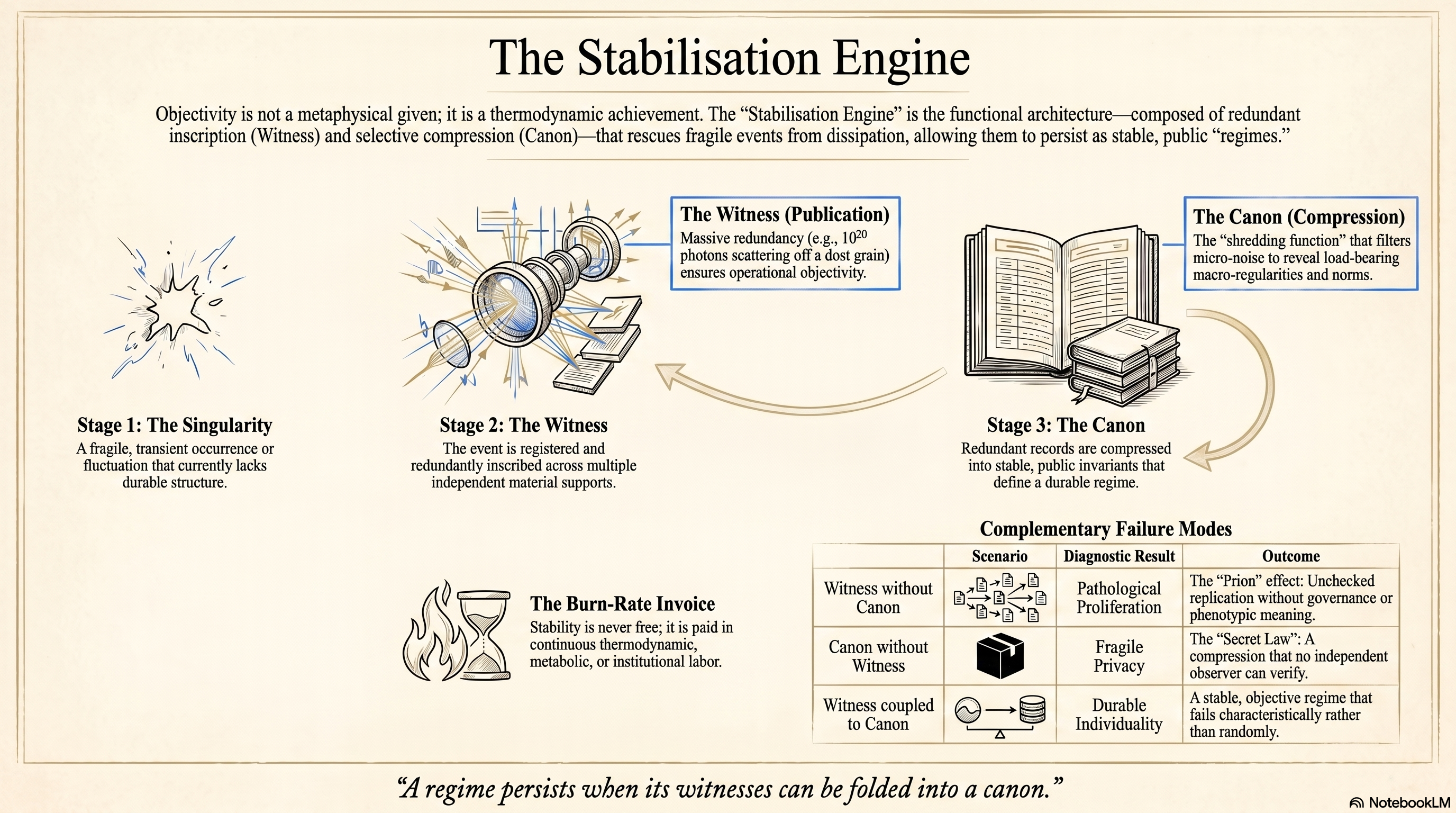
DIAGRAM
Stabilisation Engine Diagram
How newly installed regimes achieve durable objectivity through publication and compression.
The one-sentence version
The Witness–Canon architecture is how the world keeps hold of what transduction installs. It names the coupled structure — redundant inscription together with selective compression — that jointly achieves the durable objectivity required for an individual to persist as a stable constraint-coordinate in the environment of other systems.
Where the word comes from
The compound name signals that neither function is sufficient alone. Witness without Canon generates inscription floods that no governance architecture can use; Canon without Witness operates on an unstable, unredundant signal and cannot achieve robustness against perturbation. The architecture is the coupling — a specific structural achievement in which the two functions are instantiated simultaneously and reciprocally.
Chapter 6 develops the architecture through the dust grain / chloroplast / counting-house progression. The dust grain achieves minimal Witness through thermal coupling (pointer states imprinted into environmental photon fields) with minimal Canon (a small set of classical observables that decoherence selects as the dominant basis). The chloroplast achieves metabolic Witness through signal molecules and surface ligands, with a regulatory-network Canon that selects load-bearing metabolic parameters. The mediaeval counting-house achieves institutional Witness through ledger-keeping and notarised documents, with a legal-categorical Canon that selects which facts about persons and transactions are institutionally operative.
Why it matters
The Witness–Canon architecture is the second engine’s structural core, but its importance extends beyond Chapter 6. It establishes the precondition for stratification: a new stratum can fold around individuals only if those individuals are already present as stable constraint-coordinates in the environment. The Stratification Engine inherits the Witness–Canon architecture as a precondition and shows how the architecture’s success — the durability it achieves — generates the coordination pressures that require a new closure.
The architecture also explains the Formal Isomorphism Principle: that structurally analogous diagnostic tests are applicable at R2, R3, and R4 despite the radical difference in mechanisms. The tests work because the Witness–Canon architecture is the same formal structure at every stratum, even though the mechanisms are incommensurable. Physical pointer states, metabolic signatures, and institutional categories are not comparable; the Witness–Canon coupling structure that organises them is.
The architecture has a characteristic failure mode: prion-like runaway. When Witness is sustained without Canon — when redundant inscription propagates without selective compression — the result is proliferation without governance. The prion accumulates misfolded copies of itself into every available substrate without selecting which copies are load-bearing. The counting-house analogy is the bureaucracy that records everything and archives nothing: an institution that generates inscription without selecting which records are actionable. Both exhibit Witness-without-Canon pathology.
What it is not
The Witness–Canon architecture is not a theory of representation, memory, or cognition. It is a structural form for achieving durable objectivity, and it operates below the threshold of cognition at R2 (physical and biological strata) as well as above it at R4 (institutional strata). Cognition is one mechanism by which the architecture is implemented at R3 — not its definition.