CONCEPT · ENTRY 020 · R2 BIOLOGICAL
Witness
Redundant environmental inscription that makes a newly installed individual publicly accessible — the mechanism by which a fragile singularity produced by transduction achieves durable objectivity through stable, reproducible readability by external systems.
- Register
- R2 biological — metabolic-closure.
- Burn rate
- W/K at physical stratum (pointer states, thermal coupling); kcal/day at biological (metabolic maintenance of signal molecules and receptors); person-hours/year at institutional (labour of record-keeping and inscription)
- Genealogy
- Zurek 2003 · Joos et al. 2003 · Blumenfeld-Jones 1997
- Appears in
- Chapter 6 — The Stabilisation Engine
- What it is not
-
- Not observation in the subjective or epistemic sense.
- Not record-keeping as institutional practice specifically — the Witness function operates at physical, biological, and institutional strata with different mechanisms.
- Not sufficient for persistence on its own — without Canon, Witness generates a flood of inscription that governance cannot use.
- Not consciousness or sentience.
DIAGRAM
Stabilisation Engine Diagram
How newly installed regimes achieve durable objectivity through publication and compression.
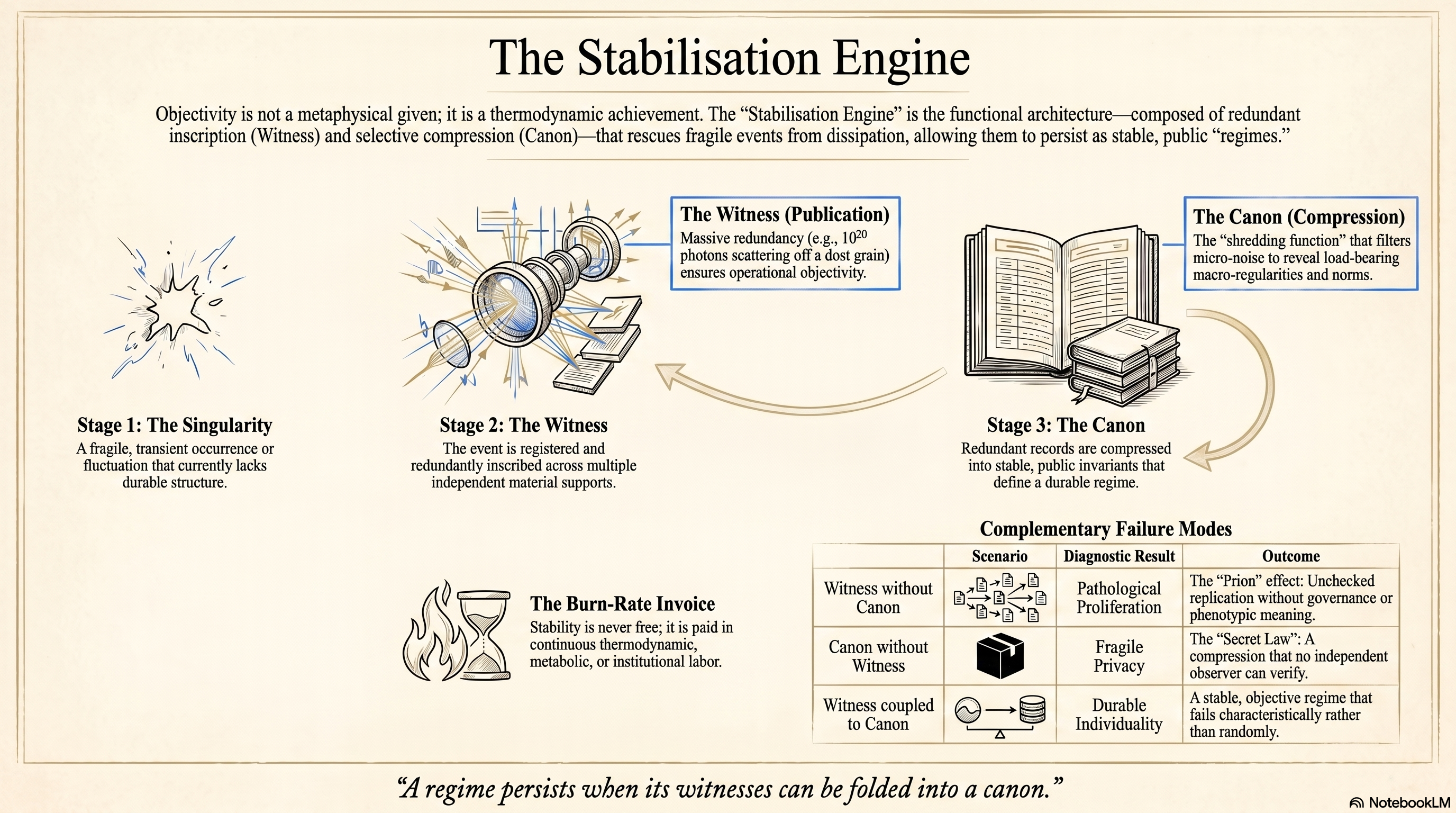
The one-sentence version
The Witness makes the individual visible to its world. Not through consciousness or record-keeping as a human practice, but through redundant environmental inscription — the mechanism by which a newly transduced individual achieves the stable, publicly accessible existence required for it to function as substrate for the next stratum.
Where the word comes from
At the physical stratum, Witness is implemented by Quantum Darwinism: a quantum system interacting with its environment produces redundant pointer-state imprints in multiple environmental fragments simultaneously. The imprints are the same across fragments and robust against individual-fragment decoherence. An observer who reads any one fragment obtains the same information about the system’s classical state — the system is witnessed by its environment, not by any single observer, and this witnessing is thermodynamically enforced rather than cognitively chosen.
The burn rate of physical Witness is W/K (watts per kelvin): the thermal coupling rate at which the system leaks its pointer-state information into environmental modes. At the biological stratum, the mechanism shifts to metabolic inscription — signalling molecules, membrane surface ligands, extracellular matrix components, and receptor architecture collectively inscribe the cell’s state into redundant copies across its local environment at a cost of kcal/day. At the institutional stratum, the mechanism is record-keeping and inscription practices at a cost of person-hours/year.
The three-stratum realisation — physical, biological, institutional — was first noticed in Chapter 6 through the dust grain / chloroplast / counting-house progression. All three rely on redundant inscription that stabilises a pointer state or functional state against perturbation, and all three have a characteristic burn rate at their stratum.
Why it matters
The Witness function solves the objectification problem: how does a fragile singularity produced by transduction become a stable object that other systems can reliably interact with? The answer is redundant inscription into the environment. An individual that is inscribed into sufficiently many environmental copies achieves robustness not by being intrinsically stable but by being publicly readable — any perturbation that would destroy the individual must simultaneously erase all its environmental imprints, and the thermodynamic cost of doing so is proportional to the number of imprints.
Without Witness, even a successful genesis event leaves nothing that other systems can interact with reproducibly. The lattice grows, but the environment has no stable record of its existence; any perturbation to the crystal is unwitnessed and therefore uncompensated. At the biological stratum, a cell that fails to inscribe its state into its local environment loses the capacity for signalling, coordination, and immune recognition — it becomes operationally invisible to the systems that would otherwise maintain it.
What it is not
Witness is not sufficient for stabilisation. A system whose environment is saturated with redundant inscription of every detail of its state has not thereby achieved durable objectivity — it has generated a flood. The Witness function produces more inscription than governance can use. What the Canon function adds is the compression that selects which inscriptions are load-bearing: which pointer states are the ones other systems will use to interact with the individual. Without Canon, Witness is noise at scale.