CONCEPT · ENTRY 021 · R2 BIOLOGICAL
Canon
The selective compression that reduces the flood of environmental inscription to a small set of load-bearing stable variables — structurally consequential forgetting that makes the Witness function useful by selecting which inscriptions govern further interaction.
- Register
- R2 biological — metabolic-closure.
- Genealogy
- Shannon 1948 · Mossio & Moreno 2010
- Appears in
- Chapter 6 — The Stabilisation Engine
- Related
- Witness · Witness–Canon Architecture · Stabilisation Engine
- What it is not
-
- Not a catalogue or archive — the Canon actively selects and discards, not merely records.
- Not lossless compression — Canon is lossy by design.
- Not arbitrary selection — which inscriptions become load-bearing is determined by the regime's governance architecture.
- Not identical with the institutional canon in any discipline — the term names a structural function, not a cultural practice.
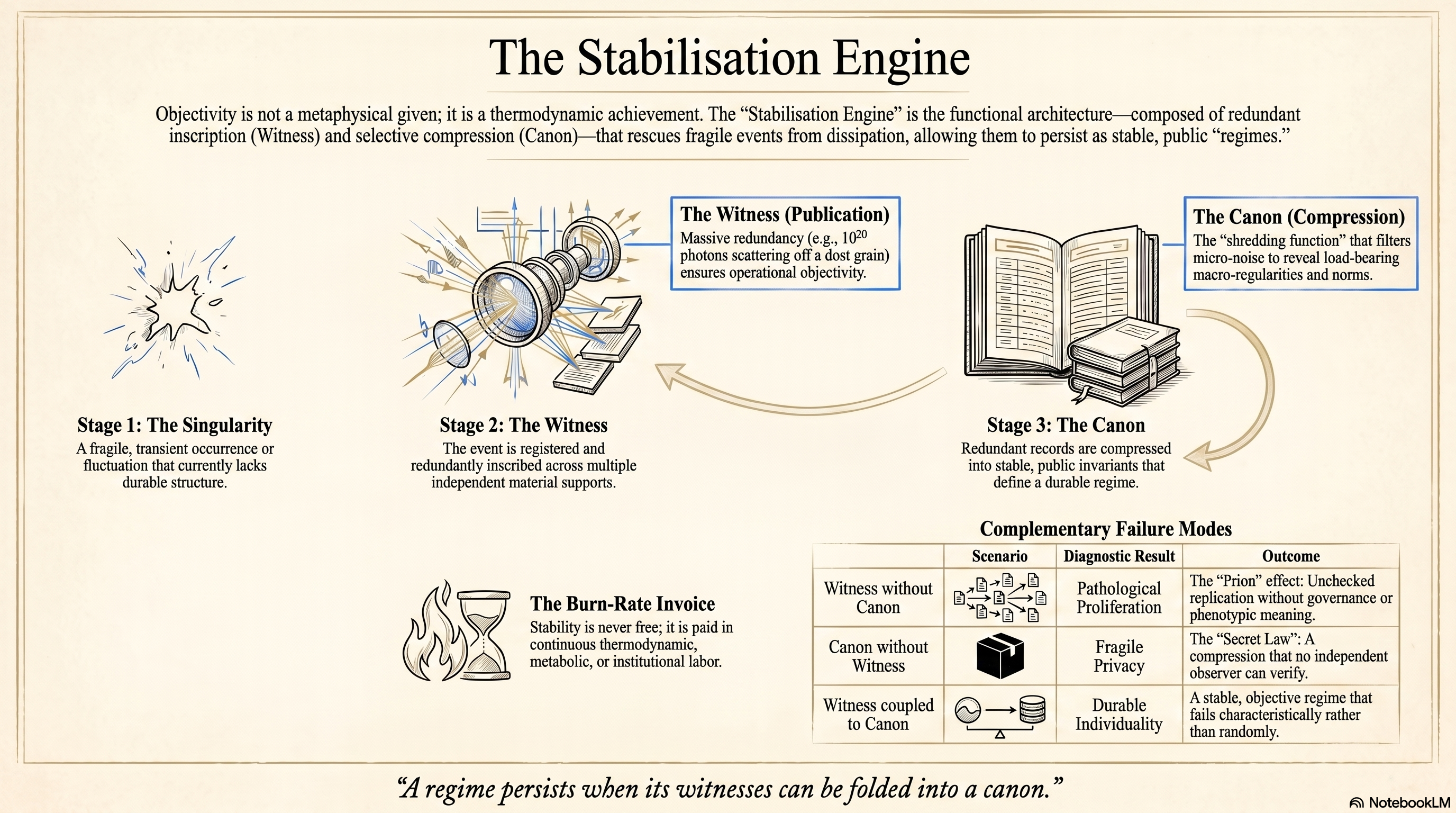
DIAGRAM
Stabilisation Engine Diagram
How newly installed regimes achieve durable objectivity through publication and compression.
The one-sentence version
The Canon is consequential forgetting. It is the selective compression that takes the flood of redundant environmental inscription produced by the Witness function and selects the small set of load-bearing variables — the pointer states, metabolic signatures, institutional categories — that will govern how other systems interact with the individual.
Where the word comes from
The term is drawn from its theological and literary usage — the selection of authoritative texts from a larger corpus — but refunctioned as a structural concept. A canon is not merely a list of approved works; it is a compression that forecloses alternatives. The selection is lossy: what is excluded from the canon is not archived for future retrieval but rendered structurally inert — inoperative for the purposes of governance, interaction, and further development.
In information-theoretic terms, the Canon function implements lossy compression of the Witness’s output. Shannon’s rate-distortion theorem guarantees that no lossless compression scheme can reduce the redundant inscription flood below its entropy — compression necessarily discards information. What the Canon adds to standard rate-distortion theory is a selection criterion: not compression to minimum description length, but compression to governance-functional variables. The discarded information is not random noise but operationally irrelevant detail.
Why it matters
Without Canon, Witness generates a problem at scale. A cell inscribed into every receptor, surface ligand, and extracellular matrix component of its environment has not thereby stabilised its existence — the environment is flooded with detail, and no governance architecture can use all of it. What makes the Witness’s output useful is the selection of which inscriptions are the ones that subsequent systems will route on.
At the physical stratum, the Canon function is implemented by decoherence-selected pointer states: not all environmental imprints are equal, and thermodynamic stability selects which states are the dominant basis vectors that environmental monitoring will converge on. At the biological stratum, the Canon is implemented by the genetic code and its regulatory architecture — not all metabolic signatures are tracked, and the regulatory network selects which ones are load-bearing for developmental and immune decision-making. At the institutional stratum, the Canon is implemented by legal, bureaucratic, and accounting categories — not all facts about a person or entity are institutionally relevant, and the selection of which facts are tracked determines which interactions are possible.
The Canon is also the mechanism of erasure. A regime that is forgotten from the canon does not merely lose influence — it loses the capacity to function as substrate for governance at the next level. Extinction from the canon is not death, but something in some ways more final: it is the cancellation of the individual as an operant in the governance network.
What it is not
Canon is not arbitrary censorship. Which inscriptions become load-bearing is determined by the governance architecture of the regime, not by fiat. The prion is the negative case: a misfolded protein that propagates its own misfolding without a canon, installing a Witness without compression — redundant inscription without selective stability. The result is runaway accumulation rather than durable objectivity. The prion exhibits Witness-without-Canon’s characteristic failure mode: the flood becomes the pathology.