ESSAY · 12 · OPENING ORIENTATION
The Symbolic Exit.
Chapter 12 explains how institutional-symbolic systems externalize answerability and make strangers governable through records, categories, and enforcement.
DIAGRAM
Symbolic Exit
Symbolic exit begins when memory, norm, and answerability leave the organism and return as public record, institution, and sanction.
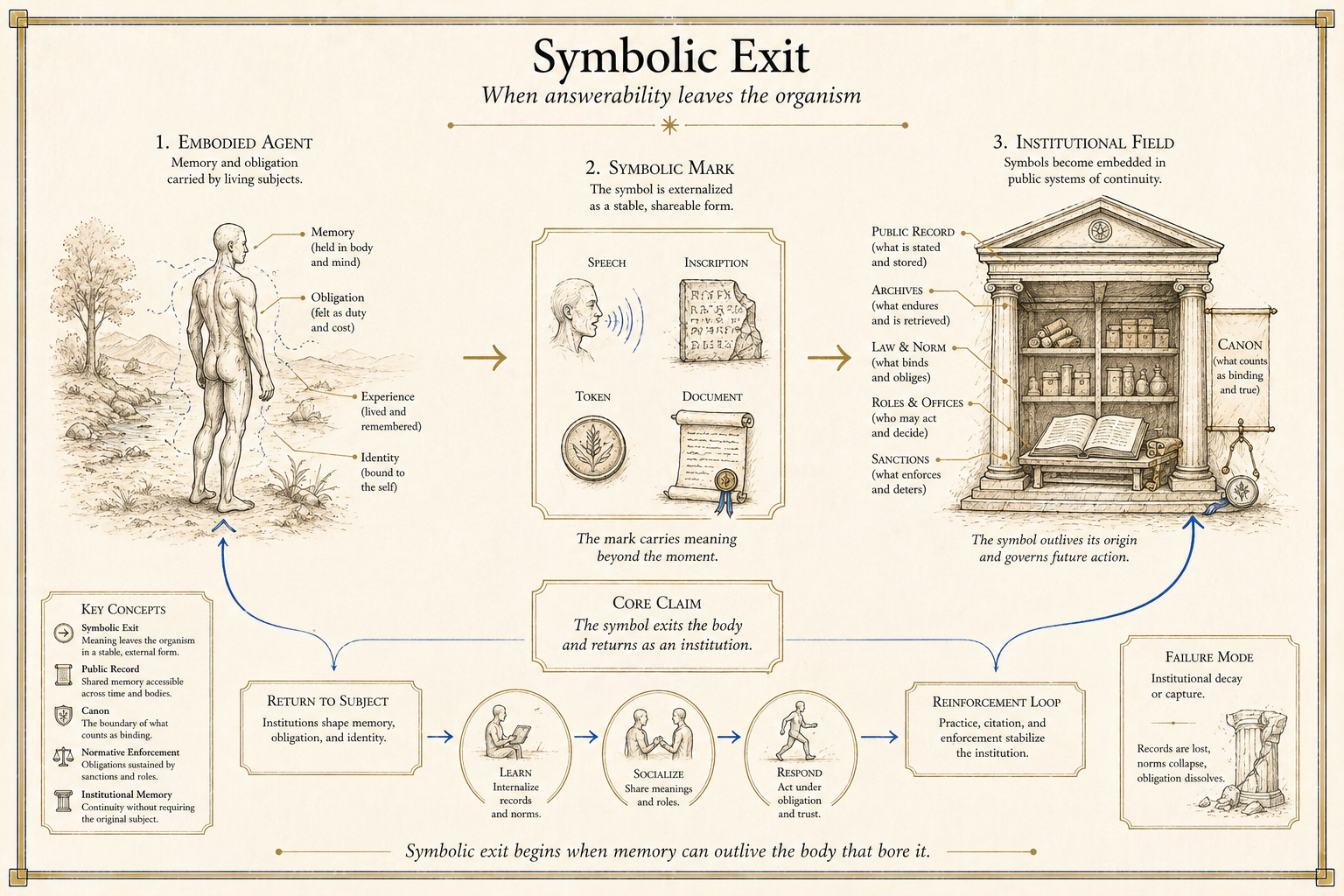
Chapter 12 — The Symbolic Exit
The problem
How can large polities hold strangers answerable to categories, rules, and witnesses none of them personally authored or personally observed? Chapter 12 answers by treating symbolic order as a real closure with its own burn rate, its own witness structures, and its own predictable failures.
The opening ordeal
The courtroom scene makes the argument concrete. A defendant wears a shirt he did not choose. Jurors are built into witnesses through procedure. Clerks, archives, HVAC systems, and public budgets all burn calories to keep one person answerable inside one institutional scene. The ordeal is not metaphorical. Symbolic order is thermodynamically subsidized all the way down.
The central operator
The central operator is the externalized answerability apparatus. Witness is built through record, testimony, and procedure. Canon is built through statute, precedent, licensure, and professional training. Replication and renormalization enter as the means by which symbolic order expands and disciplines itself across scale.
The key point is that symbols do not become real because people happen to believe in them. They become binding because institutions maintain enforcement architectures that make tokenized distinctions operationally consequential.
Key concepts
Symbolic exit names the closure by which cognition leaves the first-person frame and enters durable public token systems. Normogenesis clarifies the governance logic. Witness–canon architecture persists here in transformed form. The chapter also catalogues failure modes such as capture, sclerosis, flooding, and degradation.
What the chapter establishes
Chapter 12 establishes the sixth cognitive closure as a metabolically real, politically contested, collectively revisable stratum. It also prevents a common mistake. Because institutional norms are revisable, they are sometimes treated as somehow less real than biological ones. The chapter shows the opposite. Their reality lies in the scale, subsidy, and enforcement required to keep them binding.
This is also where the framework’s biopolitical edge becomes explicit. Symbolic order reaches the body through confinement, hunger, exposure, and managed vulnerability. The firewall between strata is real and porous.
What it hands forward
The next chapter asks what happens when a replication technology of unprecedented throughput enters a symbolic order whose canon and renormalization infrastructures were built for much slower rates. The AI moment is not treated as magic or apocalypse, but as a structural perturbation of a real stratum.
Read next
Read The Sixth Transduction for the framework’s diagnosis of LLMs and symbolic authority.
Or move through Symbolic Exit, Normogenesis, and Sixth Transduction to follow the contemporary turn.
- Essay
- 12 · The Symbolic Exit — opening orientation, ~6 min
- Authored
- April 2026
- Register focus
- R4 institutional.
- Source
- Chapter 12 — The Symbolic Exit