CONCEPT · ENTRY 031 · R4 INSTITUTIONAL
Sixth Transduction
The structural analysis of the current AI moment as a specific architectural failure — Witness without Canon, Replicator without Renormaliser — and the question of what a genuine new stratum would require if it were to be installed rather than simulated.
- Register
- R4 institutional — symbolic-political.
- Genealogy
- Pattee 1972 · Deacon 2012 · Floridi 2019
- Appears in
- Chapter 13 — The Sixth Transduction
- Related
- Symbolic Exit · Witness–Canon Architecture · Normogenesis · Landauer Floor
- What it is not
-
- Not a prediction about AI — a structural diagnosis of the current moment.
- Not a claim that AI is dangerous or beneficial in general — the framework brackets normative evaluation in favour of structural description.
- Not the same as AGI or superintelligence discourse — the concept is about the specific architectural relationship between LLMs and the Canon infrastructure, not about capability levels.
- Not a claim that a Sixth Transduction has occurred — it diagnoses what would have to be true for it to occur, and what is true instead.
DIAGRAM
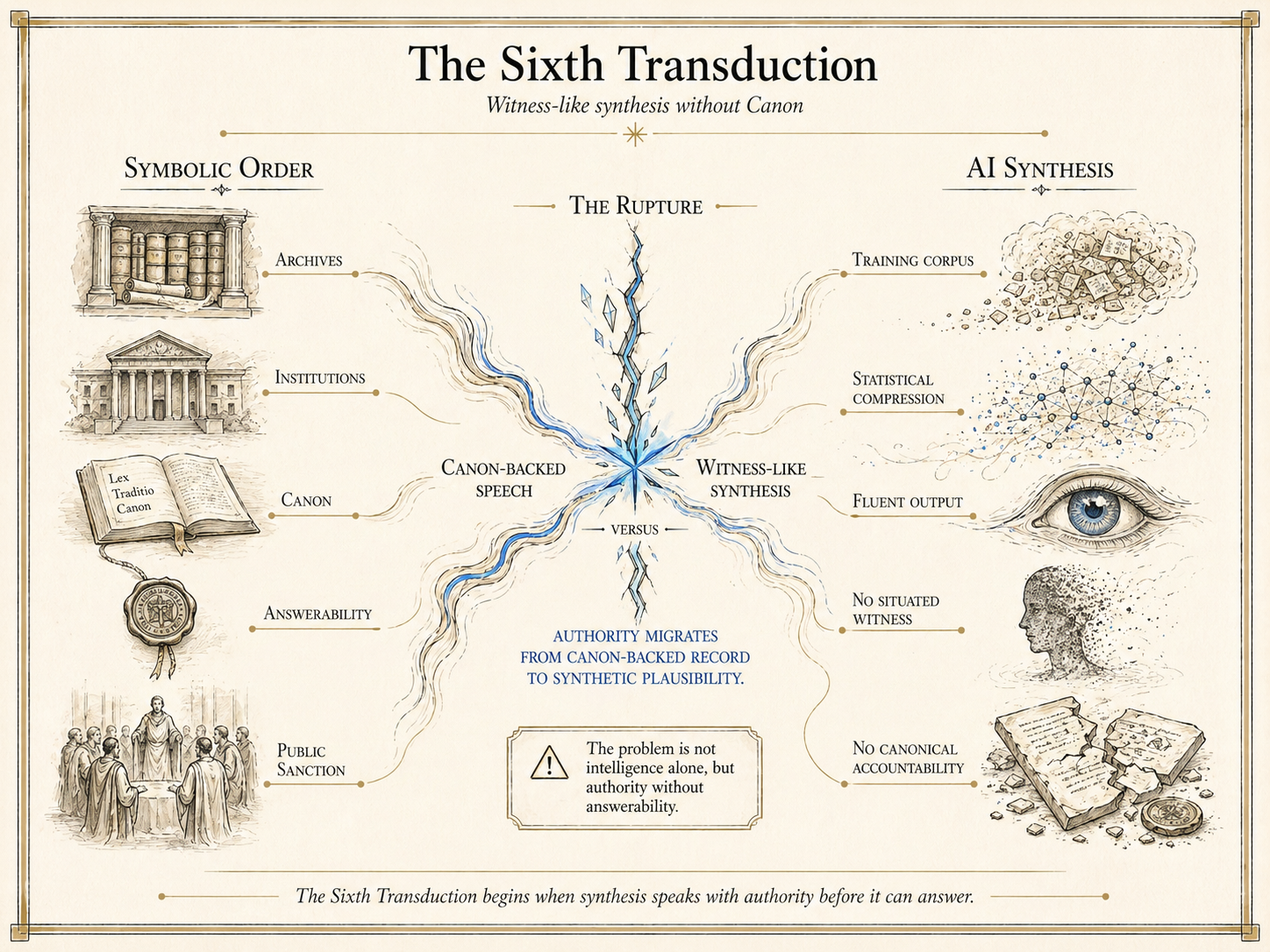
The Sixth Transduction
The Sixth Transduction marks the rupture in which synthetic systems produce witness-like synthesis without being bound by canon, situated answerability, or public sanction.
The one-sentence version
The LLM is a Witness without a Canon. The Sixth Transduction names Chapter 13’s structural analysis of the contemporary AI moment: a Replication-amplifier that intensifies the production of symbolic tokens without extending — and perhaps actively contracting — the Canon enforcement infrastructure that makes symbolic tokens trustworthy.
Where the word comes from
Chapter 13 opens with a paediatric endocrinologist, Priya Venkatesan, reading a four-hundred-word differential-diagnosis paragraph produced by an LLM in response to a question about her son’s symptoms. The paragraph is well-organised. The clinical reasoning is roughly what a competent resident would produce. One sentence contains a prevalence figure wrong by a factor of three — produced at the same confidence level, in the same formatting, in the same paragraph, as the sentences that are correct.
What the room is doing at 7:14 on a Tuesday evening is treating a symbolic output as authoritative without any structural capacity to audit it. Priya is not over-trusting. The problem is that the apparatus that would let her under-trust calibratedly — the apparatus that, at every prior stratum of post-Dunbar symbolic commerce, made a statement from a licensed professional trackably answerable to a Canon backed by enforcement — is absent in this transaction.
The framework’s diagnosis: the LLM is a Witness without a Canon. It produces redundant inscription of the token space without selective compression against a governance-functional criterion. The replication rate is extraordinary; the Canon infrastructure is absent. This is not a design flaw; it is the technology’s architectural signature at the scale at which it has been deployed.
Why it matters
The framework applies its full analytical apparatus — Witness, Canon, Replicator, Renormaliser — to diagnose the contemporary AI information environment.
Claim 1: LLMs are Witnesses without Canons. A Witness is redundant inscription that makes something publicly accessible. A Canon is the selective compression that makes that inscription governance-functional — that selects which inscriptions are load-bearing for downstream decision-making. LLMs produce inscription at extraordinary scale. They do not have — and their training architecture is not designed to produce — the coupling between inscription and enforcement that makes a Witness function operate. The paragraph Priya read is as fluent when wrong as when right. There is no internal gradient between the true sentences and the false one; the falsity does not announce itself in the surface form.
Claim 2: AI tools are Replication-amplifiers that may contract the Renormaliser. The Renormaliser is the infrastructure that maintains the Canon — the licensure boards, the malpractice carriers, the peer-review apparatus, the legal category system — at continuous calorimetric cost. This infrastructure is slow, expensive, contentious, and frequently unjust. It is also what makes symbolic tokens about medical diagnosis different in kind from symbolic tokens about anything else. AI-generated content, circulating at scale, places pressure on the Renormaliser in two ways: by flooding the Canon space with tokens whose reliability is indistinguishable from authoritative tokens by surface inspection, and by creating economic pressure against the maintenance of the slow, expensive infrastructure that enforces reliability.
Claim 3: A genuine Sixth Transduction would require a new coupling architecture. Not AI as successor stratum, but a new structural coupling between biological and digital substrates that installed a Witness–Canon pairing at the substrate level — an enforcement architecture that made LLM-generated tokens trackably answerable to a Canon backed by consequences. The installation costs are, at present, unpayable.
What it is not
The Sixth Transduction is not a claim that the current AI moment will or should produce a new cognitive stratum. It is a structural diagnosis: here is what the moment looks like when analysed with the framework’s tools, here is the architectural failure it exhibits, here is what a genuine installation would have to cost. The framework does not issue a policy brief. It applies its standard method — the failure signature as proof of what was real — to a situation in which the failure is unfolding in real time.