CONCEPT · ENTRY 030 · R4 INSTITUTIONAL
Symbolic Exit
The sixth cognitive closure — the institutional-symbolic stratum in which tokens become authoritative constraints on their own realisation, enforced by Canon architectures (licensure, legal category, record) that are collectively revisable but maintained at continuous calorimetric cost across the polity.
- Register
- R4 institutional — symbolic-political.
- Genealogy
- Pattee 1972 · Foucault 1975 · Searle 1995 · Deacon 2012
- Appears in
- Chapter 12 — The Symbolic Exit
- Related
- Offline Mind · Normogenesis · Witness–Canon Architecture · Sixth Transduction
- What it is not
-
- Not language in general — the Symbolic Exit is specifically about the institutional enforcement architecture that makes symbols authoritative, not just communicative.
- Not culture or meaning in general — the focus is on the structural enforcement mechanisms (licensure, legal category, record, sanction) that give symbols binding force.
- Not a claim that symbols are arbitrary — they are collectively revisable, but their revision is contested and enforced, not arbitrary.
- Not identical with Pattee's epistemic cut — it extends that concept to the institutional enforcement level.
DIAGRAM
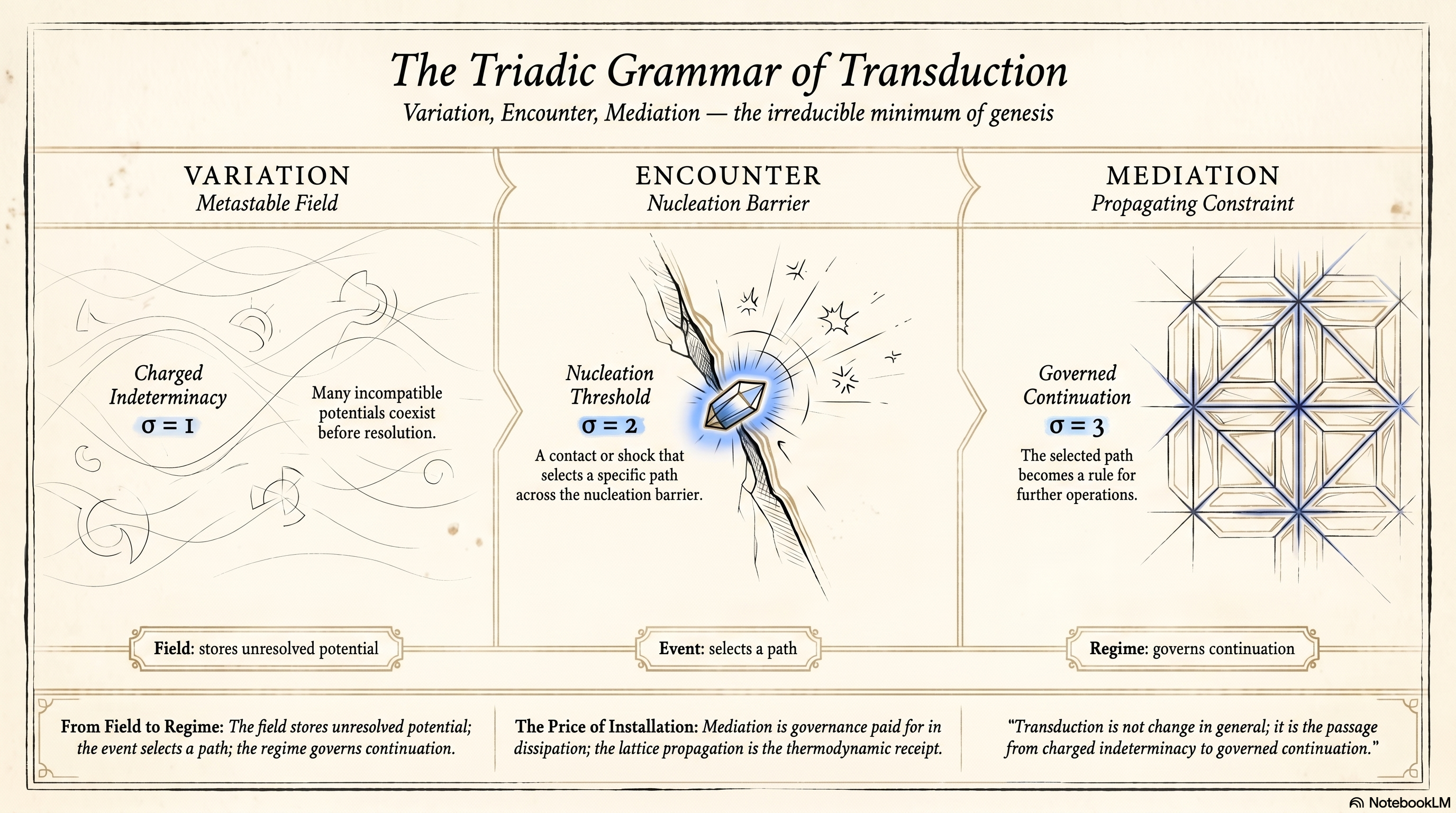
Triadic Grammar
The minimum logical structure for any act of meaning-making: A thing, a sign, and an interpreter. This replaces the dyadic subject-object split with a functional triad.
The one-sentence version
Everything in the courtroom is burning calories to hold one person in place. The Symbolic Exit names the institutional-symbolic stratum — the sixth cognitive closure — in which tokens become authoritative constraints on their own realisation, and the authority is maintained at continuous calorimetric cost by enforcement architectures distributed across the polity.
Where the word comes from
Chapter 12 opens in a courtroom. The defendant is wearing a shirt he did not choose. His lawyer chose it — pale blue, no tie, collar pressed — because every detail of the defendant’s visible surface has been engineered against the Canon of affect that this particular jury has been culturally trained to read. The stenographer’s fingers burn calories. The HVAC system burns electricity. The archives burn storage. The jurors have donated a day’s wages to the apparatus. The defendant’s own eighty watts of metabolic output are being shaped, at every moment, by the institutional architecture that has jurisdiction over his body.
This is the Symbolic Exit in its paradigmatic form: the institutional-symbolic stratum as an enveloping closure that reaches through cognition into biological survival. The enforcement is not metaphorical. The state’s ultimate sanctions — starvation, confinement, the management of mortality risk — are the ground-floor enforcement mechanism of the symbolic stratum, and their existence is not an exception to institutional normativity but its structural necessity. An enveloping closure that cannot ultimately reach the substrate it governs is not a closure — it is a request.
The term exit names the structural achievement: the organism’s cognitive processing exits the first-person frame and enters a coordinate system defined by tokens, categories, and records that persist independently of any individual mind. The exit is not transcendence; it is envelopment. The symbolic stratum folds around the cognitive stratum just as the cognitive stratum folds around the biological one.
Why it matters
The Symbolic Exit installs what the lower strata could not: collective revisability. At R2, norms are non-revisable (no procedure for negotiating with thermodynamics). At R3, norms are partially revisable through learning (policies can be updated, but architectural constraints cannot be abolished without loss of competence). At R4 — the symbolic stratum — norms are collectively revisable via procedure and sanction. This is the revisability gradient’s fourth position: the stratum at which enforcement is political rather than metabolic.
The revocability is real but limited. Voir dire is the procedure by which the apparatus builds a Witness that did not exist before: sixty-four citizens selected essentially at random, processed over a day into twelve licensed Witness-instruments, calibrated to a specification that both sides of the case have agreed is minimally acceptable. The jurors are not asked whether they consent. They are told that twelve people they do not know will be built into a Witness against the defendant, and that the construction is the thing that permits the state to hold him answerable at all.
The Symbolic Exit’s burn rate is the distributed calorimetric expenditure across the polity that maintains the Canon: the wages of every clerk, bailiff, archivist, and barber employed by the system; the electricity of every data centre archiving the indictments; the time of every juror who donates a day’s wages to keep the Witness function solvent. The canonical fact of modern governance is that the Canon infrastructure costs more than any individual can see, and that the cost is paid by aggregated metabolic subsidy from the governed population.
What it is not
The Symbolic Exit is not a cynical theory of power. It is a structural analysis: the institutional-symbolic stratum is a genuine closure with a real burn rate, real failure modes, and real revisability — but the revisability is politically contested, and the question of who revises the norms is never merely procedural. The framework’s contribution is not to take a side in that contestation but to show what kind of thing it is: a structurally generated conflict internal to a closure that manages instability by creating new instability of a different kind.