ESSAY · 13 · OPENING ORIENTATION
The Sixth Transduction.
Chapter 13 applies the full apparatus to the AI moment and argues that current language models amplify symbolic replication without installing the canon they would need to count as a new stratum.
DIAGRAM
The Sixth Transduction
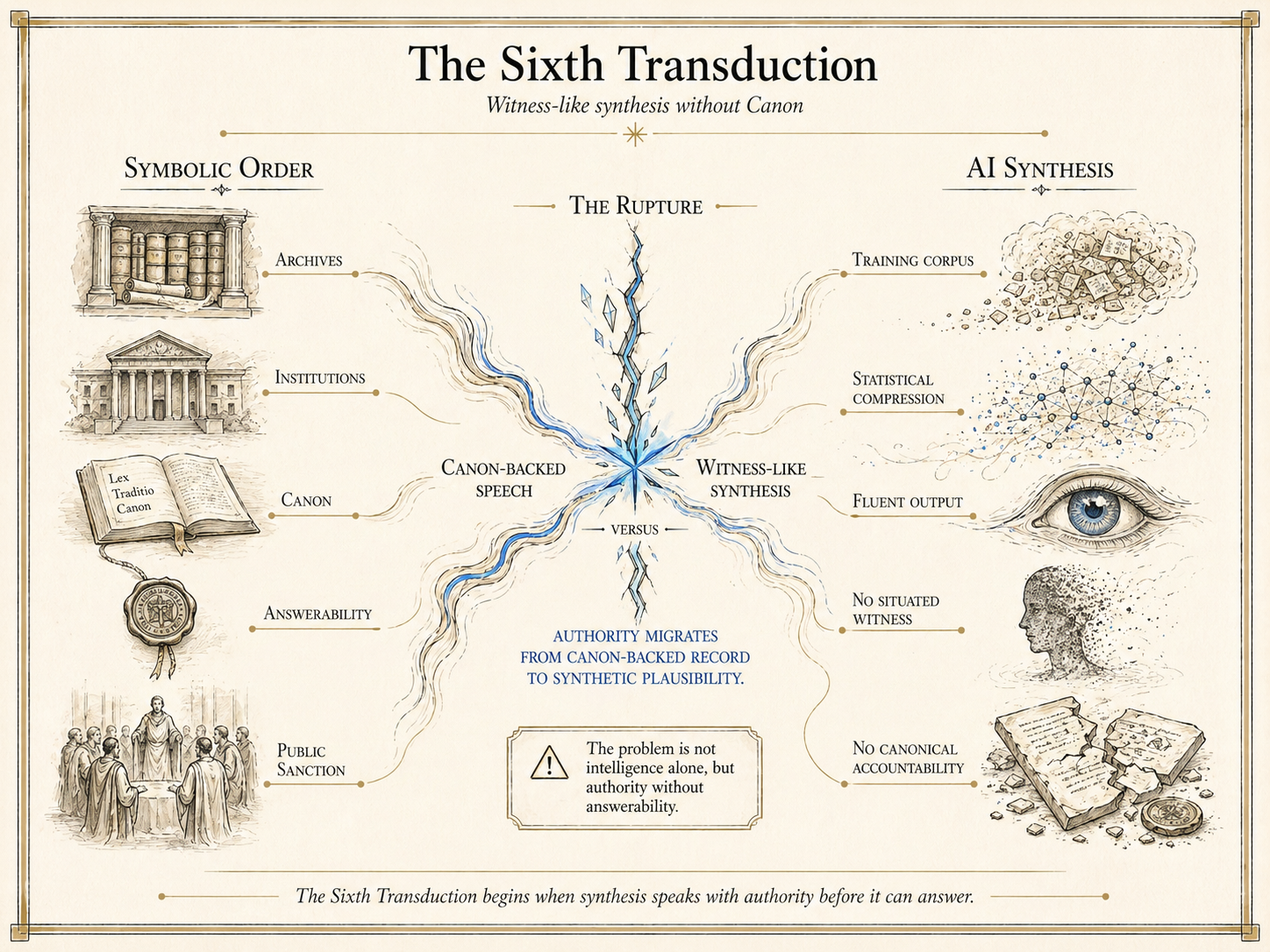
The Sixth Transduction marks the rupture in which synthetic systems produce witness-like synthesis without being bound by canon, situated answerability, or public sanction.
Chapter 13 — The Sixth Transduction
The problem
Do large language models constitute a new cognitive stratum, or are they high-throughput operators inside a stratum whose enforcement architecture they do not maintain? Chapter 13 answers by running the framework’s full diagnostic apparatus against the contemporary AI scene.
The opening ordeal
The chapter opens in a kitchen, not a lab. A physician reads an LLM-generated paragraph about her son’s symptoms. Much of it is plausible. One part is wrong. The paragraph still lowers fear because it has the surface form of authoritative reasoning while lacking the institutional apparatus that would let its authority be priced with discipline.
The ordeal matters because it is ordinary. The problem is not spectacular superintelligence. It is everyday symbolic uptake without canon.
The central operator
The central operator is a negative diagnosis. Current LLMs are witnesses without canons. They publish symbolic continuations at immense scale, but they do not install the enforcement, accountability, or substrate-coupled consequence structures that would make those continuations canonical in the framework’s sense.
From there the chapter makes a second move. These systems are replication amplifiers operating inside symbolic order while depending parasitically on the slower and more expensive renormalization infrastructures that symbolic order already had. That mismatch is the real contemporary crisis.
Key concepts
Sixth transduction names both the question and the verdict. Symbolic exit provides the stratum being perturbed. Witness–canon architecture supplies the missing coupling. The chapter also foregrounds cost-ratio asymmetry between cheap replication and expensive correction.
What the chapter establishes
Chapter 13 establishes that present AI systems are not successors to the symbolic stratum. They are accelerants and parasites within it. The chapter is not anti-technology in a rhetorical sense. It is diagnostic. A new stratum would require a new substrate-level coupling in which costs of error, authority, and maintenance were jointly borne. Current systems do not meet that condition.
The chapter also turns the framework reflexively on itself. This book too enters a symbolic environment where canon cannot be assumed. Its own uptake becomes part of the test.
What it hands forward
The chapter closes rather than handing forward in the ordinary way. Its forward motion is recursive. The framework has now reached the present and must survive there under the same conditions it diagnosed. What remains is reader uptake, community formation, and the longer audit of whether the book’s claims install any durable canon of their own.
Read next
Return to The Symbolic Exit to review the stratum this chapter diagnoses, or circle back through Witness–Canon Architecture and Sixth Transduction to track the negative verdict more directly.
- Essay
- 13 · The Sixth Transduction — opening orientation, ~6 min
- Authored
- April 2026
- Register focus
- R4 institutional.
- Source
- Chapter 13 — The Sixth Transduction