ESSAY · 06 · OPENING ORIENTATION
The Stabilisation Engine.
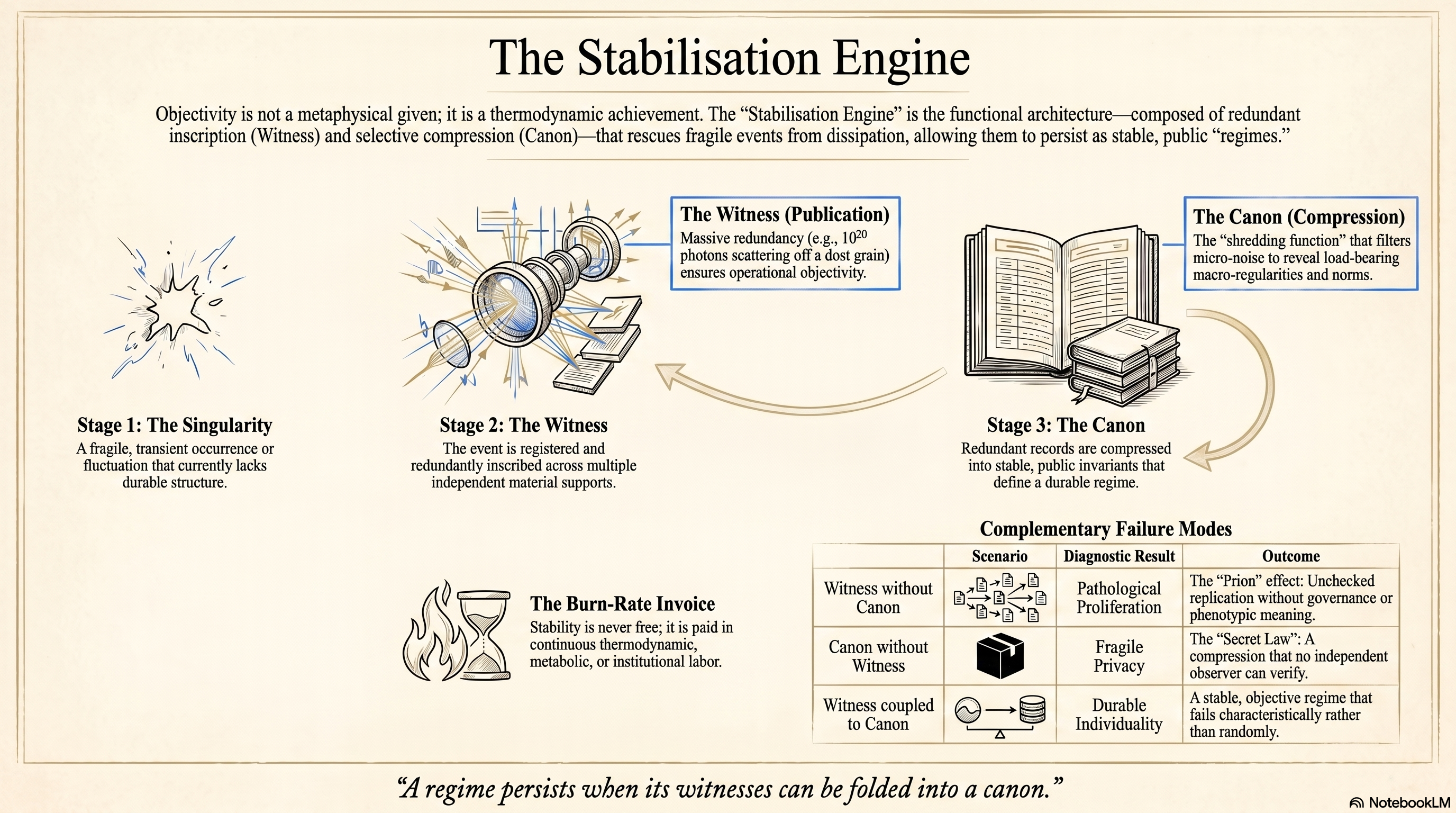
Chapter 6 explains how a newly installed regime becomes durable through the coupling of redundant inscription and selective compression.
DIAGRAM
Stabilisation Engine Diagram
How newly installed regimes achieve durable objectivity through publication and compression.
Chapter 6 — The Stabilisation Engine
The problem
Genesis can install a regime, but installation is not persistence. Chapter 6 asks how something newly produced by transduction survives its own fragility long enough to become a stable fact in the world.
The opening ordeal
The ordeal is simple and merciless. A newly formed closure meets noise, entropy, and disturbance immediately. If nothing lifts it into durable objectivity, the regime dissolves almost as soon as it appears. The question is not whether it was real for a moment. The question is what makes that reality last.
The central operator
The central operator is the Witness–Canon architecture. Witness names the redundant inscription of a pattern into its environment or support structure. Canon names the selective compression that determines which of those inscriptions are load-bearing. Together they produce a form of persistence stronger than mere local stability. The regime becomes publicly available, reproducibly legible, and therefore governable.
The chapter’s deeper claim is that persistence is not just more of genesis. It is a distinct architectural achievement. A regime can be born without yet being stabilized.
Key concepts
Witness and canon are the headlining terms. Their coupling is formalized as the witness–canon architecture. The stabilisation engine names the diagnostic form of this architecture. The chapter also prepares the closure-crisis lemma by showing that durable objectivity increases coupling density and therefore increases the likelihood that within-regime governance will eventually saturate.
What the chapter establishes
Chapter 6 establishes the architecture of durability. A regime persists not because it simply sits in a favorable basin, but because it is redundantly inscribed and selectively compressed in ways that make it robust to disturbance. That structure scales. Dust grains, chloroplasts, and institutions do not share mechanism, but they do share the formal problem of stabilizing what would otherwise remain too fragile to matter.
The chapter also makes failure informative. Witness without canon floods a system with useless inscription. Canon without witness compresses unstable or underpublished signal. Durable objectivity requires the pair.
What it hands forward
Once stable individuals accumulate, they crowd one another. Chapter 7 takes up the resulting problem. When durable regimes saturate the coordination space they were built to manage, what distinguishes the rare case where a higher-order closure is installed from the far more common cases of plateau, fragmentation, or collapse?
Read next
Read The Stratification Engine for the chapter that turns persistence pressure into stratum formation.
Or move through Witness, Canon, Witness–Canon Architecture, and Stabilisation Engine for the chapter’s main machinery.
- Essay
- 06 · The Stabilisation Engine — opening orientation, ~6 min
- Authored
- April 2026
- Register focus
- R2 biological.
- Cites
- Witness · Canon · Witness–Canon Architecture · Stabilisation Engine
- Source
- Chapter 6 — The Stabilisation Engine