ESSAY · 07 · OPENING ORIENTATION
The Stratification Engine.
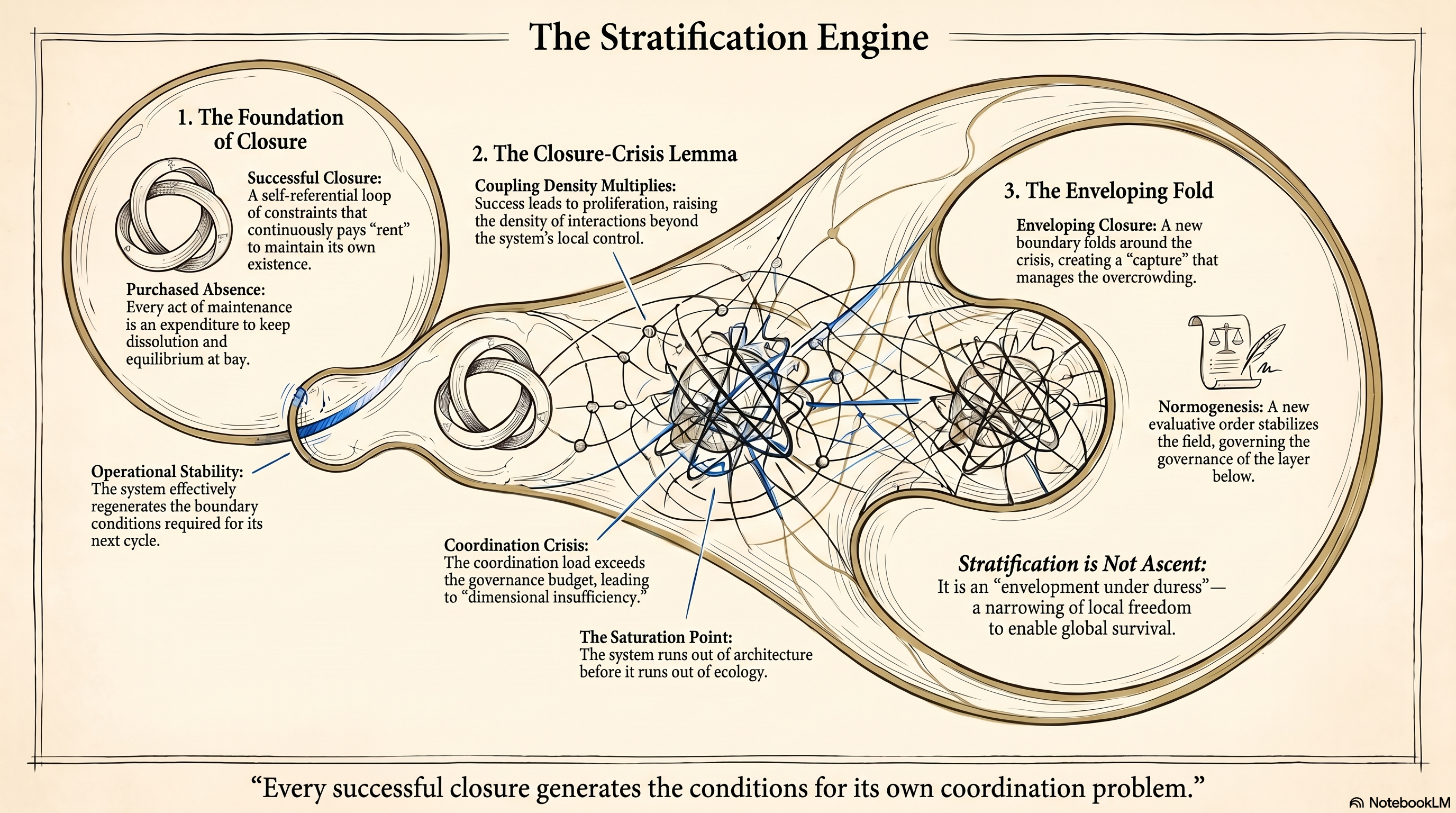
Chapter 7 explains why successful closures generate coordination crises and how rare envelopment events install a genuinely new stratum.
DIAGRAM
Stratification Engine Diagram
The transition from successful persistence to crisis and rare envelopment.
Chapter 7 — The Stratification Engine
The problem
A stable regime can persist, proliferate, and even become dense without creating a new level. Chapter 7 asks what distinguishes genuine stratification from mere continuation under heavier load.
The opening ordeal
The chapter’s governing image is not ascent but crowding. Bunk beds appear because the room can no longer house the bodies it already contains. Nuclei, nervous systems, and institutions are not monuments to increasing grandeur. They are cramped solutions to coordination crises produced by earlier success.
The central operator
The central operator is the closure-crisis lemma culminated in the stratification engine. Successful stabilisation increases coupling density. Coupling density raises coordination burden. Once the burden exceeds what the incumbent regime can absorb, crisis becomes structurally expectable. Most crises end badly or inertly. The rare case is envelopment. A new closure folds around the prior one, taking its constraints as material for governance.
The chapter operationalizes this through four tests. Genuine stratification shows a distinctive breakdown signature, supports constitutive intervention across levels, imposes dependency of the lower regime on the higher governance, and exhibits a specific revisability profile.
Key concepts
Closure-crisis lemma names the pressure law. Stratification engine names the diagnostic form of successful envelopment. Normogenesis names the installed governance that follows. The revisability gradient distinguishes biological, cognitive, and institutional norms without flattening them into one kind of constraint.
What the chapter establishes
Chapter 7 establishes that strata are exceptions, not defaults. Plateau, collapse, parasitism, and fragmentation are the normal outcomes. Stratification is the rare case where governance becomes structurally necessary and is successfully installed.
That claim matters because it blocks the later cognitive sequence from reading like a ladder of progress. Each new fold is a desperate answer to a crisis created by the previous fold’s success.
What it hands forward
The cognitive sequence begins here, but Chapter 8 has a special burden. It must demonstrate the full analytic template in the cleanest possible case before later chapters are allowed to let parts of that template go implicit. The first cognitive closure is therefore shown at tissue scale where the burn rate, witness, canon, and failures can be most directly seen.
Read next
Read The Bioelectric Governor for the first full demonstration of a cognitive closure in vivo.
Or move through Closure-Crisis Lemma, Stratification Engine, and Normogenesis to stay with the chapter’s operators.
- Essay
- 07 · The Stratification Engine — opening orientation, ~6 min
- Authored
- April 2026
- Register focus
- R3 cognitive.
- Source
- Chapter 7 — The Stratification Engine