ESSAY · 01 · OPENING ORIENTATION
The Hard Problem of Grounding.
Chapter 1 installs the book's realist wager: meaning, reference, and theoretical contact do not float above the world, but arise as materially instantiated structural relations whose reality can be tested by the conditions under which they fail.
DIAGRAM
The Grounding Problem
The hard problem of grounding asks: how do physical substrates acquire semantic content? Neither pure mechanism nor pure intentionality solve the binding between mind and world.
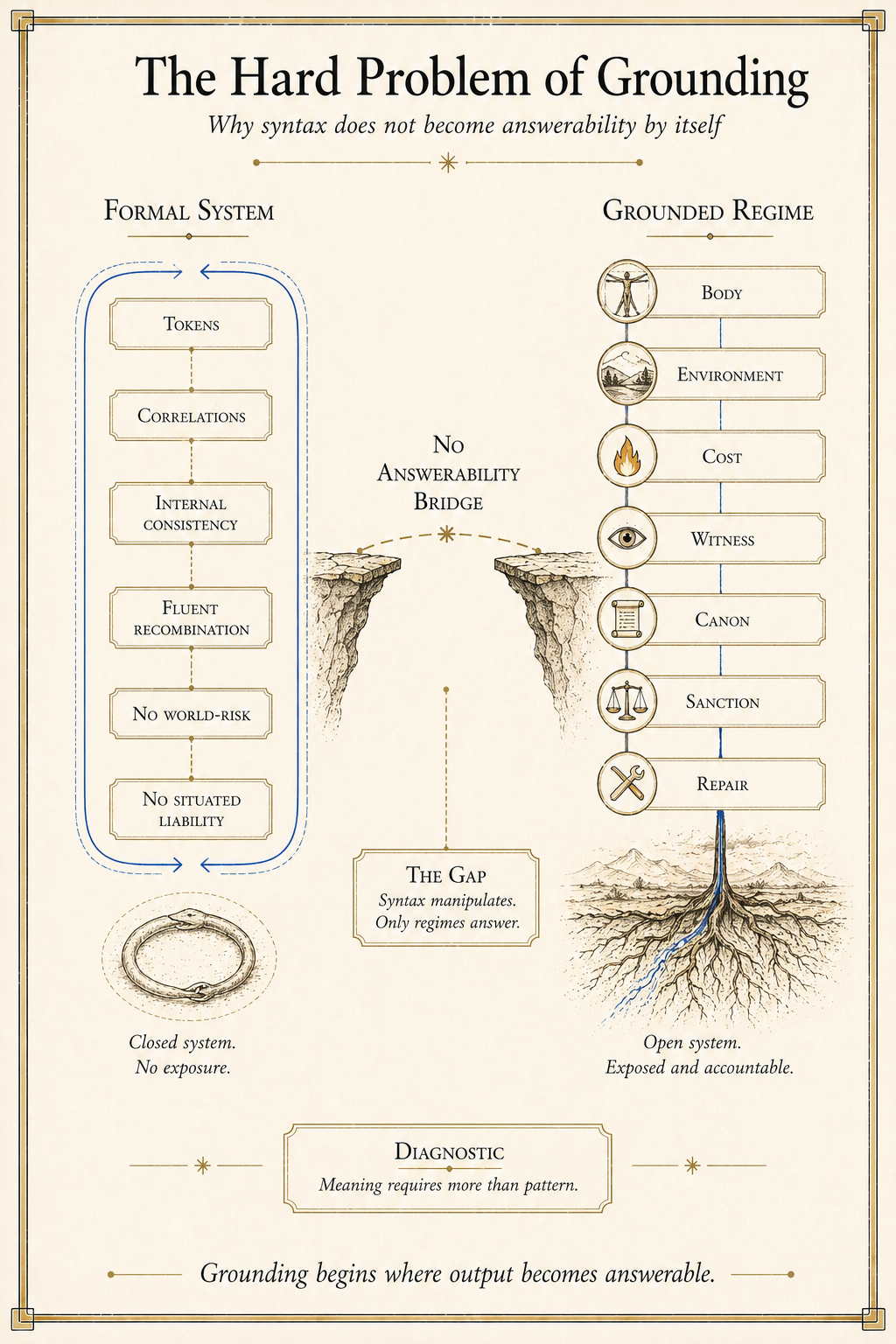
Chapter 1 — The Hard Problem of Grounding
The problem
The book opens by refusing an easy split. If meaning is only a human projection, then theory never really reaches the world. If meaning is reduced to particle descriptions, then the specific structures theories name disappear into an inventory too fine-grained to explain anything. Chapter 1 frames this as the hard problem of grounding: how can a claim, concept, or theoretical operator genuinely touch reality without appealing either to a ghostly representational layer or to a flattening materialism that explains contact by abolishing the thing that made contact worth naming?
The chapter’s wager is realist but not naive. It does not say that words mirror the world. It says that some structured achievements in the world are real enough that theory can succeed by tracking them, and fail by missing them.
The opening ordeal
The ordeal here is philosophical before it becomes biological or thermodynamic. Rival ontologies compete to explain how concepts latch onto reality, and most of them solve the problem by erasing one side of it. Pure constructivism preserves discourse but loses the world. Flat physicalism preserves matter but loses regime-specific structure. The chapter insists that neither move is good enough, because the rest of the book will need a realism strong enough to talk about levels, closures, and failures without pretending they are either supernatural or merely convenient descriptions.
What matters is not having a theory about contact. It is identifying the conditions under which contact can be said to obtain at all.
The central operator
The chapter’s central operator is compositional immanence. The claim is that content is not a detached representation standing over against the world, but a materially instantiated structural relation within it. A theory contacts reality when its operators are answerable to real patterns and real failures. In this framework, grounding is established through contact conditions: the world pushes back, not by giving us a perfect mirror, but by enforcing constraints on what can successfully be said, built, maintained, or navigated.
That move is decisive for everything that follows. Once the framework treats contact as a matter of structurally instantiated relations rather than mental pictures, later chapters can ask whether a level is real, whether a closure is operative, and whether a norm is binding without changing metaphysical vocabulary at every step.
Key concepts
The load-bearing concepts are already visible even before the later machinery arrives.
Compositional immanence names the realist stance. Rival ontologies names the field of rejected alternatives. Contact conditions names the test for whether an operator is real rather than merely useful. Ontogony is seeded here as the claim that being is generated and maintained, not simply found ready-made.
The chapter also sets up the book’s refusal of flat physicalism, though the full argument against it waits for Chapter 2. The point is not that matter is unreal. It is that matter described without priced structure cannot explain why some organizations become binding realities while others do not.
What the chapter establishes
Chapter 1 establishes the book’s permission structure. It earns the right to talk about real structure above the microphysical floor without invoking transcendence. It also sets a hard standard: no later claim about levels, cognition, institutions, or AI can simply be asserted. Each one will have to show how it satisfies contact conditions and what kind of failure would count against it.
This is why the chapter matters even though its drama is quieter than the chapters that follow. Without it, the staircase of strata would look like metaphor. With it, the staircase can be treated as a claim about reality that stands or falls by the world’s own constraints.
What it hands forward
What Chapter 1 hands forward is not yet a mechanism but a criterion. Later chapters will turn that criterion into thermodynamic accounting, cessation signatures, and crisis-driven stratification. But the basic demand is already fixed: if a regime is real, there must be a way for its reality to matter in the world and a way for its absence to show up when the regime fails.
Chapter 2 takes exactly that demand and hardens it. If grounding is real, it must be paid for by finite observers embedded in matter. The next move, then, is to ask what observation, discrimination, and maintained order cost.
Read next
Read The Demon’s Unpaid Bill for the thermodynamic version of the grounding problem.
Or step sideways into Ontogony, Transduction, and Flat Physicalism to see the first layer of the conceptual lexicon.
- Essay
- 01 · The Hard Problem of Grounding — opening orientation, ~5 min
- Authored
- April 2026
- Register focus
- R1 field.
- Cites
- Ontogony · Transduction · Flat Physicalism
- Source
- Chapter 1 — The Hard Problem of Grounding