CONCEPT · ENTRY 012 · R1 FIELD
Flat Physicalism
The thesis that higher-level regularities are merely epistemic symptoms of finite-observer limitations — that macrostates are interaction-constituted equivalence classes with no ontological depth beyond the microphysical state they supervene on.
- Register
- R1 field — pre-individual.
- Genealogy
- Hemmo & Shenker 2012 · Laplace 1814 · Maxwell 1867
- Appears in
- Chapter 2 — The Demon's Unpaid Bill
- Related
- Finite Observer · Landauer Floor · Constitutive Dissipation · Ontogony
- What it is not
-
- Not the same as physicalism in general — ontological flatness is a shared premise, not the target.
- Not a strawman — flat physicalism is the most sophisticated contemporary form of the Demon wager.
- Not refuted by pointing to emergence — the response must be thermodynamic, not conceptual.
- Not equivalent to reductionism as such, which need not claim that levels are merely epistemic.
DIAGRAM
Flat Physicalism
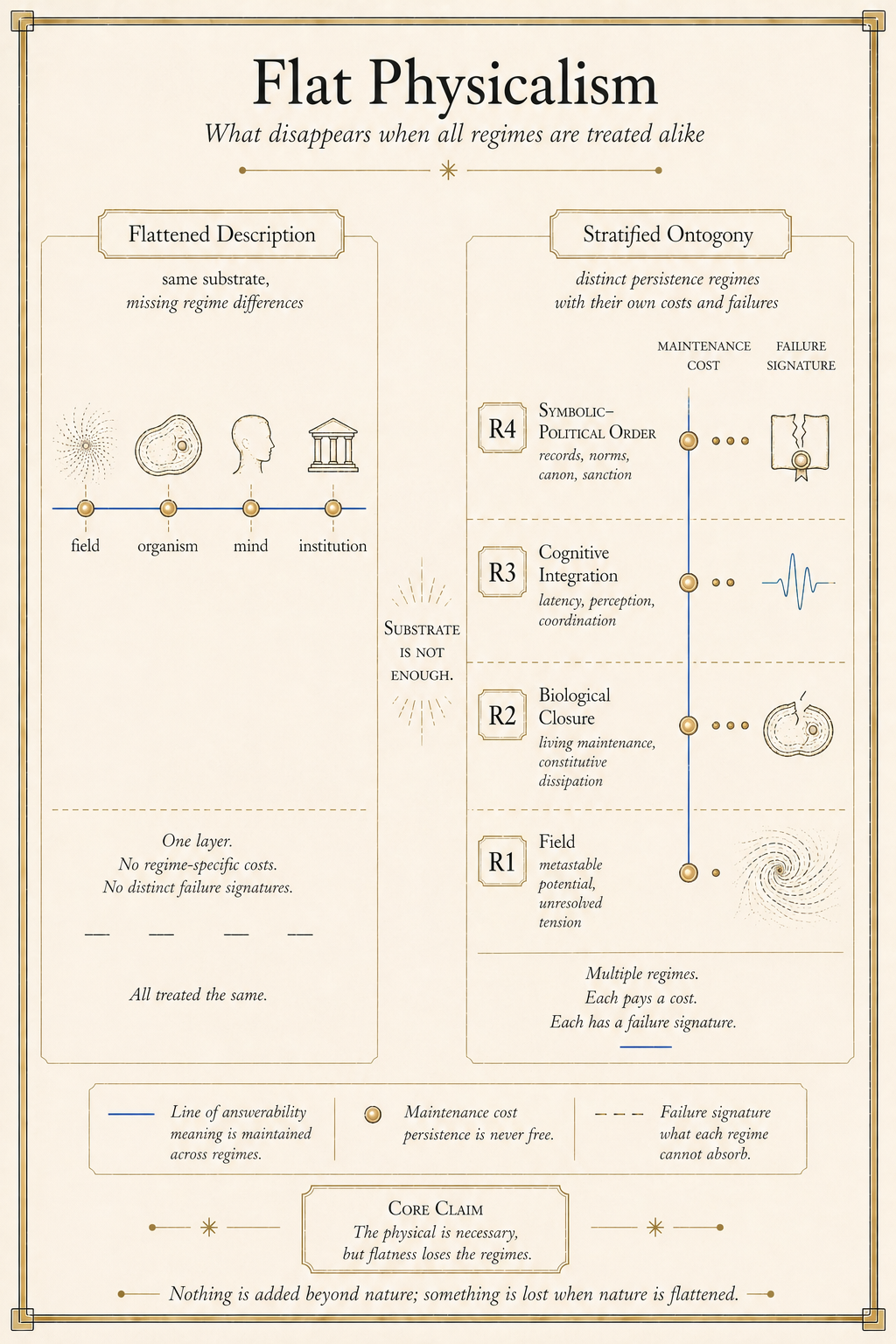
The Laplacian wager that macrostates are pure epistemic shorthand — and the thermodynamic bill it cannot pay.
The one-sentence version
Flat physicalism is the thesis that higher levels owe everything to lower ones and add nothing to reality. Macrostates are real enough to track, but their reality is a symptom of our finitude — from the Demon standpoint, the full microstate is all there is, and macroscopic regularities dissolve into it without remainder.
Where the word comes from
The most careful contemporary formulation is Hemmo and Shenker’s (2012) programme, which holds that macrostates are equivalence classes carved out by the physical couplings of finite observers — interaction-constituted, not observer-independent. The ontology bottoms out, without remainder, in micro-configurations and their dynamics. Higher-level regularities are genuine and indispensable, but their indispensability is a symptom of our finitude, not a mark of ontological depth.
Flat physicalism is a sophisticated position. It accepts that macroscopic descriptions are practically necessary; it denies that they pick out anything real over and above the microphysical. The qualifier that does all the work is merely: macro-facts are merely epistemic, merely interaction-constituted, merely the coarse-grainings that finite observers are forced to use because they cannot access the Demon standpoint.
Why it matters
The flatness thesis is the philosophical inheritance of a pre-thermodynamic epistemic ideal — the Laplacean demon who knows every position and momentum, the Maxwellian sorter who discriminates without spending. Both survey without coupling. Both discriminate without entropy production. Flat physicalism is the contemporary version of that innocence.
The problem is not the ontological flatness claim, which this framework accepts: the microphysical state is all there is. The problem is the slide from dependency to dispensability — from “macro-facts depend on micro-facts” to “macro-facts add nothing real.” That slide requires the Demon standpoint as a contrast class. The merely in “merely epistemic” is a contrastive classifier: it demotes macroscopic structure by gesturing toward a vantage from which the demotion would be confirmed.
But that vantage is not occupiable by any physically embedded system. The finite observer concept shows why: four independent structural constraints seal off the Demon standpoint. The Landauer floor shows that the Demon’s discriminating operations are not free — every observation pays a bill. Remove the contrast class, and merely loses its purchase. What remains is not flatness but levels — real, priced, and irreducible not because they violate physicalism but because physicalism, properly understood, generates them.
The upshot: accept the physics, exclude the Demon, and you do not get flatness — you get levels.
What it is not
Flat physicalism is not the same as physicalism. Ontological supervenience — the claim that macro-facts depend on micro-facts — is common ground, shared by this framework. The target is the additional claim that dependence licenses dispensability. Many physicalists do not make that claim; they accept both physical supervenience and the genuine reality of higher-level regularities. Flat physicalism is a specific, additional thesis, and it is that specific thesis — carried by the word merely — that the thermodynamic argument is aimed at.