ESSAY · 02 · OPENING ORIENTATION
The Demon's Unpaid Bill.
The second chapter turns observation into an energy problem and argues that every finite observer pays to discriminate, store, and maintain order.
DIAGRAM
The Demon's Ledger
Why discrimination is not free: measurement, memory, and erasure all belong to a thermodynamic ledger.
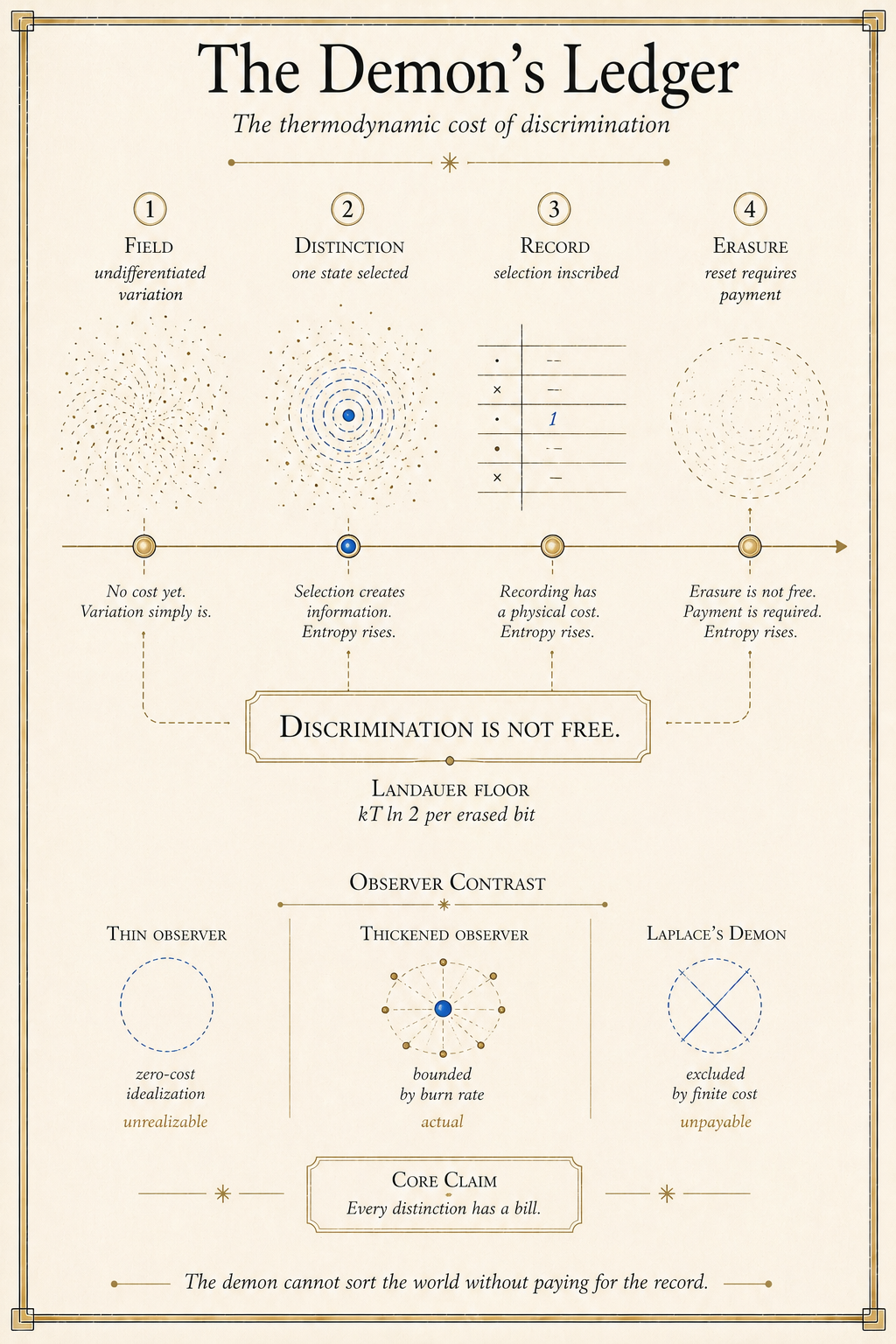
Chapter 2 — The Demon’s Unpaid Bill
The problem
If a finite system observes, distinguishes, remembers, or tracks anything at all, what does that activity cost? Chapter 2 answers by refusing the fantasy of costless observation. The chapter’s target is every theory that treats information as if it were a free abstraction detachable from the energetic conditions of its production and maintenance.
The opening ordeal
The demon of the title inherits Maxwell’s famous fantasy of a discriminator that sorts the world without paying for the sorting. Chapter 2 insists that the bill arrives anyway. A finite observer is not outside thermodynamics. It must erase, discriminate, and maintain records with embodied machinery, and those operations have a floor below which they cannot be driven.
The chapter’s ordeal is therefore austere and universal. Before there are organisms, minds, or institutions, there are finite systems trying to hold distinctions in a world that charges for every reliable difference.
The central operator
The central operator is Landauer’s principle generalized into an observer condition. Any physically embedded discriminator pays an irreducible thermodynamic cost when it resolves alternatives and stabilizes the result as a usable difference. The point is not merely that information has a physical implementation. It is that the implementation cost is ontologically decisive.
From there the chapter derives the finite observer as a structural position rather than a human epistemic limitation. Every observer is finite because every observer is physically embedded, budget-constrained, and asymmetrically situated. No one gets a God’s-eye inventory for free.
Key concepts
Landauer floor is the chapter’s most explicit anchor. Finite observer names the general condition. Flat physicalism appears as the framework that cannot account for observer-specific cost without collapsing all structure into one undifferentiated floor. The chapter also sharpens the idea that causal tracking is an achievement, not a given.
What the chapter establishes
Chapter 2 installs the calorimetric discipline the rest of the book never abandons. No closure may be posited without naming how it pays. No level may be called real if its maintenance has no energetics. No observer may be granted neutral access to the world if the access conditions are themselves structured by cost.
This is the chapter that makes the ledger unavoidable. Once discrimination is priced, ontology can no longer be free of thermodynamics.
What it hands forward
The next chapter asks what follows when different organizations pay in different currencies and at different rates. If observation already has a bill, then persistence has one too. Chapter 3 turns the unpaid bill into the positive claim that levels are real wherever distinct burn rates sustain distinct closures.
Read next
Read The Price of Being for the chapter that turns energetic cost into a criterion for ontological levels.
Or move through Landauer Floor, Finite Observer, and Flat Physicalism to see the chapter’s load-bearing vocabulary.
- Essay
- 02 · The Demon's Unpaid Bill — opening orientation, ~5 min
- Authored
- April 2026
- Register focus
- R1 field.
- Cites
- Landauer Floor · Finite Observer · Flat Physicalism
- Source
- Chapter 2 — The Demon's Unpaid Bill