CONCEPT · ENTRY 029 · R3 COGNITIVE
Offline Mind
The decoupled cognitive closure — the fourth and fifth cognitive strata — in which the organism can generate and price trajectories it has never traversed, by coupling the simulation engine to the Affective Witness through a seam whose failure taxonomy distinguishes it from every stratum below.
- Register
- R3 cognitive — neural-integrative.
- Genealogy
- Raichle 2001 · Hassabis & Maguire 2007 · Dunbar 1998
- Appears in
- Chapter 11 — The Offline Mind
- Related
- Affective Witness · Symbolic Exit · Embodied Present
- What it is not
-
- Not the imagination in a general sense — the Offline Mind is a specific architectural closure with a measurable burn rate and diagnosable failure modes.
- Not consciousness or the stream of consciousness — the closure is diagnosed through its failure signatures and selective pressures, not through phenomenology.
- Not dreaming specifically — though dreaming is one mechanism by which the decoupling architecture maintains itself.
- Not the capacity for abstract thought in general — the Offline Mind is specifically about the decoupling of cognitive processing from real-time sensorimotor coupling.
DIAGRAM
The Offline Mind
The offline mind buys time by simulating possible futures when the world is absent.
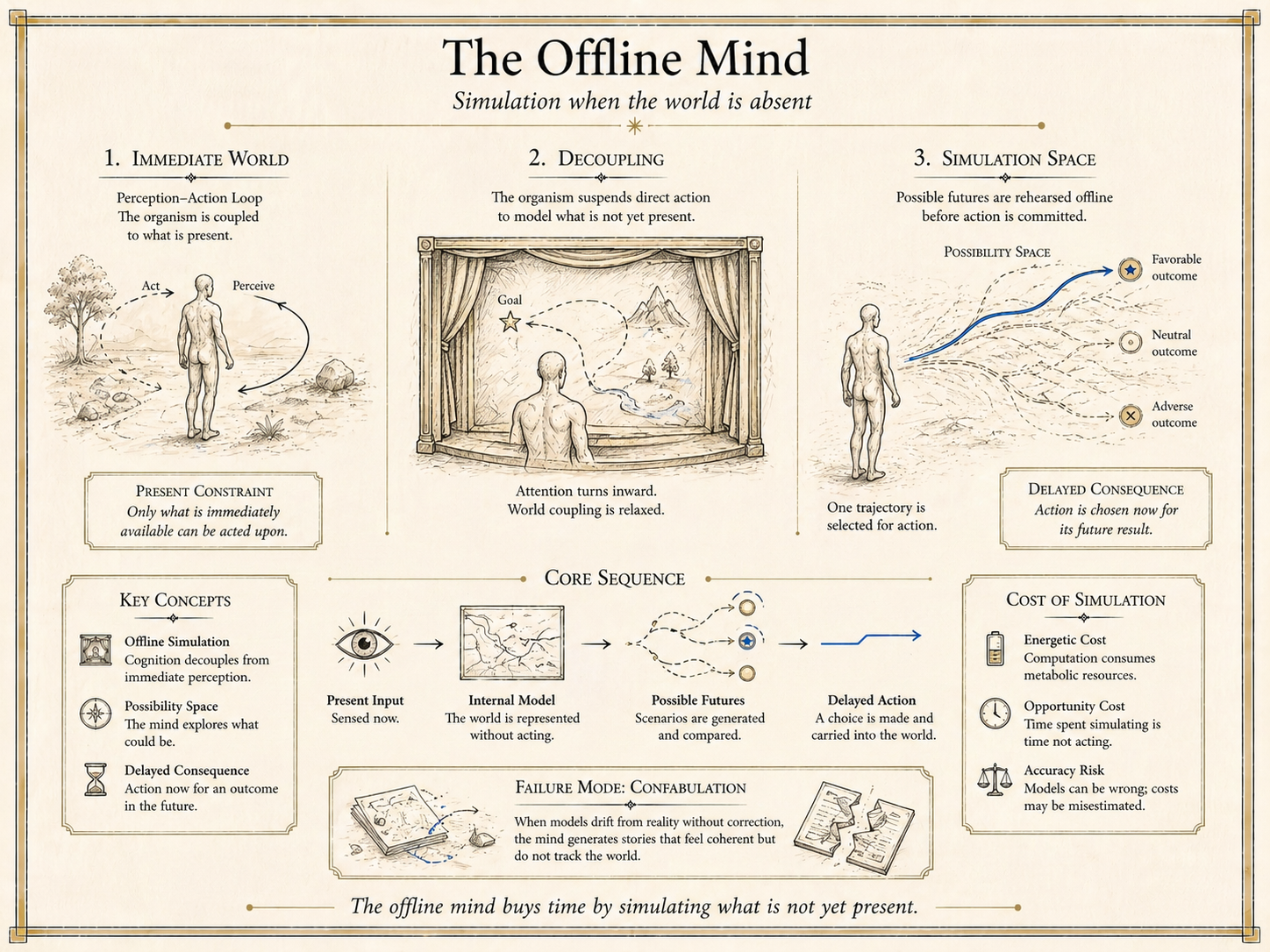
The one-sentence version
A simulation engine coupled to an interoceptive pricing apparatus. The Offline Mind names the architectural closure in which the cognitive stream is decoupled from real-time sensorimotor coupling — generating, in the space opened by that decoupling, the capacity to price trajectories never traversed, social situations never encountered, and futures never yet real.
Where the word comes from
Chapter 11 opens with the frozen junction. A mind that generates trajectories it cannot feel the cost of is not a functioning offline mind — it is a simulation engine with the pricing connection severed. The VMPFC lesion patient on the Iowa Gambling Task produces this case: correct propositional reasoning, intact homeostasis, intact perception, specific absence of the anticipatory skin-conductance response that would have weighted the simulated next draw before the draw was made. The simulation runs. The junction where the simulation’s output would have been priced is not operating.
The Offline Mind names the closure in which the junction is operating: the simulation engine coupled, at a specific and diagnostically legible seam, to the Affective Witness’s broadcast architecture, such that simulated trajectories are priced under the same broadcast regime as traversed ones.
The closure has two faces. The first is decoupling from the present sensorimotor stream: the organism can hold a representation of a future or counterfactual state against the pressure of incoming sensory drive (the hippocampal replay, the default-mode network’s task-negative activation, the prefrontal sustained maintenance). The second is decoupling from the first-person frame: the organism can generate trajectories from within a simulated other mind (theory of mind, recursive mentalisation, the social-brain hypothesis’s central capacity). The two faces share the same Witness–Canon problem at their shared seam and the same failure taxonomy when the coupling fails.
Within the book’s Chapter 8-11 cognitive sequence, this names a local position in that sequence; the page’s R-register marks its broader placement in the site’s macro-map.
Why it matters
The Offline Mind resolves the lethal-cost problem: the Affective Witness’s interoceptive pricing apparatus prices only trajectories that have been traversed — a first lethal encounter is the last learning opportunity. The organism that can price trajectories before committing biological resources to their traversal survives classes of environment the purely embodied organism cannot.
The closure is not costless. The default-mode network runs at a metabolic rate comparable to task-positive networks, continuously. The gain-control architecture required to decouple the simulation from sensory flooding is metabolically expensive and architecturally specific. The drift-bounding mechanism that prevents simulated trajectories from decorrelating from reality within a small number of iterations requires a further architectural commitment. The three costs are joint; a partial installation is worse than none.
The selective regime that pays the installation cost has three features: delayed reward (highest-yield trajectories have payoffs at timescales the embodied apparatus cannot reach), environmental novelty (the environment drifts faster than traversal-based learning can track), and cached social contingency (fitness depends on the concealed states of conspecifics whose intentions cannot be directly observed). The corvid caching literature, the primate coalition-intelligence literature, and the hominin archaeological record all exhibit the three-feature pattern.
Rumination is the Offline Mind’s characteristic civilian failure mode: a simulation loop in which the Witness provides a global aversive flatness across all iterations, the differential pricing that would select among iterations and terminate the loop is absent, and the loop runs at metabolic cost without delivering the pricing that justifies the cost.
What it is not
The Offline Mind is not the imagination as a faculty. It is an architectural closure with a measurable burn rate (default-mode network CMRO₂), a specific coupling seam (the junction between the simulation architecture and the Affective Witness’s broadcast), and a failure taxonomy that distinguishes it from every stratum below. The fact that the architecture supports what we call the imagination is a consequence of the closure, not its definition.