CONCEPT · ENTRY 006 · R3 COGNITIVE
Recursive Stack
The architecture by which transductive resolutions become substrates for further transductive resolutions, layer by layer, each level installing its own dominant variables and conditions of failure.
- Register
- R3 cognitive — neural-integrative.
- Genealogy
- Simondon 1958 · Deacon 2011
- Appears in
- Chapter 7 — The Stratification Engine
- Related
- Transduction · Ontogony · Constitutive Dissipation
- What it is not
-
- Not a hierarchy of dominance.
- Not a catalogue of "levels of reality."
- Not a reduction relation.
- Not a software stack except as loose analogy.
DIAGRAM
The Book Spine
A one-page map of the 13-chapter argument from grounding to the AI verdict.
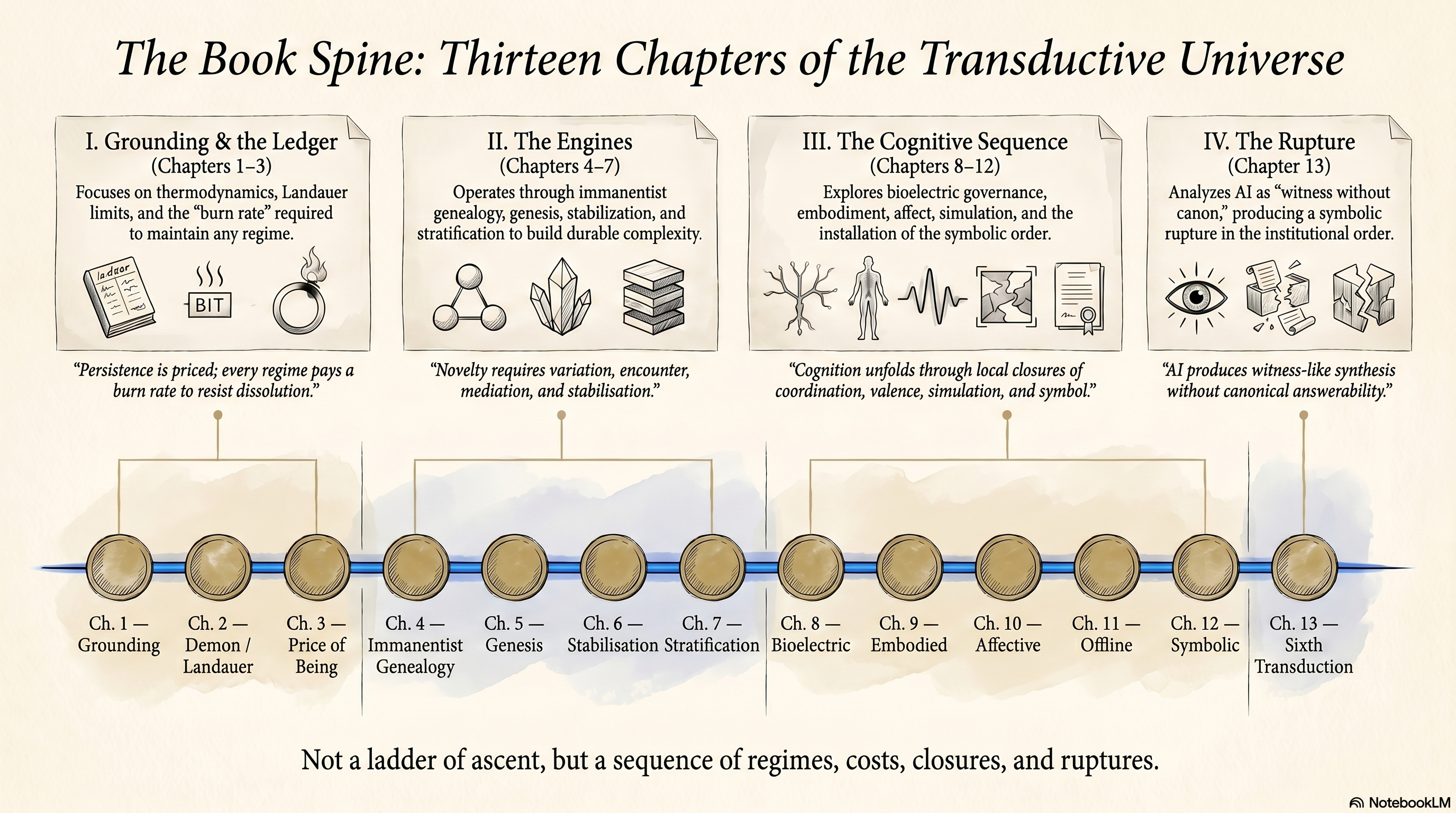
The one-sentence version
The recursive stack is what becomes possible when one transduction makes another available. Each new regime, once installed, can serve as the metastable field for further individuations — and the cumulative result is a layered architecture in which each level has its own vocabulary, its own normativity, and its own price.
Where the word comes from
The phrase is borrowed from systems and computing, where a stack names a layered architecture in which each layer abstracts over the one below. Ontogony uses the term in a stricter sense than the metaphor invites. A recursive stack here is not just a hierarchy; it is a hierarchy built by transduction, where every step up was the resolution of a metastable field whose dominant variables were not constructible from the level immediately beneath.
The shape this picks out has many partial cousins in the literature: Simondon’s stratified registers of individuation, Deacon’s ascending dynamics from morphodynamics to teleodynamics, the engineering vocabulary of “levels of abstraction.” The recursive stack is the operational core they all reach for: a sequence of priced installations.
Why it matters
Two things follow from taking the recursive stack seriously.
The universe becomes more capacious over time. Each successful transduction installs a new register of description — a new set of dominant variables, a new vocabulary of failure, a new domain in which further metastable fields can develop. The stack is the trace of that capacitation. It is also the reason the world supports the kinds of distinctions it does: you can talk about cells because biological transductions installed them on top of chemical regimes; you can talk about beliefs because cognitive transductions installed them on top of biological regimes.
Higher layers rent from lower ones. Each level in the stack inherits the constitutive dissipation of the levels beneath it. A cognitive regime is paid for partly out of biological maintenance; a biological closure is paid for partly out of physical-chemical gradient discharges. The cost-structure compounds. When a layer’s funding fails, the cessation signature reverses the order of installation — higher layers fail first, and the sequence of collapse is informative about what was being maintained.
This second consequence is what gives the framework predictive bite. Stratification is not a layering of ontological dignities; it is a layering of expenses, each conditioned on the persistence of the one below.
What it is not
- Not a hierarchy of dominance. Higher layers do not control lower ones; they rent persistence from them.
- Not a catalogue of “levels of reality”. The stack is built; it is not a fixed taxonomy. What counts as a level is determined by what was transductively installed, not by an a priori list.
- Not a reduction relation. Higher layers are not derivable from lower ones, by construction: each was installed by a transduction whose products were non-constructible from the prior register.
- Not a software stack, except as a loose analogy. Software layers can be peeled off without affecting their substrates; transductive layers cannot, because the substrates are also paying the bill.
The shortest summary: each new layer is a new set of bills the universe has agreed to keep paying.