DIAGRAM · CHAPTER 05
Closure-Crisis Lemma.
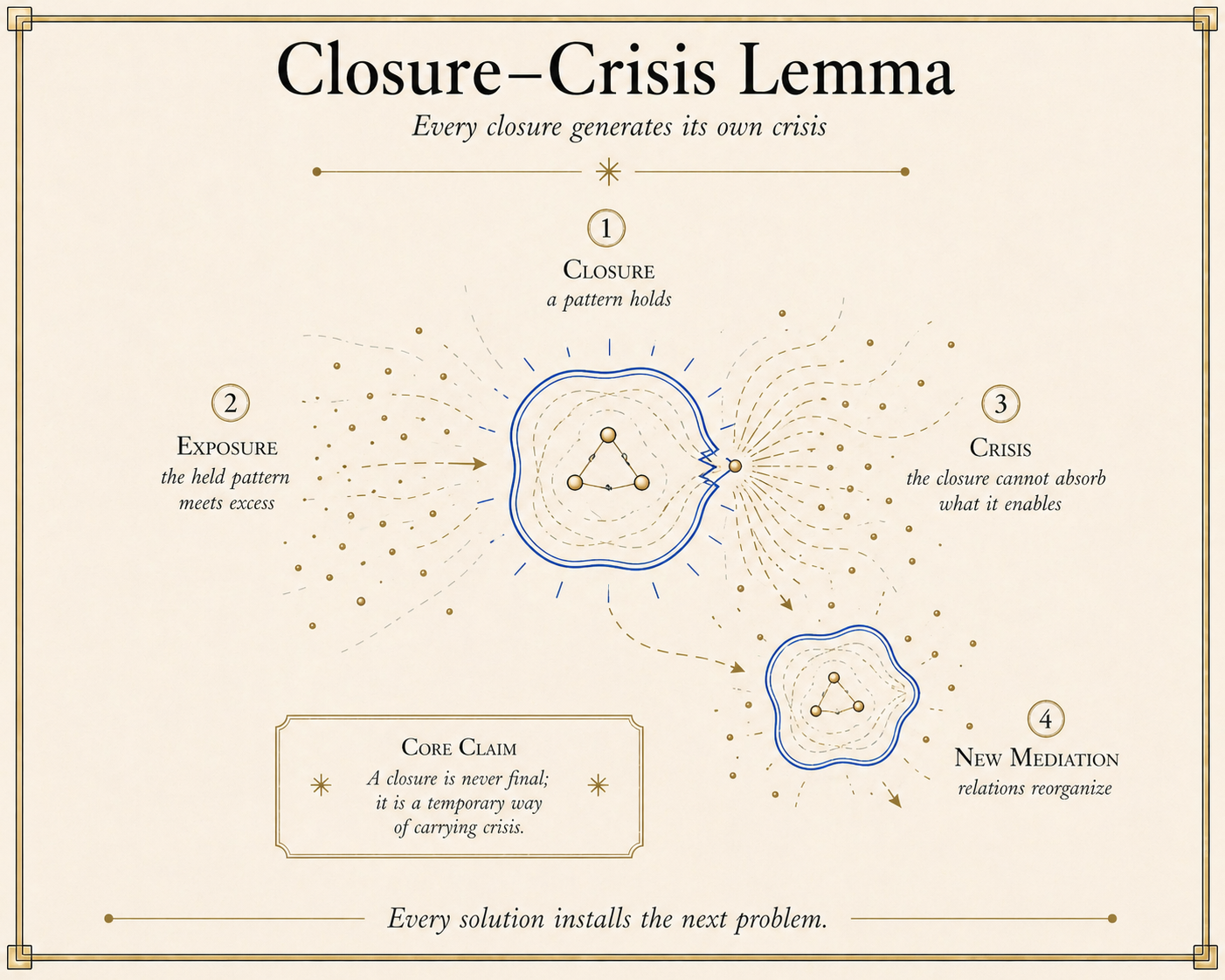
Every successful stabilisation exhausts the coordination space that permitted it and thereby accumulates the metastable conditions for the next crisis.
ATLAS PLATE
Closure-Crisis Lemma
Every successful stabilisation exhausts the coordination space that permitted it and thereby accumulates the metastable conditions for the next crisis.
The one-sentence version
The Closure-Crisis Lemma states that every successful stabilisation — by exhausting the coordination space that permitted it — generates the metastable conditions for the next crisis: the Genesis Engine’s exhaust is the Stabilisation Engine’s fuel. Stability is self-undermining.
Where the term comes from
The structural insight derives from Prigogine’s bifurcation theory, where the achievement of a stable dissipative structure simultaneously raises the system’s sensitivity to perturbation. Kauffman’s work on fitness landscapes adds the coordination-load dimension: as a regime stabilises, the mutual dependencies it forges increase coupling density faster than within-regime governance can absorb, until a threshold is crossed and the coordination space is saturated.
Why it matters
The Closure-Crisis Lemma explains why history does not converge to a final equilibrium and why institutions, ecosystems, and cognitive frameworks all share a characteristic arc: successful closure followed by mounting instability, crisis, and the possibility — not the guarantee — of stratification to a higher register. Understanding this lemma is the precondition for understanding why novelty is structural rather than accidental.
- Chapter
- 5
- Book title
- The Genesis Engine
- Collection
- Diagram