ESSAY · 08 · OPENING ORIENTATION
The Bioelectric Governor.
Chapter 8 demonstrates the first cognitive closure at tissue scale and shows that the construction plan can be rewritten without changing the genome.
DIAGRAM
The Bioelectric Governor
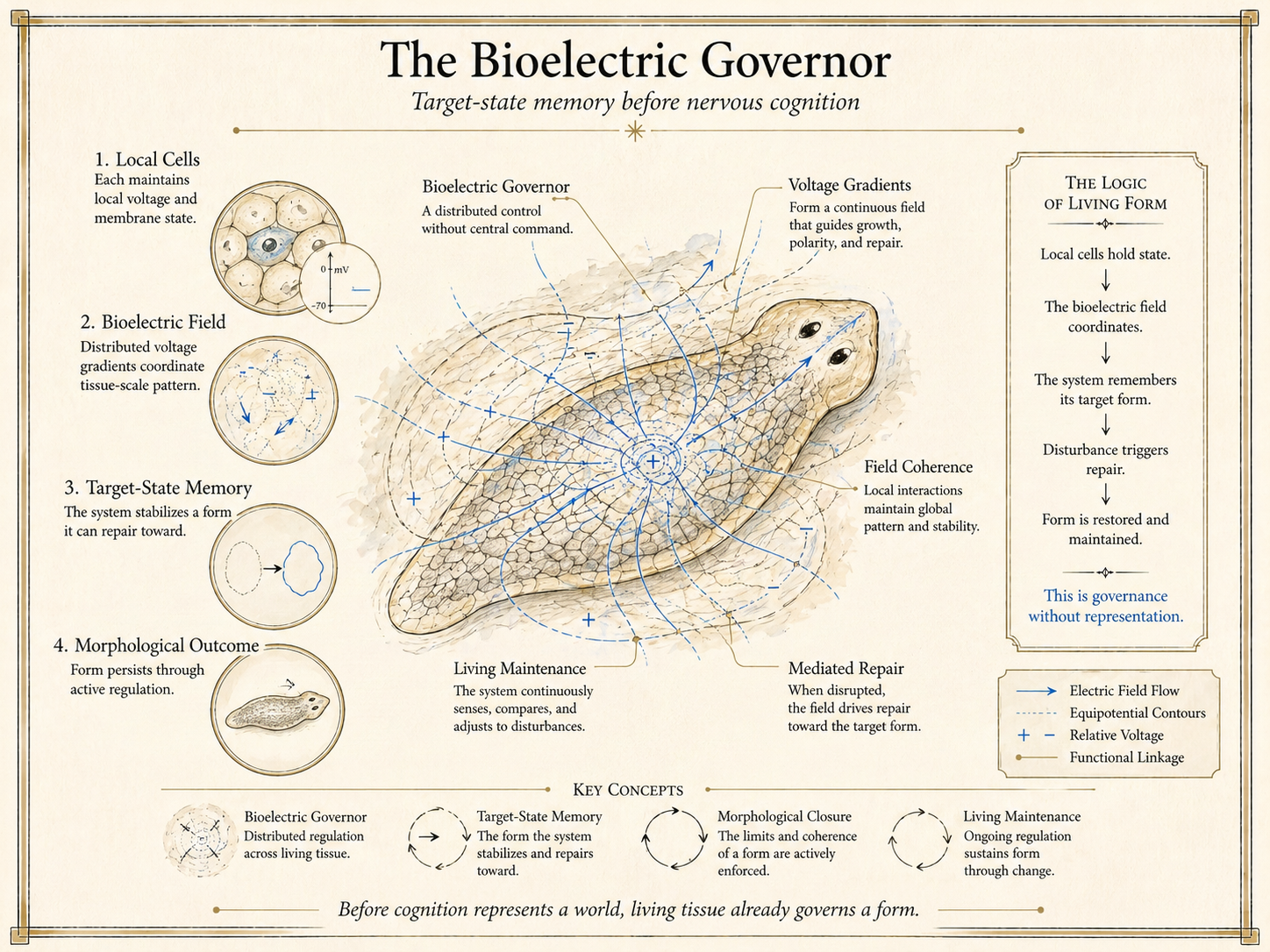
The bioelectric governor names a distributed regime of living form: local cells hold state, voltage gradients coordinate tissue-scale pattern, and the organism repairs toward a target morphology before nervous representation appears.
Chapter 8 — The Bioelectric Governor
The problem
How can morphology be governed at tissue scale if the genome only lists parts? Chapter 8 answers by showing that tissues carry a dynamical control variable above the molecular inventory and that this variable governs morphological targets in reproducible, experimentally manipulable ways.
The opening ordeal
The chapter begins with laboratory shocks that are too clean to dismiss. Block gap junctions in a bisected planarian and the fragment regenerates a second head. Impose a voltage pattern on flank tissue in frog embryo and a functional ectopic eye appears. The proteins do not change. The genome does not change. The plan does.
The central operator
The chapter’s central operator is the bioelectric governor. Distributed transmembrane voltage patterns coupled through gap junctions create a tissue-scale attractor that governs which morphological target the organism converges on. The genome supplies components. The bioelectric field supplies target-level governance.
This is why the chapter matters so much to the book’s middle. It gives the full template in its cleanest case. Burn rate is literal ATP expenditure on ion pumping. Witness is the distributed voltage pattern. Canon is the attractor landscape that selects which target is load-bearing. Failure modes can be produced on demand.
Key concepts
Bioelectric governor is the chapter’s namesake. Morphogenetic governance is the functional claim. Witness–canon architecture is demonstrated rather than merely named. The chapter also introduces the graveyard framing for the cognitive sequence. Most lineages do not climb. Most stabilize here.
What the chapter establishes
Chapter 8 establishes the first cognitive closure and makes a crucial negative claim. Governance can be real, normative, and experimentally tractable without requiring interiority. Tissue can pursue a target and correct deviations from it without consciousness entering the picture.
That result matters because it keeps later chapters honest. When interiority does arrive, it will have to arrive through a specific architecture, not by being projected backward onto every earlier instance of coordination.
What it hands forward
The success of tissue-scale governance creates its own next crisis. Once organisms move through the world, they must distinguish self-generated sensory change from external change. Chapter 9 receives that debt as the reafference problem and answers it with allocentric spatial governance.
Read next
Read The Embodied Present for the chapter where the world becomes a stable place rather than a shifting pile of signals.
Or move through Bioelectric Governor and Witness–Canon Architecture to stay with the chapter’s main operators.
- Essay
- 08 · The Bioelectric Governor — opening orientation, ~6 min
- Authored
- April 2026
- Register focus
- R2 biological.
- Source
- Chapter 8 — The Bioelectric Governor