ESSAY · 03 · OPENING ORIENTATION
The Price of Being.
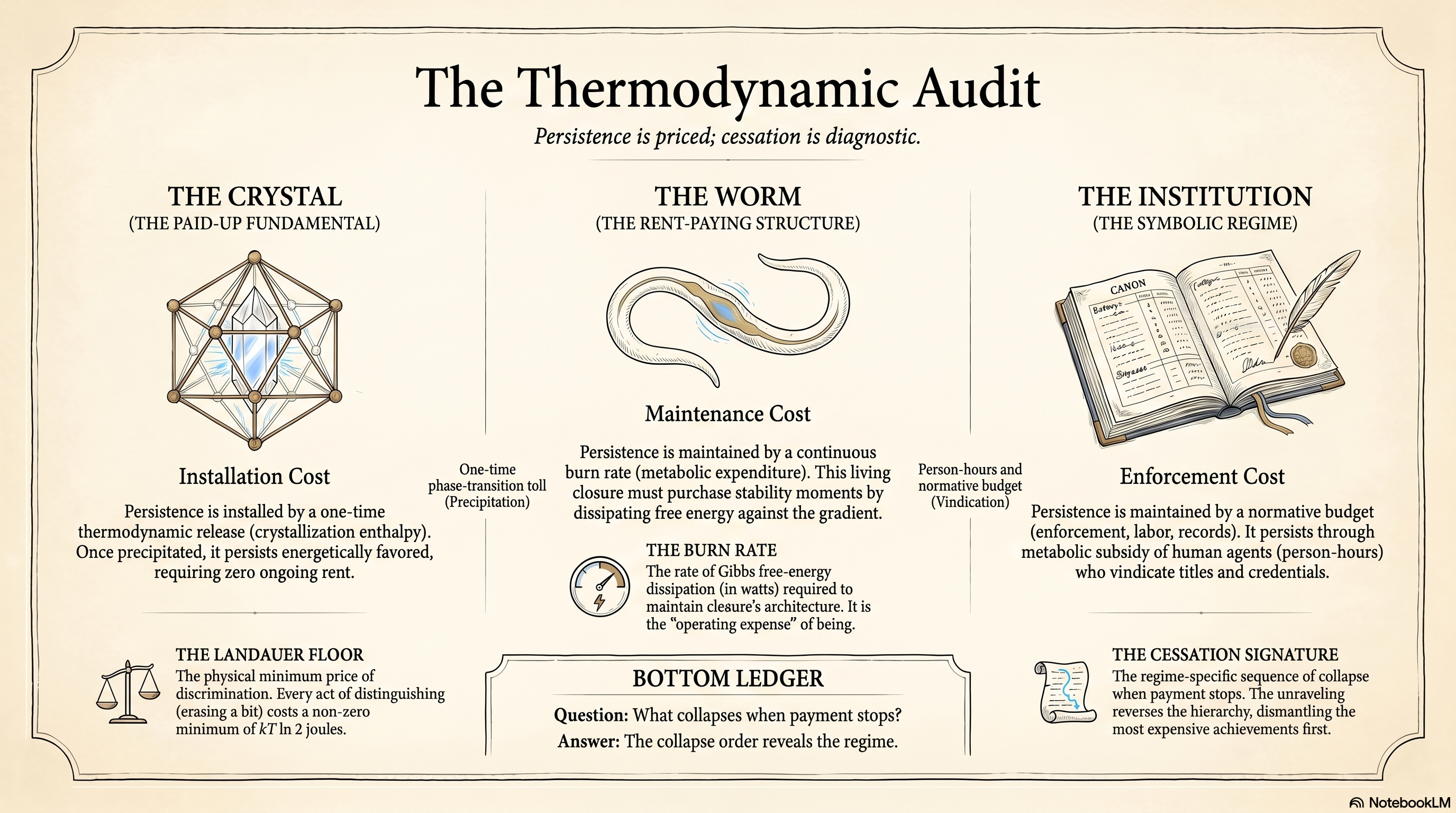
Chapter 3 argues that levels are real where persistence is purchased at a distinct burn rate and where breakdown reveals a regime-specific order of collapse.
DIAGRAM
Thermodynamic Audit
Finite observers settle accounts through irreversibility, not abstraction.
Chapter 3 — The Price of Being
The problem
Once observation has been priced, what makes one organization of matter count as a real level rather than a convenient redescription? Chapter 3 answers by tying ontology to maintenance. A level is real where its persistence costs something specifiable and where its collapse follows a regime-specific order rather than generic relaxation.
The opening ordeal
The chapter’s scene is the ledger opening over the question of being itself. It is not enough for a pattern to appear. The pattern must keep buying the conditions of its own coherence. If the funding stops, the way it falls apart reveals what kind of thing it had been.
This is the chapter that makes the phrase “the price of being” literal. Being is not a metaphysical bonus laid over matter. It is a maintained achievement.
The central operator
The central operator is the coupling of burn rate and cessation signature. Burn rate names the rate of free-energy dissipation required to keep a closure’s constraint-architecture intact. Cessation signature names the regime-specific order in which that architecture collapses when payment ceases.
Taken together, the two give the framework its first full ontological test. If a regime has no distinct burn rate, it may be derivative of another regime’s maintenance. If it has no specific cessation order, then its collapse tells us nothing about an organization proper to it. Real levels are the ones that can be thermodynamically audited both in persistence and in failure.
Key concepts
Burn rate and cessation signature are the chapter’s headline terms. Ontogony sharpens into the claim that being is generated and maintained. The stratogonic principle is seeded as the formal criterion that will later distinguish full closure from weaker kinds of organization. The chapter also clarifies why distinct currencies matter. Watts, calories, and labor-hours are not interchangeable just because they can all be priced.
What the chapter establishes
Chapter 3 establishes the reality-of-levels claim. Levels are not epistemic conveniences. They are real wherever a closure regenerates itself at a positive cost in its native currency and where the cessation sequence maps the order of commitments that had been maintained.
That move is crucial because it prevents the later staircase from collapsing into metaphor. When the book later distinguishes biological, cognitive, and institutional orders, it does so under a rule first stabilized here. Each level must have its own ledger.
What it hands forward
The next task is to explain how anything genuinely new gets installed in the first place. If levels are real where they are paid for, then novelty cannot be a decorative flourish. Chapter 4 supplies the genealogical and anti-teleological ground on which that novelty can be understood.
Read next
Read The Immanentist Underground for the genealogy that prepares the book’s account of novelty.
Or step into Burn Rate, Cessation Signature, and Stratogonic Principle for the chapter’s key operators.
- Essay
- 03 · The Price of Being — opening orientation, ~6 min
- Authored
- April 2026
- Register focus
- R2 biological.
- Source
- Chapter 3 — The Price of Being