ESSAY · 04 · OPENING ORIENTATION
The Immanentist Underground.
Chapter 4 gives the book a genealogy of novelty and exaptation so that later stratification can be read as contingent repurposing rather than as ascent toward a goal.
DIAGRAM
The Immanentist Underground
A genealogy of thinkers who refused the split between mind and nature: Spinoza, Bergson, Whitehead, Simondon, and DeLanda build a tradition of ontologies that refuse transcendence.
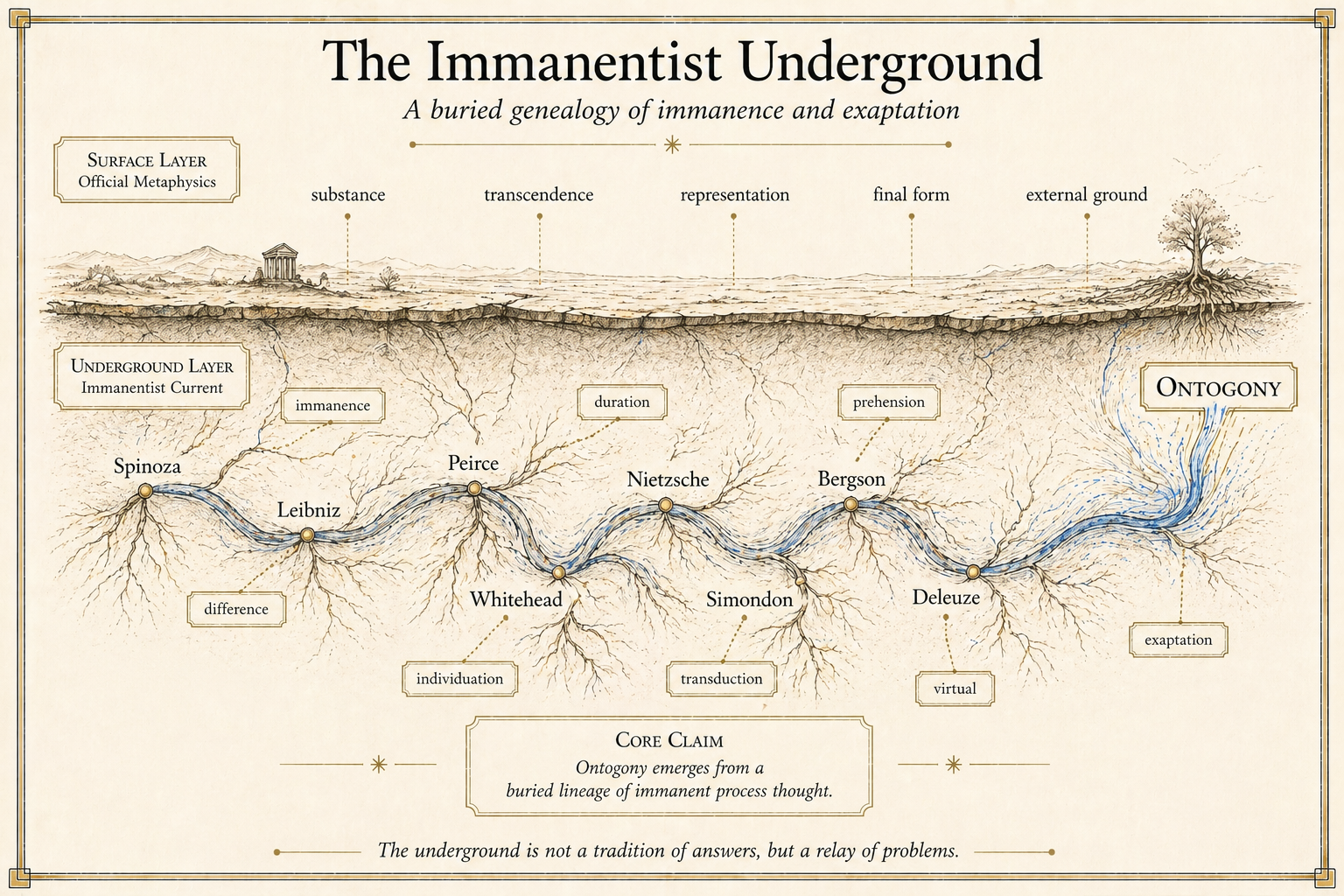
Chapter 4 — The Immanentist Underground
The problem
If the book is going to claim that new closures appear, it must explain novelty without smuggling in purpose, progress, or design. Chapter 4 takes up that burden by constructing a genealogy of immanentist thinking around exaptation, virtual structure, and contingent reuse.
The opening ordeal
The ordeal is historical and conceptual. There is a powerful temptation to narrate every successful organization as if it had been aiming at itself all along. Chapter 4 refuses that retrospectively flattering story. It asks how functions get repurposed, how capacities outlive the problems that first selected them, and how novelty can be real without being teleological.
The central operator
The central operator is exaptation read through an immanentist lens. A mechanism installed for one coordination problem can be captured and reused in another context without the later use being the mechanism’s original reason for existence. Novelty therefore arrives by contingent redeployment, not by a hidden blueprint.
This chapter also prepares the discipline later imposed on the virtual. Potentials are not infinite metaphysical reserves waiting to be poetically invoked. They are structured fields of compatibility and incompatibility whose later thermodynamic treatment will be sharpened by the concepts of metastability and transduction.
Key concepts
The virtual appears here as a precursor concept rather than a final one. Exaptation names the repurposing logic. Metastability is the bridge from genealogy to physicalized novelty. Transduction is foreshadowed as the operator that will later do the heavy formal work. The chapter also protects the book from progressivist readings by making contingency load-bearing.
What the chapter establishes
Chapter 4 establishes the book’s anti-teleology clause. The staircase of strata is not a ladder of improvement. Each new fold is a contingent response to pressures produced by older folds, often using materials and operators that were installed for very different reasons.
This matters because later chapters on cognition and institutions could otherwise be misread as a triumphal ascent from chemistry to symbols. Chapter 4 blocks that reading in advance. New closures are not better in any simple sense. They are expensive reconfigurations of inherited materials under pressure.
What it hands forward
The next chapter stops being genealogical and becomes formal. If novelty can arrive without teleology, Chapter 5 must now show how it arrives at all. The problem shifts from history to mechanism. What is the minimum architecture that lets a new regime precipitate from a metastable field?
Read next
Read The Genesis Engine for the book’s formal grammar of novelty.
Or move through The Virtual, Metastability, and Transduction to follow the concepts this chapter hands forward.
- Essay
- 04 · The Immanentist Underground — opening orientation, ~5 min
- Authored
- April 2026
- Register focus
- R1 field.
- Cites
- The Virtual · Metastability · Transduction
- Source
- Chapter 4 — The Immanentist Underground