ESSAY · 11 · OPENING ORIENTATION
The Offline Mind.
Chapter 11 installs the decoupling architecture that lets organisms simulate and evaluate trajectories they have never physically taken.
DIAGRAM
The Offline Mind
The offline mind buys time by simulating possible futures when the world is absent.
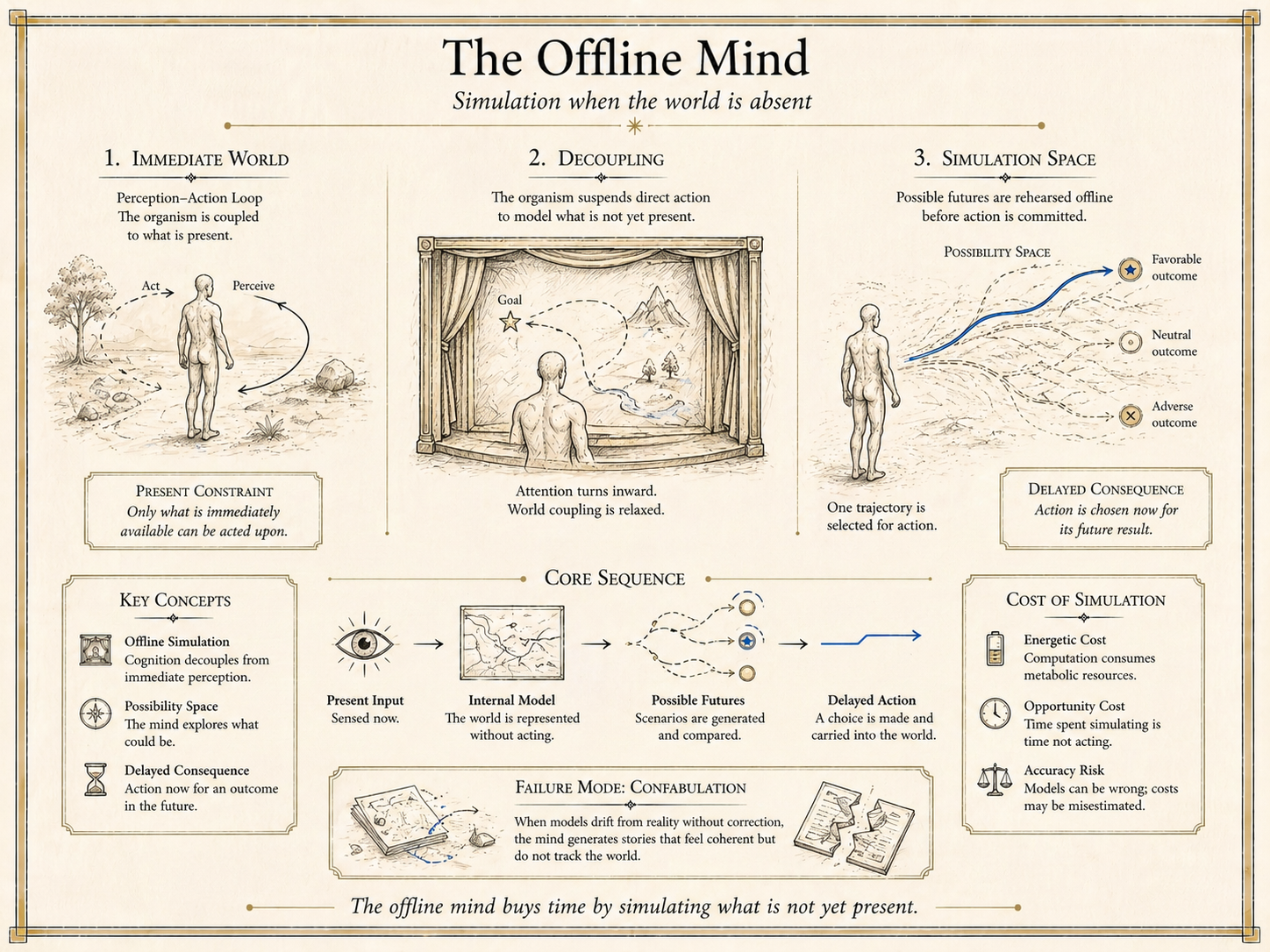
Chapter 11 — The Offline Mind
The problem
How does an organism survive problems whose first failed attempt is fatal or unrecoverable? Chapter 11 answers by installing the closure that allows trajectories to be generated, rehearsed, and priced without being physically traversed.
The opening ordeal
The chapter opens at the frozen junction. Simulation runs, but pricing does not pass cleanly through it. The result is confabulation, bad choice, or rumination. This is an excellent opening ordeal because it makes the seam visible. The capacity is real precisely because it can fail in specific ways.
The central operator
The central operator is decoupling. The cognitive stream can separate from immediate sensorimotor coupling and still remain usable because it stays tied to affective pricing through a controlled seam. This makes prospection, replay, counterfactual testing, and perspective-taking possible without immediate bodily commitment.
The chapter treats temporal simulation and perspectival simulation as two orientations of the same closure rather than as completely separate faculties. Both depend on generating trajectories not currently being lived and subjecting them to proxy pricing.
Key concepts
Offline mind is the umbrella term. Decoupling names the enabling move. Proxy pricing captures how felt valuation enters simulated trajectories. Rumination and confabulation serve as failure signatures. The chapter also prepares the vocabulary later used against overeasy representationalism and, eventually, against AI boosterism.
What the chapter establishes
Chapter 11 establishes the fourth and fifth cognitive strata as a real closure rather than a convenient cluster of abilities. It also identifies the cost of the closure. Offline cognition is metabolically expensive, drift-prone, and valuable only where delayed reward, novelty, or social opacity make traversal-first learning too costly.
That anti-teleological point matters. The offline mind is not inevitable. It is selectively worth paying for only in certain ecologies. Like every staircase step in this book, it is an expensive answer to a pressure problem.
What it hands forward
Once simulation and perspective-taking are available, the next question is how symbols can leave any one organism and become binding across strangers. Chapter 12 receives that debt by showing how externalized answerability works at post-Dunbar scale.
Read next
Read The Symbolic Exit for the chapter where tokens become authoritative constraints beyond any single mind.
Or move through Offline Mind, Affective Witness, and Symbolic Exit to stay with the main handoff.
- Essay
- 11 · The Offline Mind — opening orientation, ~6 min
- Authored
- April 2026
- Register focus
- R3 cognitive.
- Cites
- Offline Mind · Affective Witness · Symbolic Exit
- Source
- Chapter 11 — The Offline Mind