CONCEPT · ENTRY 028 · R3 COGNITIVE
Affective Witness
The interoceptive governance architecture that reads its own accounts — the third cognitive closure, in which precision-weighted prediction over the body's homeostatic variables is broadcast across the distributed cognitive apparatus, making trajectories through the allocentric frame felt rather than merely processed.
- Register
- R3 cognitive — neural-integrative.
- Genealogy
- Craig 2002 · Seth 2021 · Damasio 1994 · Barrett 2017
- Appears in
- Chapter 10 — The Affective Witness
- What it is not
-
- Not emotion in the psychological sense — the Affective Witness is an architectural closure that emotions are the downstream products of.
- Not consciousness or qualia — the chapter derives felt valence from the architecture's structure, not from a prior assumption about experience.
- Not the same as the homeostatic apparatus — homeostasis is the substrate, not the closure.
- Not a theory of mood or mental illness specifically — though the failure taxonomy covers these.
DIAGRAM
The Affective Witness
The affective witness turns interior cost into valence, pricing trajectories before explicit reasoning.
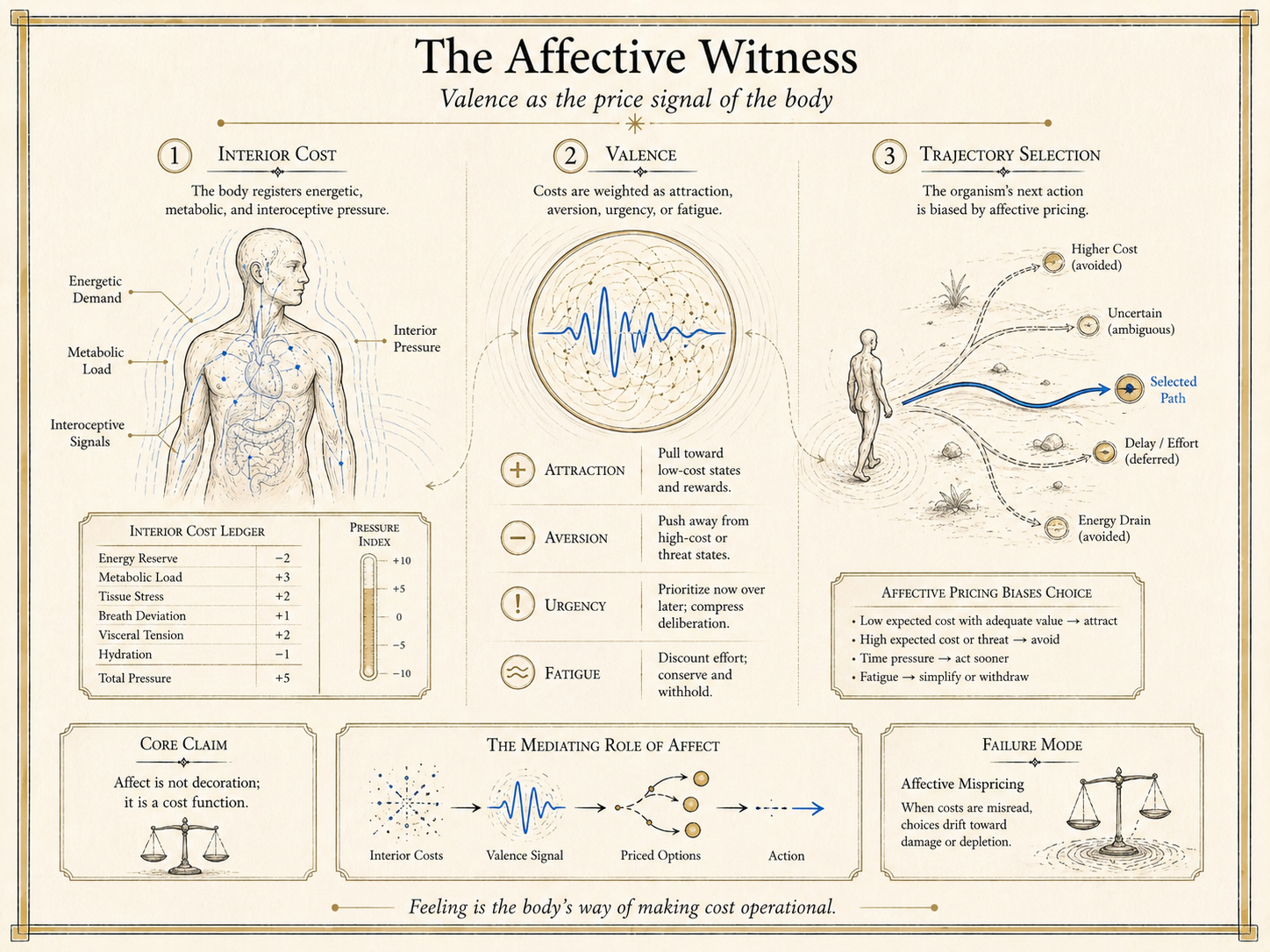
The one-sentence version
The body reads its own ledger, and it does so from the inside. The Affective Witness names the interoceptive governance closure in which precision-weighted prediction over the body’s homeostatic state is broadcast across the distributed cognitive apparatus — not merely tracking the body’s condition, but making the tracking felt, so that trajectories through the spatial frame are priced rather than merely navigated.
Where the word comes from
Chapter 10 inherits an unpaid debt from Chapter 9: the allocentric frame prices trajectories, but the pricing is functional (which path is selected) rather than phenomenal (which path is felt as preferable). The distinction is not the hard problem of consciousness in disguise — it is a structural distinction between two architectural achievements. The Embodied Present installs the frame; the Affective Witness installs the architecture by which the organism is inside the pricing rather than adjacent to it, and within the book’s Chapter 8-11 cognitive sequence this names a local position in that sequence while the page’s R-register marks its broader placement in the site’s macro-map.
Three architectural prerequisites, none of which the bare homeostatic controller satisfies, jointly define the closure:
A prediction loop over the homeostatic accounts. The organism is not merely sensing its internal state; it is maintaining a forward model of where its homeostatic variables are about to go under the current trajectory. The ascending interoceptive pathway — lamina I, spinothalamic tract, posterior and mid-insular cortex, anterior insular re-representation — is the anatomical substrate. The re-representation at the anterior insula carries the prediction-error signal whose correlate is the felt weight of the body’s own condition.
Precision-weighting of the interoceptive prediction error. Raw prediction error on a single channel is insufficient to adjudicate the organism’s situation. Neuromodulatory gain control — noradrenergic broadcast from the locus coeruleus, serotonergic modulation from the raphe nuclei, dopaminergic pricing from the ventral tegmental area — implements precision-weighting that reflects the reliability of predictions, the cost of uncertainty, and the joint implication for the organism’s integrity.
Broadcast across the distributed cognitive apparatus. The precision-weighted valence signal propagates from the anterior insula through dense reciprocal connections to the anterior cingulate cortex, the amygdala, the ventral striatum, and thence through descending modulation into the hypothalamus and brainstem. This broadcast weights attention, memory retrieval, motor planning, autonomic output, and endocrine release. Damasio’s somatic-marker hypothesis — the Iowa Gambling Task, the ventromedial prefrontal lesion findings — provides the laboratory anchor: the broadcast is real, its ablation is diagnostically specific, and its presence is what allows the organism to integrate anticipated affective consequences into decision-making.
Why it matters
The Affective Witness is the chapter’s load-bearing claim: felt valence is not an added phenomenal commentary on the interoceptive architecture — it is the architecture’s own inside at this stratum. In this framework, these three prerequisites are proposed as a derivation of why there is something it is like to be in a body with this architecture, without invoking any additional explanatory gap. The felt weight of a situation is the precision-weighted prediction error broadcast through the distributed cognitive apparatus — not represented by it, not correlated with it, but instantiated by it.
The failure taxonomy confirms the closure is real. VMPFC lesion produces the frozen junction: intact homeostasis, intact interoceptive detection, specific impairment of integrating anticipated valence into real-world choice. Anxiety disorders produce gain control pathologies: the precision-weighting machinery over-estimates prediction error, generating felt weight disproportionate to the homeostatic stakes. Alexithymia produces the Canon without Witness problem: the broadcast architecture operates without the anterior insular re-representation that would make the organism’s own interoceptive state legible to the cognitive governance layer.
What it is not
The Affective Witness is not the same as emotional experience in the phenomenological or folk-psychological sense. Emotions are the culturally and contextually shaped downstream products of the affective broadcast — they are the labelled, socially interpretable configurations that the broadcast generates in concert with memory, social knowledge, and linguistic categories. The Affective Witness is the architectural precondition for emotions, not their identity.