ESSAY · 05 · OPENING ORIENTATION
The Genesis Engine.
Chapter 5 defines the minimal architecture of novelty and explains how a new regime installs itself through the co-implication of variation, encounter, and mediation.
DIAGRAM
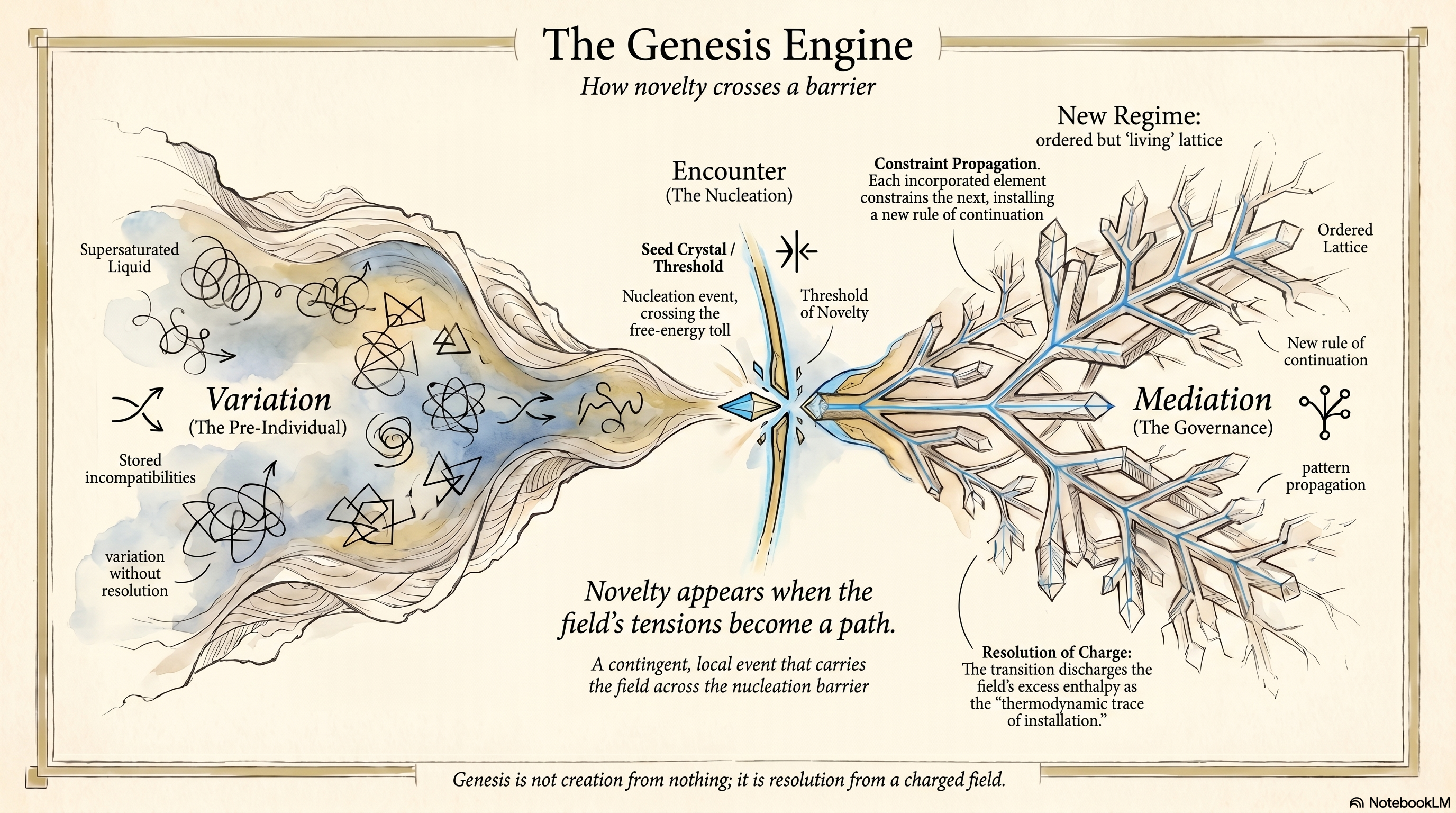
Genesis Engine Diagram
The diagnostic sequence for regime installation as distinct from mere saturation.
Chapter 5 — The Genesis Engine
The problem
What distinguishes genuine novelty from a system merely exhausting the possibilities of a regime it already had? Chapter 5 answers by isolating the minimal architecture required for a new constraint identity to appear.
The opening ordeal
The chapter stands at the edge of a metastable field. Multiple futures are live, incompatible, and not yet discharged. What matters is not that the field contains possibility in some vague sense, but that it contains more structured tension than any single outcome can realize. Genesis begins where that tension can no longer remain deferred.
The central operator
The chapter’s central operator is the triadic grammar of variation, encounter, and mediation. Variation names the metastable field’s superabundance. Encounter names the discrete, irreversible event at the boundary where incompatibility must discharge. Mediation names the ongoing governance that propagates the new constraint topology across the opened domain.
The force of the chapter lies in treating these as co-constitutive rather than sequential decorations. Without variation there is nothing to resolve. Without encounter there is no commitment. Without mediation there is no regime, only a spent event.
Key concepts
Variation, encounter, and mediation are the chapter’s core concepts. Transduction is the name for the full operation they compose. The genesis engine itself is the diagnostic form that tells us when a new identity has actually been installed. Closure-crisis debt also appears here in embryo, because every successful installation exhausts the coordination space that made it possible.
What the chapter establishes
Chapter 5 establishes the grammar of novelty for the rest of the book. Later chapters can change scale, substrate, and currency, but they do not change this operator. Every genuine new regime must emerge from a field of incompatible potentials, pass through a brute commitment point, and install a governance form that makes the result durable enough to matter.
This chapter therefore does more than describe one transition. It creates the diagnostic language for all later transitions.
What it hands forward
Genesis alone is not enough. A regime may appear and immediately disappear. Chapter 6 takes up that exact problem. Once a new closure has been installed, what architecture lifts it into durable objectivity so it can survive noise, disturbance, and time?
Read next
Read The Stabilisation Engine for the architecture that keeps genesis from vanishing as soon as it appears.
Or move through Variation, Encounter, Mediation, and Genesis Engine to stay with the formal core.
- Essay
- 05 · The Genesis Engine — opening orientation, ~6 min
- Authored
- April 2026
- Register focus
- R2 biological.
- Cites
- Variation · Encounter · Mediation · Genesis Engine
- Source
- Chapter 5 — The Genesis Engine