ESSAY · 09 · OPENING ORIENTATION
The Embodied Present.
Chapter 9 installs allocentric spatial governance and explains how a world becomes inhabitable rather than merely sensed.
DIAGRAM
The Embodied Present
The embodied present stabilizes a world across movement by distinguishing self-caused sensory change from world-caused variation.
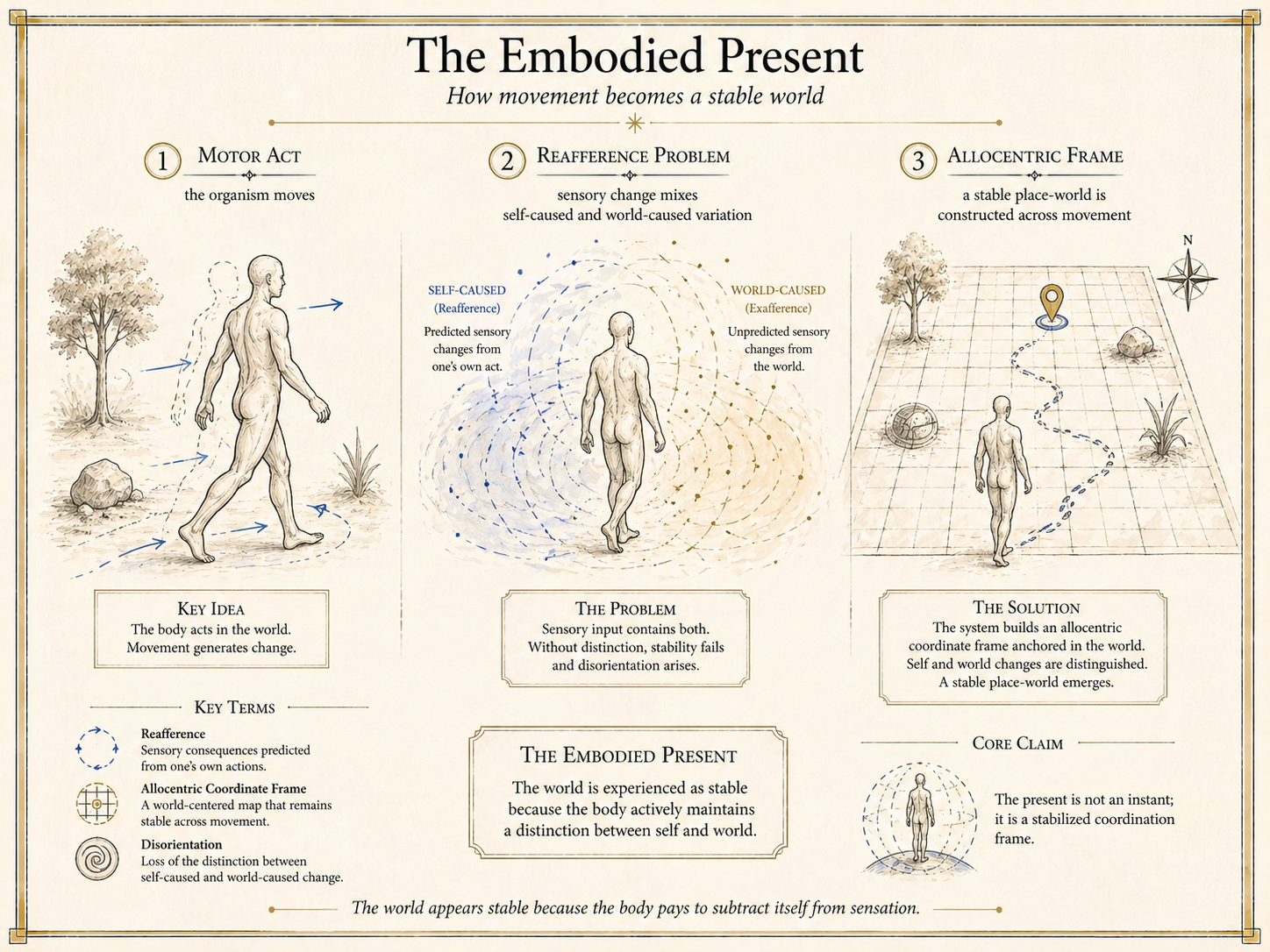
Chapter 9 — The Embodied Present
The problem
How does an organism keep the world stable while it moves through it? Chapter 9 answers by showing that the stable scene is not given by any single sense but by a governance architecture that composes multiple streams into a unified coordinate frame.
The opening ordeal
The chapter opens with bilateral vestibular loss. The room looks correct. The feet report pressure correctly. Yet the floor is not where the floor is. The signals are intact, but their composition has lost its convenor. The world arrives as picture rather than place.
The central operator
The central operator is allocentric spatial governance. Vestibular, proprioceptive, and visual information are integrated into a coordinate frame stable enough to survive locomotion and self-generated sensory change. Reafference cancellation is part of the achievement. The system subtracts what the organism itself caused so that the remaining change can count as change in the world.
The chapter’s force lies in showing that this integration is usually invisible precisely because it is continuous, cheap relative to conscious compensation, and below attention. When it fails, the metabolic and cognitive cost of reconstructing the scene becomes glaring.
Key concepts
Embodied present names the closure. Reafference names the crisis inherited from Chapter 8. Allocentric governance names the installed solution. The chapter also fuses embodied pricing into the navigational frame while deliberately stopping short of identifying that pricing with felt phenomenology.
What the chapter establishes
Chapter 9 establishes the second cognitive closure. The world is not just sensed but composed as a stable, inhabitable scene. This gives the organism a navigable present rather than a set of uncoordinated channels.
It also sharpens the economic logic of the staircase. What used to arrive for free through deep integration must, when the closure fails, be laboriously reconstructed at higher cost and lower fidelity.
What it hands forward
Navigation is not enough. A map without pricing cannot choose among trajectories except by crude or already-traversed reward histories. Chapter 10 receives this debt by asking what makes trajectories not only selectable but felt as costly, urgent, or attractive from within.
Read next
Read The Affective Witness for the chapter where interoceptive pricing becomes the inside of the architecture.
Or move through Embodied Present, Bioelectric Governor, and Affective Witness to follow the next turn of the sequence.
- Essay
- 09 · The Embodied Present — opening orientation, ~6 min
- Authored
- April 2026
- Register focus
- R2 biological.
- Source
- Chapter 9 — The Embodied Present