CONCEPT · ENTRY 027 · R2 BIOLOGICAL
Embodied Present
The allocentric spatial governance closure — the second cognitive stratum — in which vestibular, proprioceptive, and visual signals are integrated into a unified coordinate frame that makes the floor where the floor is, at a continuous metabolic cost that only becomes visible when the integration fails.
- Register
- R2 biological — metabolic-closure.
- Genealogy
- Merleau-Ponty 1945 · Berthoz 1997 · Clark 1997
- Appears in
- Chapter 9 — The Embodied Present
- What it is not
-
- Not the experience of being present — an architectural closure, not a phenomenological state.
- Not proprioception alone — the Embodied Present is the integration of multiple sensory streams into a unified coordinate frame.
- Not the same as spatial awareness or cognition — the Embodied Present is the silent precondition that makes spatial cognition possible, not spatial cognition itself.
- Not costless — the integration runs continuously at measurable metabolic expenditure, which is why its failure is so disorienting.
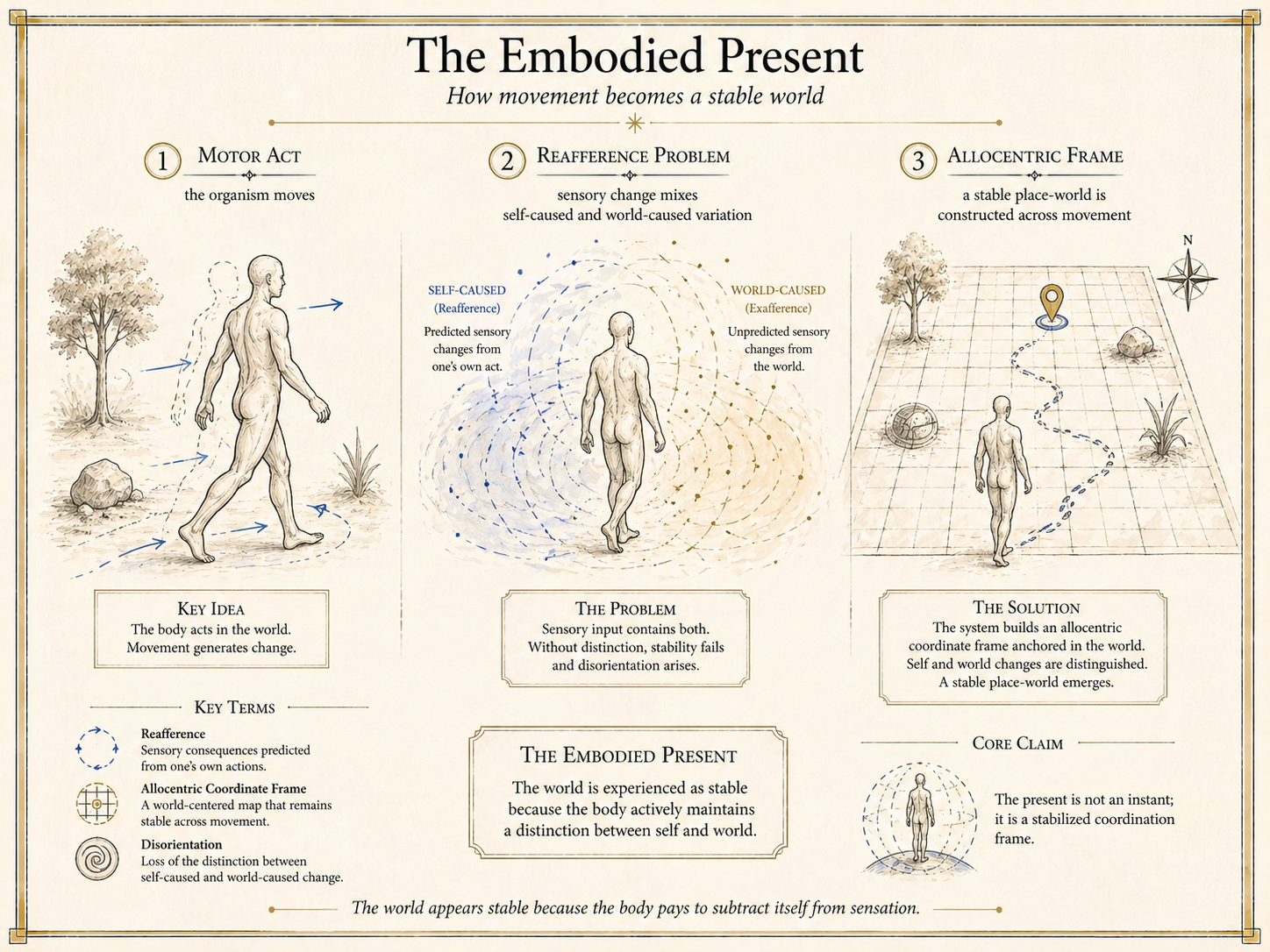
DIAGRAM
The Embodied Present
The embodied present stabilizes a world across movement by distinguishing self-caused sensory change from world-caused variation.
The one-sentence version
The floor is where the floor is because something is working. The Embodied Present names the allocentric spatial governance closure — the second cognitive stratum — in which vestibular, proprioceptive, visual, and kinesthetic signals are continuously integrated into a unified coordinate frame that delivers the world as a world rather than as a collection of independent signals.
Where the word comes from
Chapter 9 opens with a woman who lost her vestibular apparatus to gentamicin toxicity. She has all her senses. The visual field is correct. Her feet report the floor accurately. What is gone is the agreement among them — the silent referee whose operation was invisible precisely because it was continuous. In its absence, the level room will not stay level; the floor is a picture of a floor that she cannot stand up in.
The chapter’s opening extends the framework’s central diagnostic method: the failure signature reveals the closure. The woman’s disorientation is not a failure of any single sense but a failure of the integration architecture that composed the senses into a unified scene. The scene was never delivered by vision or proprioception alone; it was delivered by the agreement among them, and the agreement had a convenor — the vestibular apparatus — whose loss exposes, retrospectively, how much work was being done below the threshold of attention.
The Embodied Present is the architectural name for that work: the continuous integration of multimodal spatial signals into an allocentric coordinate frame stable enough to serve as the substrate for locomotion, navigation, and the spatial pricing of trajectories that the next stratum will install.
Within the book’s Chapter 8-11 cognitive sequence, this names a local position in that sequence; the page’s R-register marks its broader placement in the site’s macro-map.
Why it matters
The Embodied Present resolves the reafference problem the Bioelectric Governor’s success generated. A tissue-scale morphogenetic controller that governs multicellular form cannot distinguish self-generated sensory change from external perturbation. Once the organism moves through heterogeneous terrain, its own actions become a systematic source of spatial uncertainty. The Embodied Present installs the architecture that cancels reafference — the predicted sensory consequences of self-generated action — and stabilises the allocentric frame against self-motion.
This architecture is a genuine stratogonic closure. Its burn-rate currency is CMRO₂ (cerebral metabolic rate of oxygen consumption) — the continuous oxidative expenditure required to maintain the prediction and integration loops running in the vestibular, proprioceptive, and visual-association cortices. Its Witness function is the distributed multimodal signal array whose redundant inscription makes the organism’s spatial state publicly accessible to its own governance architecture. Its Canon function is the attractor dynamics of the multisensory integration that select the dominant coordinate frame — the one that downstream navigation and action will treat as authoritative.
The key structural fact is that the Embodied Present is ordinarily invisible. Like all deep architectural closures, it only becomes visible in its failure — the vestibular patient’s disorientation, the drunk person’s swaying, the swimmer’s loss of up/down in turbid water. The invisibility is not phenomenological incidence; it is the structural consequence of how the integration runs: below the threshold of attention, continuously, at a cost that ordinary waking life absorbs without trace.
What it is not
The Embodied Present is not presence in the phenomenological sense — it is not the sense of being here, of first-person immediacy, of lived experience. It is an architectural achievement: the closed-loop integration of multimodal spatial signals into a stable coordinate frame. The phenomenological richness of spatial experience is downstream of this architecture, not identical with it. The patient who lost her vestibular apparatus has not lost her phenomenology; she has lost the silent precondition that used to make her phenomenology habitable.