ESSAY · 10 · OPENING ORIENTATION
The Affective Witness.
Chapter 10 argues that felt valence is the inside of a precision-weighted interoceptive governance architecture rather than an added commentary on it.
DIAGRAM
The Affective Witness
The affective witness turns interior cost into valence, pricing trajectories before explicit reasoning.
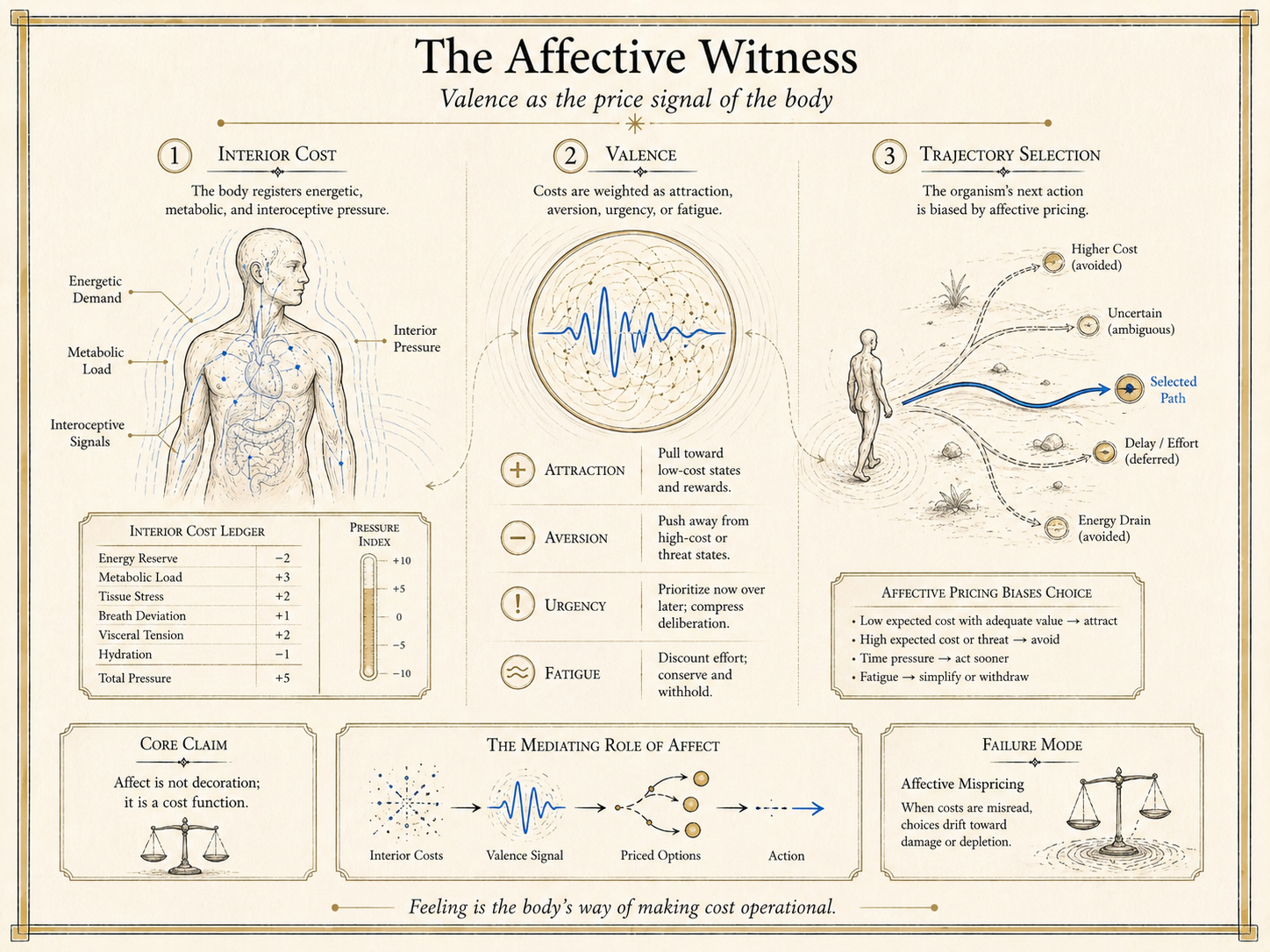
Chapter 10 — The Affective Witness
The problem
If trajectories through the world are being priced, what makes that pricing felt rather than merely computed? Chapter 10 takes up the problem Chapter 9 deliberately deferred and argues that felt valence is not an add-on to the architecture but its inside.
The opening ordeal
The chapter opens in the middle of a panic night. A body in maximum-gain miscalibration does not need a philosophical argument to know that something has become urgent. The ordeal matters because it localizes the issue. The problem is not abstract consciousness in general. It is the specific architecture by which the body’s own accounting becomes inescapably felt.
The central operator
The central operator is the affective witness. Interoceptive prediction over homeostatic variables is precision-weighted by neuromodulatory systems and broadcast across memory, attention, and action networks. That broadcast is not merely informative. It is what gives a trajectory its felt weight.
The chapter’s strongest claim is structural rather than rhetorical. Felt valence is what this architecture is from within. The inside is not a separate substance riding alongside the machinery. It is the machinery at this stratum under the mode of its own operation.
Key concepts
Affective witness is the chapter’s namesake. Interoceptive prediction and precision weighting provide the computational vocabulary. Broadcast gives the architecture system-wide consequence. The chapter also differentiates its view from nearby predictive-processing accounts by refusing to let representation language obscure the closure’s materially installed character.
What the chapter establishes
Chapter 10 establishes the third cognitive closure and uses it to dissolve the book’s version of the hard problem. Feeling is not added after the architecture does its work. Feeling is how the architecture’s pricing operation is lived at this level.
The chapter also sharpens failure taxonomy. Anxiety, anhedonia, depersonalization, and affective capture become diagnostically informative because they are failures of a real closure rather than mere disturbances of mood in the loose sense.
What it hands forward
The next debt is practical and lethal. Even a well-priced organism can only directly price trajectories it has actually traversed. That is not good enough in environments where the first bad trial kills the learner. Chapter 11 takes this problem up by installing offline simulation coupled to affective pricing.
Read next
Read The Offline Mind for the chapter where simulation becomes usable because it can inherit pricing without traversal.
Or move through Affective Witness, Embodied Present, and Offline Mind to stay on the cognitive spine.
- Essay
- 10 · The Affective Witness — opening orientation, ~6 min
- Authored
- April 2026
- Register focus
- R3 cognitive.
- Cites
- Affective Witness · Embodied Present · Offline Mind
- Source
- Chapter 10 — The Affective Witness