CONCEPT · ENTRY 004 · R1 FIELD
Metastability
A regime that occupies a local minimum in a free-energy landscape but carries unresolved potentials capable of crossing a threshold and installing a new regime.
- Register
- R1 field — pre-individual.
- Genealogy
- Simondon 1958 · Prigogine 1984
- Appears in
- Chapter 1 — The Hard Problem of Grounding
- Related
- Transduction · Individuation · The Virtual
- What it is not
-
- Not unstable — unstable systems collapse rapidly without crossing a threshold.
- Not near-equilibrium.
- Not steady-state.
- Not a kind of dynamism in general.
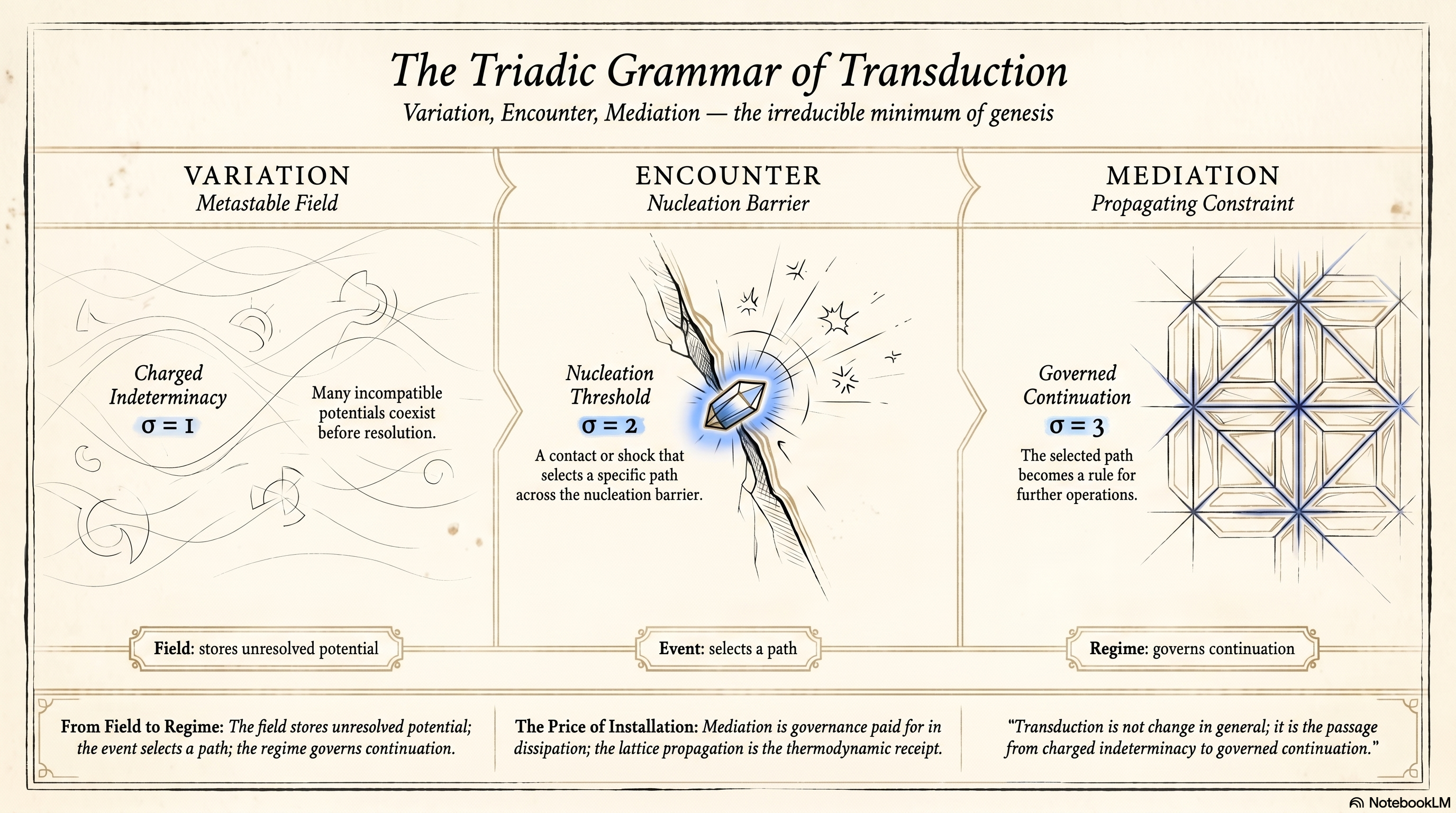
DIAGRAM
Variation-Encounter-Mediation
The triadic minimum of genesis and the grammar of novelty.
The one-sentence version
A metastable system is one that looks settled but is not. It rests in a local minimum, yet it carries enough structured tension that the right encounter can tip it across a threshold into a different regime — one whose vocabulary it could not have produced on its own.
Where the word comes from
The word comes from thermodynamics and statistical mechanics, where a metastable state is distinguished from a stable equilibrium: stable systems have nowhere lower to go, while metastable systems sit in a basin that is locally the lowest but globally not. A supersaturated solution is the textbook example. It is not “almost crystallising” in the sense of being mid-action; it is poised, with a structured charge of potentials whose discharge is a real physical operation requiring a real physical trigger.
Simondon adopted the term as the philosophical name for the préindividuel: the field of incompatible potentials that precedes and conditions any individuation. Ontogony keeps both senses and treats them as the same fact described at different registers.
Why it matters
Most ontologies tacitly take stable equilibrium as the default state of reality and treat departures from it as anomalies to be explained. Ontogony reverses the default. Reality is constitutively metastable. What requires explanation is not change but persistence — the work that any regime does to defer the equilibrium that would erase its boundaries.
Three consequences follow.
The field is real. A metastable field is not an absence of structure; it is a determinate organisation of unresolved differences. The supersaturated solution is exactly this concentration, exactly this temperature, exactly this distance from the discharge threshold. None of those facts is incidental.
Resolution is irreversible. Once a metastable field is discharged, the field is consumed. The crystal is here; the supersaturated state is not preserved alongside it. This is why transductive precipitations are events, not reversible transformations.
Thresholds matter more than averages. Metastable systems are governed by their distance from a discharge threshold, not by their mean state. A small local perturbation can install a wholly new regime. A large global change may do nothing at all. Predictive models that average over thresholds will systematically miss the moments at which reality reorganises.
What it is not
- Not unstable. An unstable system collapses spontaneously and rapidly; a metastable system is poised and can persist indefinitely without crossing its threshold.
- Not near-equilibrium. A near-equilibrium system is one small perturbation away from rest. A metastable system is structurally distinct from its lower-energy neighbour and cannot reach it through ordinary fluctuations alone.
- Not steady-state. A steady-state system is a flow that maintains a constant profile under continuous throughput. A metastable system carries a discharge potential that, once triggered, ends the prior regime entirely.
- Not a kind of dynamism. Metastability names the specific structure of a poised field, not energy or activity in general. A turbulent flow is dynamic but need not be metastable; a still solution can be metastable while displaying nothing at all.