CONCEPT · ENTRY 003 · R1 FIELD
Individuation
The operation by which a determinate something precipitates from a metastable field — not the selection of an option, but the installation of a regime that did not exist as an option.
- Register
- R1 field — pre-individual.
- Genealogy
- Simondon 1958
- Appears in
- Chapter 1 — The Hard Problem of Grounding
- Related
- Transduction · Metastability · The Virtual
- What it is not
-
- Not identification.
- Not selection from a menu of options.
- Not differentiation from a uniform substrate.
- Not personal identity in the social sense.
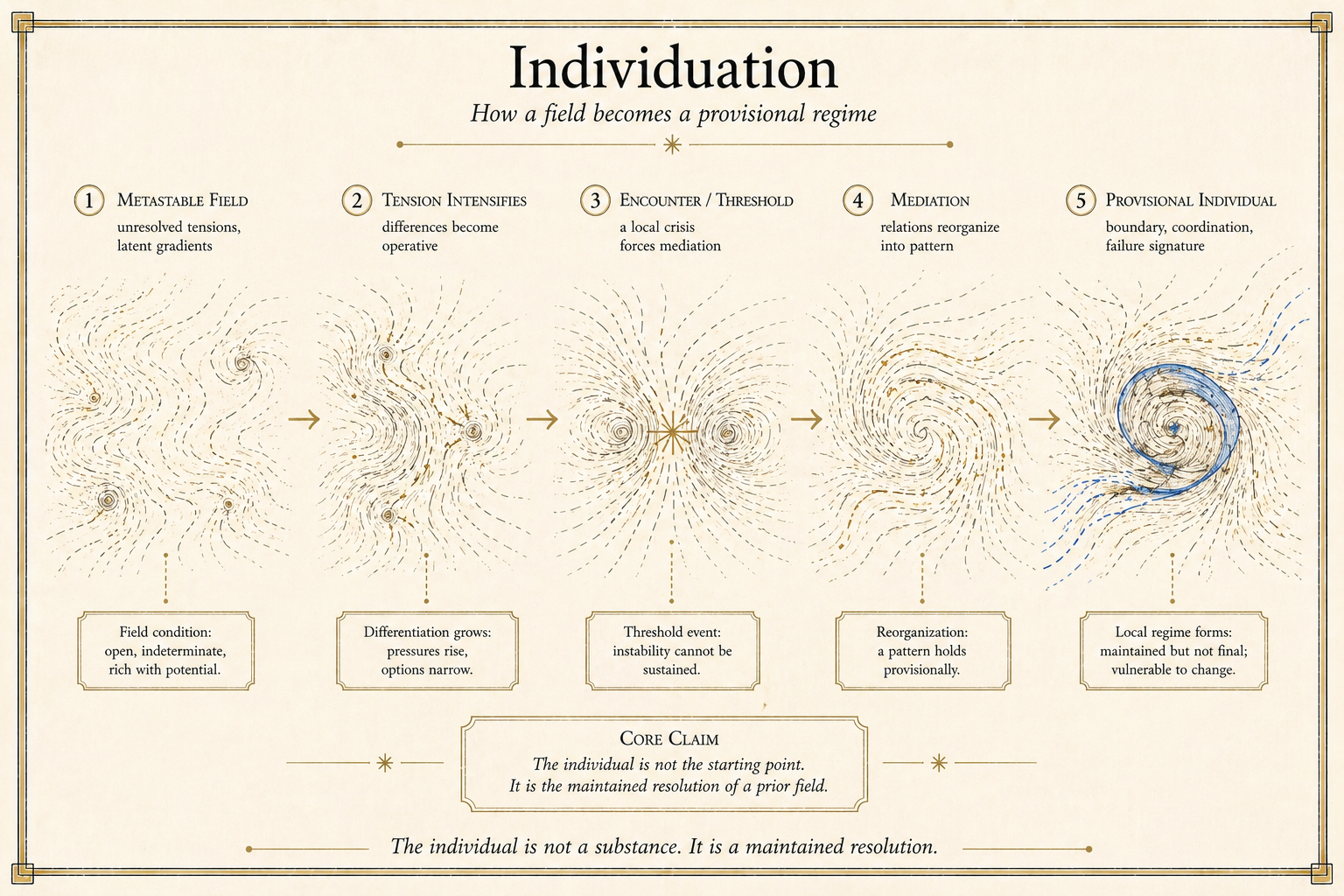
DIAGRAM
Individuation
The process by which a system distinguishes itself from its field: not a given identity but an achievement of constraint-closure that persists only through continuous work.
The one-sentence version
Individuation is what produces an individual. It is not the discovery, recognition, or naming of one. The individual is the result of an operation that resolves a field of incompatible potentials, and the operation is the primary fact.
Where the word comes from
The term in its modern sense comes from Gilbert Simondon’s L’individuation à la lumière des notions de forme et d’information (1958). Simondon’s move was to invert the standard order. Most philosophy starts with individuals and asks how they relate. Simondon argued that this puts the cart before the horse: you do not start with individuals; you start with metastable fields whose unresolved potentials make individuals possible at all. The individual is what crystallises out of such a field — and the field’s tension is at least as real as anything that precipitates from it.
Ontogony retains this commitment without modification, and adds the thermodynamic spine the original framework lacked. Every individuation is a transduction, and every transduction is priced.
Why it matters
Individuation reframes the question of identity. Instead of asking what is this thing made of? the question becomes what operation installed it, and what does it cost to keep that operation running? A cell, an institution, a theorem, a habit — each, on this view, is the ongoing trace of an individuation that has not yet failed.
Two consequences follow.
The pre-individual is real. The metastable field that precedes any individuation is not “mere potential” or “what is left after we abstract away the things.” It is structured, charged with virtual tendencies, and itself the source of further individuations. Reality is at least as much in the field as in the individuals that crystallise from it.
Individuation is plural and layered. The same operational shape recurs at every register where new structure is installed: physical individuation at phase transitions, biological individuation at the closure of metabolic loops, psychic individuation in the formation of perceptual and affective patterns, collective individuation in the consolidation of institutions. None of these is reducible to the others; each has its own dominant variables, its own conditions of failure, its own price.
What it is not
- Not identification. Identification is the act of recognising or labelling an already-existing individual. Individuation is what makes there be an individual to identify in the first place.
- Not selection from a menu of options. The new individual was not on the prior register’s list. Individuation installs vocabulary that the prior field could not have produced.
- Not differentiation from a uniform substrate. The pre-individual field is already structured by incompatible potentials; it is not bland stuff awaiting a stamp.
- Not personal identity in the social or psychological sense (though psychic individuation is one of its registers). The framework concerns the constitutive operation, not the narratives we build on top of it.
The shortest summary: individuals are events, not nouns.