DIAGRAM · CHAPTER 03
Constitutive Dissipation.
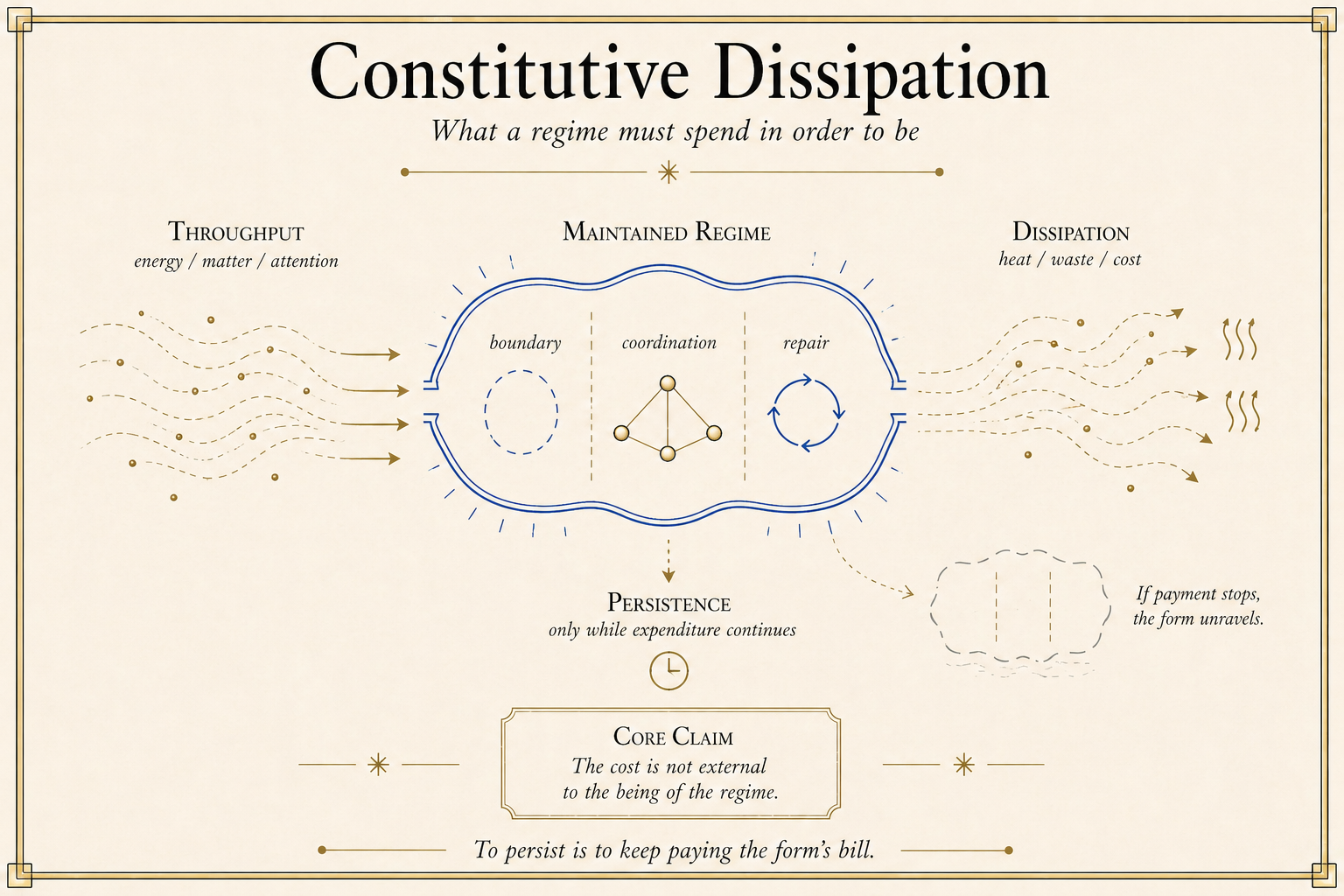
A regime's identity is not what it is made of but the continuous burn rate it pays to keep itself from dissolving — being is a sustained thermodynamic achievement.
ATLAS PLATE
Constitutive Dissipation
A regime's identity is not what it is made of but the continuous burn rate it pays to keep itself from dissolving — being is a sustained thermodynamic achievement.
The one-sentence version
Constitutive dissipation is the thesis that a regime’s identity is defined not by its material composition but by the continuous free-energy throughput — the burn rate — it must sustain in order to persist as the particular kind of thing it is. To be is to pay.
Where the term comes from
Prigogine’s dissipative structures established that far-from-equilibrium systems are constituted by their energy flows rather than by fixed material configurations. Schrödinger’s claim that life feeds on negative entropy, and Mossio and Montévil’s work on closure, converge on the same structural point. Ontogony radicalises this by applying it not just to cells but to every stratogonic level, including cognitive and institutional regimes.
Why it matters
If identity is constituted by dissipation, then cessation — the collapse of a regime — is not destruction of a substance but the ending of a process: the burn rate falls to zero, and the regime’s specific achievements unwind in reverse order of their energetic cost. This transforms how we understand extinction, death, institutional collapse, and cognitive disintegration — all are cessation signatures, not annihilations.
- Chapter
- 3
- Book title
- The Price of Being
- Collection
- Diagram