ESSAY · 03 · OPENING ORIENTATION
The Worm in the Mud.
A planarian flatworm circles in a depleted nutrient gradient, and what follows — the dissolution — has a specific order. That order is the first evidence the field guide asks you to take seriously.
DIAGRAM
Thermodynamic Audit
Finite observers settle accounts through irreversibility, not abstraction.
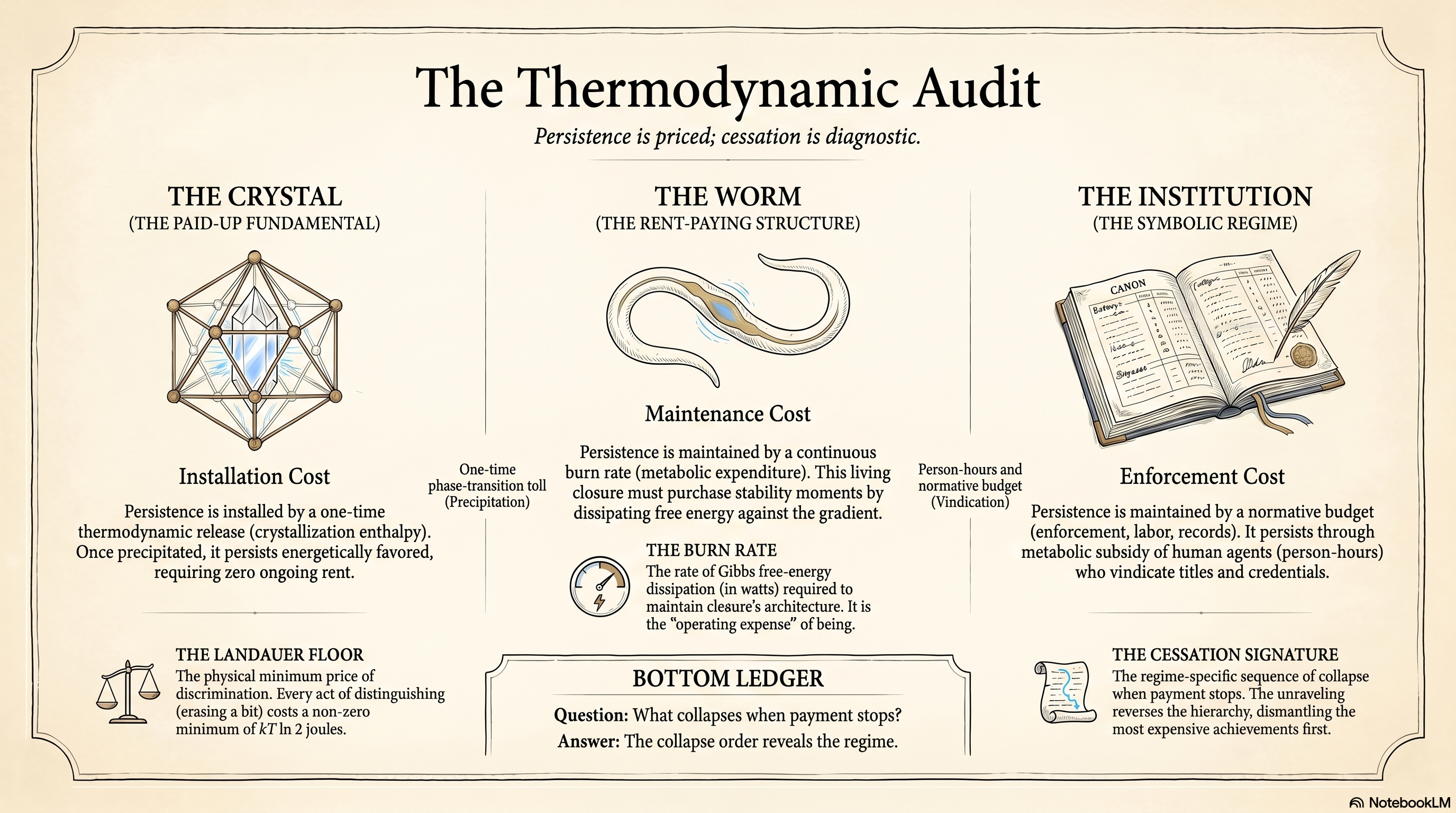
Energy expenditure remains positive — measurable in watts per kilogram of body mass — but the coupling that justified the expenditure has failed. Metabolic reserves deplete without resupply. Membrane potentials flicker as ATP-dependent ion pumps lose their substrate. The boundary between organism and environment softens, the constraint-architecture that was the worm unravels from the inside, and what persists is a smear of organic molecules equilibrating with the surrounding medium.¹
That is not a metaphor. The claim is not that physics lacks the vocabulary to describe the dissolution; it is that the vocabulary adequate to the parts is not adequate to the regime they were maintaining. Every molecular position can in principle be specified. The description is complete — and it misses everything that matters.
What it misses is that the worm’s organisation was being maintained at continuous thermodynamic cost. That cost has a name. Burn rate: the rate of Gibbs free-energy dissipation required to keep a closure’s constraint-architecture intact, denominated in the register’s native currency.²
The micro-description of the smear is continuous with a micro-description of the worm five minutes earlier. The difference is not in the parts. It is in the organisation that was being maintained.
Follow the worm into dissolution and the unravelling has an order: it reverses the hierarchy of the worm’s own commitments, dismantling the most energetically expensive achievements first. This is the cessation signature — a regime-specific sequence of collapses that maps, by what dissolves and in what order, exactly what was being maintained. The signature is discovered, not presupposed; and it is the first evidence that structure is a priced achievement.
Three problems fall out of the worm’s body. They are not puzzles a clever formalism might dissolve from the seminar room. They are problems a living system answers with its body or fails to answer at all.
The cost of genesis. The worm’s chemotactic coupling did not exist in the gradient, and it did not exist in the receptor proteins. It precipitated from a metastable field whose vocabulary could not have specified it. How does a constraint-identity precipitate from a field whose predicates cannot name it?
The cost of stability. The coupling, once installed, runs only so long as throughput is met. Each pass through the closure-regeneration loop reproduces the boundary conditions that enabled the previous pass. How does a fleeting resolution become a durable fact whose persistence costs something specifiable?
The cost of normativity. The worm dies; a candle goes out; a Belousov–Zhabotinsky oscillation ceases. The differences among these endings are categorical, not quantitative — and the cessation signature is what makes the categories legible. How does a regime arise that has its own conditions of failure, without top-down legislation or bottom-up flattening?
These three costs compose a survival cascade. Without genesis, nothing to stabilise. Without stability, genesis produces transient flickers. Without normativity, stabilised closures elaborate without producing categorially new levels. The rest of this field guide is an attempt to take that cascade seriously — to describe what it costs, in physically auditable terms, to be a thing that holds itself together against a slope.
If the worm is your starting point, three concepts become unavoidable. Constitutive dissipation names the price. Transduction names the operator that installs new regimes from the field beneath it. Metastability names the field itself. Begin there, and the rest of the atlas opens around you.
- Essay
- 03 · The Worm in the Mud — opening orientation, ~6 min
- Authored
- April 2026
- Register focus
- R2 biological.
- Source
- Chapter 1 — The Hard Problem of Grounding