CONCEPT · ENTRY 011 · R3 COGNITIVE
Finite Observer
Any physically embedded system that acquires information about its environment under the four structural constraints — embedding, diagonal, reflexive, and decoherence — that together seal off the Demon standpoint.
- Register
- R3 cognitive — neural-integrative.
- Genealogy
- Breuer 1995 · Wolpert 1996 · Landauer 1961 · Zurek 2003
- Appears in
- Chapter 2 — The Demon's Unpaid Bill
- Related
- Landauer Floor · Flat Physicalism · Burn Rate · Cessation Signature
- What it is not
-
- Not equivalent to "ignorant observer" — finitude is structural, not contingent.
- Not a cognitive limitation that technology might overcome.
- Not restricted to biological or human observers.
- Not the same as measurement uncertainty in quantum mechanics, though related.
DIAGRAM
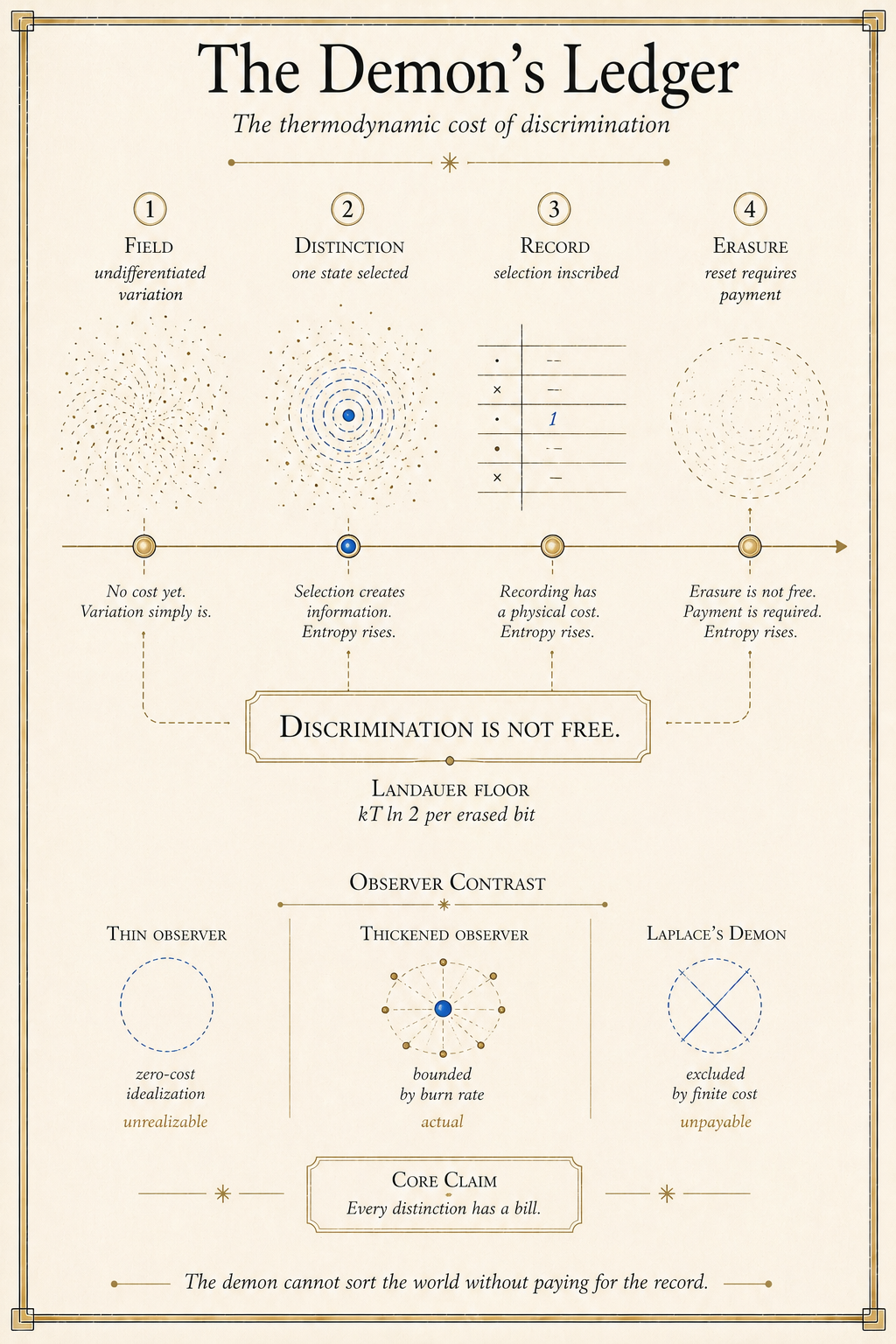
The Demon's Ledger
Why discrimination is not free: measurement, memory, and erasure all belong to a thermodynamic ledger.
The one-sentence version
Every observer is inside what it observes, and this changes everything. A finite observer is not simply an observer with limited knowledge — it is a physical system whose knowledge-acquiring operations are bounded by four independent structural constraints that together make the Demon standpoint not just practically unreachable but physically excluded.
Where the word comes from
The concept is built from the convergence of four impossibility results that Chapter 2 develops as the basin of finitude:
-
Breuer’s embedding wall (1995): no apparatus can discriminate all states of a system that contains it. The apparatus is always a proper part of its environment; its pointer-state space is strictly smaller than the state space of the whole.
-
Wolpert’s diagonal wall (1996, 2008): for any inference device embedded in a physical universe, there exist questions about that universe it cannot be guaranteed to answer correctly across all possible states. Guaranteed completeness is self-contradictory.
-
The reflexive wall: any map of the universe must map itself among the things it maps — but no map can fully capture its own operation without regress. The observer’s self-model always lags the observer’s state.
-
The decoherence wall: classical information extraction from quantum states requires environmental entanglement. The observer cannot access raw quantum microstates from a classically decoherent position without paying the decoherence cost — which is itself a discriminating operation with a Landauer floor.
These four walls are independent. Circumventing any one leaves the other three intact. Their conjunction leaves no route to the Demon standpoint.
Why it matters
The finite observer concept matters because it transforms a philosophical concession into a physical argument.
Flat physicalism holds that macroscopic regularities are merely epistemic — symptoms of finite observer limitations, not features of the world. That claim depends on contrasting how macro-facts appear to finite observers with how they would appear from the Demon standpoint, where the full microstate is available cost-free. If no physically embedded system can occupy that standpoint — not as a matter of engineering but of structural exclusion — then the contrast class is empty. The merely in “merely epistemic” has nothing to contrast with.
The finite observer concept establishes that all observation is coarse-grained observation. This is not a deficiency to be overcome. It is the structural condition of being an embedded physical system. The planarian’s 50 chemoreceptor types face an environment of ~10⁶ distinct molecular signatures per cubic millimetre. Its pointer-state space is a vanishing fraction of the environmental state space — not because evolution was stingy but because Breuer’s theorem applies. What the Demon suffers as a formal cardinality mismatch, every living observer enacts as the gap between its discriminating apparatus and the world it navigates.
What it is not
Finite observer is not a claim about cognitive limitations, biological specificity, or technological constraint. It is a claim about the structural situation of any physical system that acquires information while being embedded in the system it surveys. The finitude is not a feature of brains or bodies; it is a feature of the universe’s structure — specifically, of the four walls that together seal off the Demon standpoint.